









A composite fairing to enter the launcher arena
Presented on Mecano ID’s stand at JEC World 2026, a launcher fairing developed under the Cocomo project marks a strategic milestone for the Toulouse-based SME, now positioning itself on large composite structures for the New Space market.
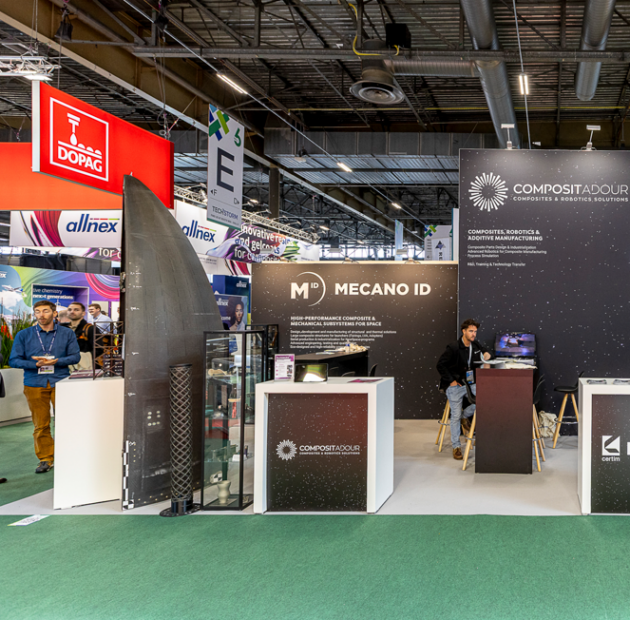
For more than 30 years, Mecano ID has been developing mechanical and thermal equipment for satellites, progressively expanding towards full subsystem integration and the manufacture of composite parts. “We have gradually broadened our scope, from design through to the production of composite components,” explains Adrien Mir, managing director. This evolution has been supported in particular by in-house mechanical and thermal testing capabilities, enabling the qualification of equipment under representative space environments.

The move into launcher structures is more recent. A request within the European Space Agency’s (ESA) Themis programme acted as a catalyst, highlighting a gap in the European supply chain for such structures. Mecano ID then identified an opportunity in critical structural elements, particularly launcher interfaces and large-scale structures. The company launched targeted R&D activities and succeeded in positioning itself alongside established players. “We proposed a more flexible approach, aligned with the new market dynamics,” says Adrien Mir.
The Cocomo project, supported by France 2030, is part of this strategy. It aims to develop a fairing tailored to European micro- and mini-launchers, in a context of strong growth in the small satellite market. Mecano ID is taking a significant step forward, moving from a subsystem supplier to a designer of primary launcher structures. The C-Micro demonstrator, approximately 3 m high and 1.8 m in diameter, embodies this increase in industrial maturity. “We are targeting the entire micro- and mini-launcher segment. In Europe, institutional launchers are Ariane and Vega, but many private players are emerging, such as MaiaSpace, Sirius, Latitude and HyPrSpace in France, as well as Isar Aerospace and RFA in Germany, and PLD Space in Spain. These are the most advanced players in this segment, and our demonstrator is intended for them,” adds Adrien Mir.

In this new paradigm, cost is becoming the primary constraint rather than structural performance alone. “We have mass targets to meet, but not necessarily reduction targets, as we consider we are already at state-of-the-art level. However, we are expected to reduce costs by a factor of two to three,” he explains. This reflects a shift towards New Space-driven industrial models, where production rate and competitiveness are key. “Once the product meets the technical requirements, the focus shifts to production rate capability,” adds Adrien Mir, in a context where the number of launches is expected to increase significantly.

Towards controlled industrialisation
The Cocomo project is based on a twohalf-shell fairing architecture, featuring a predominantly monolithic carbon (CFRP) structure, complemented by localised sandwich areas and integrated drop-off edges. The design is intended to withstand aerodynamic, vibro-acoustic and thermal loads during launch, while optimising the mass-to-performance ratio.

Manufacturing relies on Automated Fibre Placement (AFP) processes implemented by Compositadour, a long-standing partner of Mecano ID. “We have been working with Mecano ID for around 10 years on R&D projects focusing on manufacturing processes, including thermoplastic composites and automated lay-up technologies,” explains Francis Sedeilhan, director of Compositadour. This collaboration builds on earlier projects such as Bamco, which explored bio-based materials.

As Mecano ID moved towards larger structures, collaboration with Compositadour became a natural step. “The company was initially specialised in the design and manufacture of smaller space components. When it identified opportunities in launcher structures, it turned to us to assess our ability to support this scale-up,” he continues. The institute brings over 15 years of experience in automated manufacturing of large composite parts, particularly in aerospace and space applications.
The partnership is based on close co-engineering. Mecano ID retains responsibility for design and sizing, while Compositadour contributes its expertise in manufacturing optimisation. “This is a design-to-manufacturing, or even design-to-cost approach, involving continuous exchanges with design and analysis teams to integrate manufacturing constraints from the earliest stages,” explains Francis Sedeilhan. The objective is to optimise the trade-off between structural performance and production cost. Lay-up is carried out using out-of-autoclave carbon prepregs, with the aim of reducing cycle times and costs. “It is essential to make the right choices in terms of materials and processes to significantly reduce costs while maintaining a high level of performance,” he emphasises. The use of next-generation AFP machines, such as the Coriolis C1.2, enables high deposition rates and significantly shorter manufacturing times compared to manual processes, particularly for large-scale components.
The geometry of the fairing introduces specific constraints, particularly at the nose section, where fibre steering is required to accommodate complex curvature. “Robotic AFP machines now provide the flexibility needed to handle these complex geometries,” he notes. One of the key achievements of the demonstrator lies in the full AFP integration of the structure, including the nose section and drop-off edges, despite complex geometric transitions.

The Coriolis C1.2 machine also incorporates an Automated Inspection System (AIS), enabling in-line monitoring of lay-up quality. This reduces the need for time-consuming manual inspection and contributes to lowering production costs. It also opens the way to advanced data exploitation. “The objective is to move towards a full digital passport of the part, combining lay-up, inspection and design data,” says Francis Sedeilhan. Ongoing work aims to leverage these data using algorithms to detect process deviations and improve statistical process control.

After manufacturing, the structure is transferred to Mecano ID for integration of mechanical systems, including the Horizontal Separation System (HSS). A scaled demonstrator has already validated key aspects of the kinematics, with a fullscale separation test planned as the next step towards qualification.
The industrialisation of such large structures remains a major challenge. Mecano ID plans to open an 8,000 m² facility by 2029, integrating the entire value chain. “Our objective is to control the full process, from raw material to finished product,” concludes Adrien Mir. In parallel, the company is exploring eco-design approaches, including life cycle analysis and the use of bio-based materials.
Photos : Mecano ID/ Compositadour
Read this article on page 21 of issue 168 of JEC Composites Magazine.


You can create a free technological watch and keep you updated about all these subjects.
