









Aeronautics: the Fantom project automates non-destructive testing of composites
The Fantom project aims to compensate for the lack of flexibility of conventional checking fixtures in the aeronautical sector by designing a robotised system for large structures and complex geometries. Developed by the IRT Jules Verne and its partners Airbus, Axiome, Daher, Testia and CEA List, it has just been completed after three years of research.
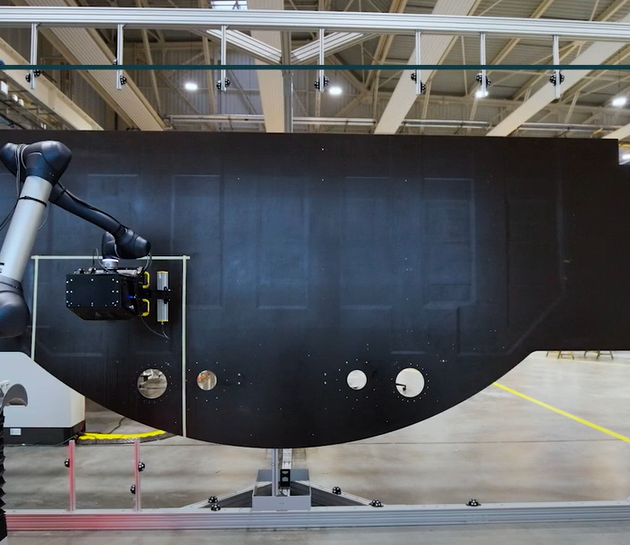
The IRT Jules Verne and its partners Airbus, Axiome, Daher, Testia and CEA List have just completed the Fantom project, a collaborative programme devoted to the automation of non-destructive testing (NDT) for the aerospace industry. Over a three-year period, the project mobilised the expertise of the partners to design an automated inspection platform for large composite parts, integrated into industrial production lines.
The flexibility of this mobile solution means that inspection operations can be carried out with precision, while at the same time reducing the downtime of parts – a crucial issue as the aerospace industry ramps up its production rates.
“This project has enabled us to overcome some major technological hurdles. Thanks to Fantom, we have taken a crucial step towards smarter, more agile non-destructive testing that is better adapted to current and future industrial needs“, says Nicolas Colin, technical leader of the project and NDT expert at IRT Jules Verne.

Inspection end-effectors including a flexible membrane ultrasound probe have been developed by French company Imasonic, which specialises in the design and manufacture of ultrasound transducers, for high-precision inspection without complex preparation.
The platform uses artificial intelligence, integrated to reduce the risk of human error, to analyse defects and optimise inspection paths.
Testia, an Airbus subsidiary specialising in structural integrity and non-destructive testing, has also developed an operator interface to facilitate the supervision and processing of the data collected using NDTkit post-processing software.

The platform’s adaptability means it can be deployed beyond the aerospace sector, in other industries such as energy and naval. “The Fantom project is a perfect illustration of the strength of industrial collaboration around a strategic technological challenge. The advances we have made mean that we can now envisage a smoother, more efficient integration of NDT in the factory of the future“, emphasises Aurélien Lunion, project leader at the IRT Jules Verne.


You can create a free technological watch and keep you updated about all these subjects.
