









An industrial demonstrator and a move to European scale for Michelin Resicare’s araminolic resins
By laying the foundation stone for an industrial unit dedicated to the 5-HMF molecule on the Osiris platform at Péage-de-Roussillon in France, Michelin Resicare is marking a strategic turning point in green chemistry. The European Cerisea project, which is supporting this move, is structuring a promising sector around this essential building block of bio-based resins, offering a concrete alternative to toxic petro-based materials.
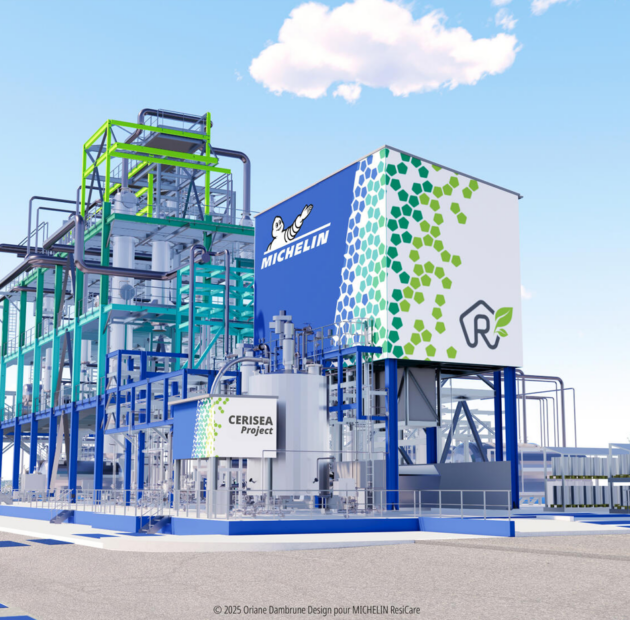
“Michelin is not a tyre company that masters composites, Michelin is a composites company that masters tyres“. It was with this powerful phrase that Maude Portigliatti, Executive Vice President of the Polymer Composite Solutions division and member of the Executive Committee of the French Michelin Group, introduced the announcement of the construction of an industrial demonstrator in France for the production of the molecule 5-HMF (5-hydroxymethylfurfural), a key component of the araminol resins of Michelin ResiCare, the Group’s branch specialising in biosourced adhesives and resins.
Scheduled for completion in 2026, the plant will be located at Péage-de-Roussillon in Isère (38), on the Osiris chemical platform, and will have an annual production capacity of 3,000 tonnes, “already the largest in the world“, explains Ms Portigliatti. This is a unique project, because “no plant of this capacity exists at the moment. The plants supplying manufacturers are all located in Asia, with small capacities“, she continues. This first plant is designed as a milestone for the roll-out of additional production units in Europe, via a licensing system. It represents a total investment of €60 million and will create 30 direct jobs. Michelin plans to produce 40,000 tonnes of 5-HMF by 2030, consolidating a self-sufficient European industry.
A strategic molecule

5-HMF, obtained by transforming fructose, has been dubbed the ‘sleeping giant’ for its potential to replace toxic or petroleum-based molecules such as formaldehyde and resorcinol. This biosourced, non-toxic monomer, produced in Europe, is already used in the formulations of Michelin ResiCare araminol resins for a variety of applications, including plywood, abrasives and moulded composites. “The three major applications for our araminol resins are composite reinforcements to bind glass or carbon fibres together; the manufacture of plywood; and their use in materials subjected to very high temperatures because they do not melt,” explains Quentin Faucret, head of the polymers division at Michelin Engineered Polymers.
“We are marketing these araminol resins to replace phenolic resins such as formaldehyde, which are hazardous to health“, says Quentin Faucret. 50 patents have now been filed on araminol resins, including the industrial process for manufacturing 5-HMF, which is covered by an operating licence. “These resins will make recycling less critical in terms of their carbon impact, although we still need to work on the recyclability of composites at the end of their life,’ he stresses. M. Faucret.
Cerisea, a European alliance to structure the industry
The Cerisea project, which stands for Chemical European Resins from Innovative Sugar-derived Engineering Applications, brings together 13 partners from 5 countries, including manufacturers (ADM, Arkema, Kraton, etc.), academic centres (CNRS, UTC, Université de Poitiers, ESCOM, etc.) and technical centres (IFPEN, ITENE, IFEU, etc.). It is supported by France 2030 via Ademe and at European level by CBE JU, the Circular Bio-based Europe Joint Undertaking.
“We have received 20 million in European subsidies for the consortium as a whole, half of which, i.e. 10 million, has been paid to Michelin for the construction of the plant. The rest went to the project partners, such as the universities of Poitiers and Compiègne, which are working to produce other derivatives of this type of material,” explains Quentin Faucret. This support has enabled Michelin to reach a new milestone: “We are the first to pass the 1,000 tonne mark, and we don’t plan to keep 100% of this production for ResiCare. A third will be reserved for our partners. The outlets are vast: materials for the automotive industry, electronics, fuels, insulation, etc. ‘With these different partners, we’re going to be able to offer a wide range of products. ‘With these different partners, we’ll be able to broaden the scope of this molecule’s applications to make different materials,” notes Quentin Faucret. And he adds: “This sleeping giant in green chemistry would open up a potential market of €12.5 billion for us. What’s more, it would strengthen our European competitiveness“, he enthuses.
“The Michelin Group’s DNA is this pioneering spirit. It’s also our industrial spirit. With courage, we know that we can contribute to this competitiveness“, concludes Maude Portigliatti. In addition to tyres, Michelin is now investing in innovative and sustainable composite solutions.
Key figures:
Production capacity: 3,000 t/year of 5-HMF by 2026, making it the world’s largest site.
Cerisea project: 13 European partners, €20 million in subsidies.
ResiCare araminol resin: 50 patents, an alternative to formaldehyde.
Potential: a market of 40,000 tonnes targeted by 2030, thanks in particular to development through licences.
Photos: Michelin Resicare © Oriane DAMBRUNE, Patrick Delapierre


You can create a free technological watch and keep you updated about all these subjects.
