









Bio-based resins: Michelin inaugurates its 5-HMF demonstrator
A unique industrial demonstrator is taking shape in Péage-de-Roussillon, in France. This 5-HMF production site is strategic for European sovereignty and low-carbon composites.
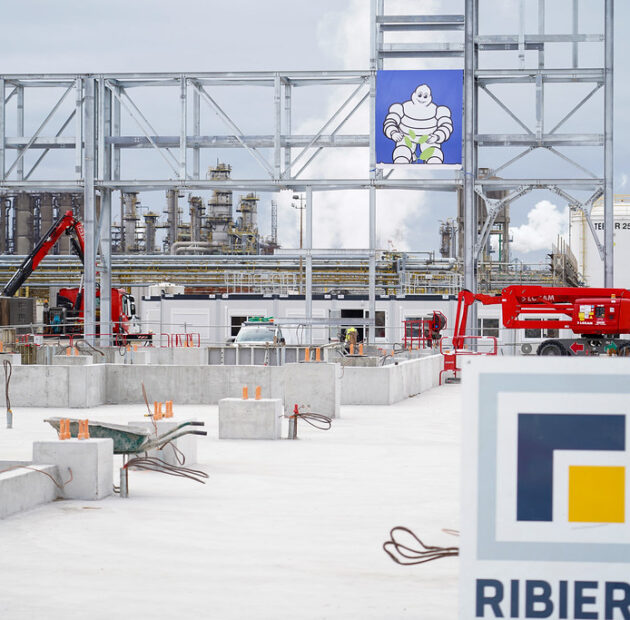
Under an autumnal sky, the first machines are busy at work on the french Osiris chemical platform in Péage-de-Roussillon. White helmets and orange vests mingle with the hustle and bustle of a large-scale construction site. Michelin has just laid the foundation stone for the future industrial demonstrator for 5-HMF, a bio-based molecule derived from fructose. With a nominal capacity of 3,000 tonnes per year, this site will be the world’s largest producer of this key substance for sustainable resins

Named Cerisea, the project is led by Michelin Engineered Polymers with the support of Technip Energies (as project manager) and the GIE Osiris (site operator). It represents an investment of €60 million, including €20 million financed by the European Union through the CBE-JU programme, and €4.5 million contributed by The French Agency for Environment and Energy Management Ademe and France 2030 led by the French General Secretariat for Investment.

The plant is based on a patented process developed with IFP Énergies nouvelles (IFPEN), which converts fructose syrup into 5-HMF using a liquid catalyst and a dual solvent recovery system.
“We recycle over 99% of the solvents and recover thermal energy to reduce steam consumption,” explains Yohann Macé, workshop leader at Michelin Engineered Polymers.

The entire production cycle, from raw material to finished product, takes only fifteen hours. The solid co-products, humins, are compostable and also valorised.

A key molecule for more sustainable composites
A true “green building block” of future chemistry, 5-HMF (5-hydroxymethylfurfural) is designed to replace petrochemical compounds such as phenol or formaldehyde, commonly used in traditional phenolic resins. Non-toxic, bio-based and high-performing, it is at the heart of Michelin ResiCare’s araminolic resins, which are used in aircraft and train interiors, brake pads, insulation materials, and technical plywood.

“Petro-based materials remain cheaper today, but the gap is closing fast,” observes Quentin Faucret, President of Michelin Engineered Polymers. “With 5-HMF, we offer a credible and competitive alternative derived from non-food European agricultural resources, which drastically reduces the carbon footprint.”

The process developed by Michelin and its partners uses 75% decarbonised steam supplied by the Osiris platform, and 20% electricity, for an almost circular production system. “For every two lorries of fructose syrup received, one lorry of 5-HMF leaves the site,” illustrates Daniel Zante, Cerisea project manager.
A structuring project for European sovereignty
The Cerisea project fits into a broader strategy for European industrial sovereignty in the face of Asian competition. Today, the world’s two main 5-HMF producers are located in China, with units not exceeding 1,000 tonnes per year. “With 3,000 tonnes, we’re reaching an unprecedented industrial milestone,” emphasises Quentin Faucret. “It’s also a response to the growing demand for secure dual sourcing among manufacturers.”
The Cerisea consortium brings together 13 partners from five countries, including Arkema, ADM, Avantium, Kraton, and academic institutions such as the CNRS, UTC, and the University of Poitiers. Together, they cover the entire value chain, from biomass to final formulation.
In the long term, Michelin plans to license the model to other European players, scaling up to 10,000–20,000 tonnes per year, while targeting 40,000 tonnes by 2030. “European expertise in solvent recovery gives us a clear edge over China,” insists Faucret. “This project demonstrates that sustainability, competitiveness and sovereignty can go hand in hand.”
With this demonstrator, the group strengthens its position as a key player in green chemistry and low-carbon composite materials. The Péage-de-Roussillon unit, expected to become operational in early 2027, will create 30 direct jobs and mark a milestone in building a European 5-HMF value chain.
Heading photo: Michelin


You can create a free technological watch and keep you updated about all these subjects.
