









Bringing natural fibre composite innovations to the sports industry
When Japan’s top-level racing competition sought to position its series in a leading role for sustainable motorsports, it turned to Swiss sustainable lightweighting company Bcomp. We spoke with Johann Wacht, Manager Motorsports & Supercars at Bcomp, to learn more about the project and how sustainable composites are transforming motorsports and the wider sports industry.
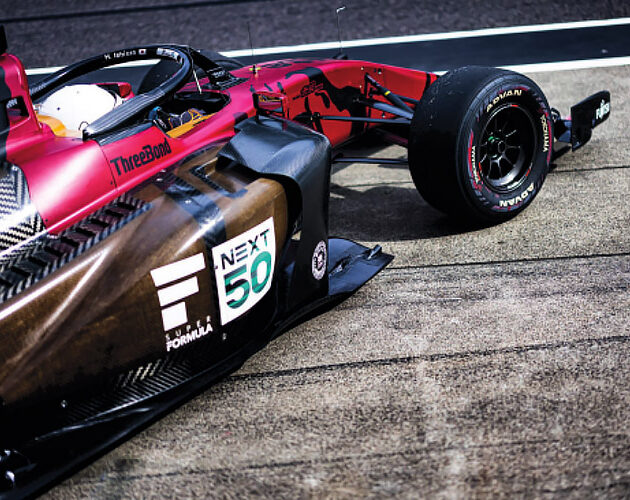
In 2022, Japan’s top-level single-seat racing series, Super Formula, introduced a host of new regulations as part of its Next 50 plan. While some changes were to make the racing more competitive, a substantial portion aimed to address the carbon footprint of the series. This involved everything from recycled tyres to the use of more sustainable materials in the construction of Super Formula race cars.
The series used carbon fibre extensively – like much of the motorsports industry – but Next 50 required a more sustainable approach. As Bcomp’s technologies have been used in motorsports by leading brands such as Porsche and BMW for many years, the potential of its flax fibre composite technologies within the new regulations was clear.
Bcomp’s flax fibre technologies
Bcomp’s composite technologies – ampliTex™ and powerRibs™ – proved to be the ideal solution for Super Formula race cars. The first one, ampliTex, is a technical fabric made of woven flax fibres and the second one, powerRibs, is a reinforcement grid that provides additional stiffness to thin-walled shell elements. Harnessing the natural properties of flax fibres, both technologies have a low density and excellent mechanical properties, optimised for high-stiffness applications. Together, they offered Super Formula engineers a significantly more sustainable alternative to carbon fibre.
Bcomp is no stranger to motorsports, either, with its technologies used in a number of high-profile applications including Formula 1, Formula E, DTM, and several novel concept vehicles. They offer significantly better vibration damping and have safer failure modes without sharp shattering compared to commonly-used carbon fibre composites, which is particularly important within the motorsports and automotive sectors.

“Working alongside numerous motorsports teams and OEMs, we have been able to leverage the benefits of our flax fibre composite technologies to produce a range of parts, particularly bodywork,” explained Johann Wacht. “With the motorsports industry now looking to reduce its carbon footprint, switching to more sustainable composites is a fantastic option. It is exciting to see such an open-minded, forward-looking and determined approach to integrating ampliTex and powerRibs into the SF23.”
Sustainability and safety
The analysis of past projects showed that using Bcomp technologies can result in a 90% reduction in material emissions when compared to equivalent carbon fibre parts and an 80% reduction in cradle-to-gate emissions. This is a substantial reduction, particularly when you multiply the savings across all teams in the championship and all races in the season.
“Our technologies are a more sustainable option for developing high-performance motorsports components,” Johann Wacht continues. “Not only do they provide a carbon emission reduction, but they also offer a viable end-of-laife option – unlike the vast majority of carbon fibre parts used in motorsports – and eliminate the need to landfill damaged or old parts.”
One obvious reason why flax fibres are sustainable is that they sequester CO2 during their growth. Using a CO2-neutral raw material is an important benefit of natural fibres and is further supported by the fact that flax can function as a rotational crop to improve food harvests. The flax used by Bcomp is also indigenous to its growth areas, resulting in low water and fertilizer requirements for long-term sustainability.
Another important consideration for composites in motorsports applications is safety. AmpliTex and powerRibs have important advantages over conventional carbon in this area.
“Safety is one of the key considerations in any motorsports innovation,” Wacht explains. “To that end, the use of our technologies in the SF23 bodywork offers a number of major advantages. Our flax fibre composites do not splinter and shatter like carbon fibres do. Instead, the failure of ampliTex and powerRibs is far more ductile, without sharp edges or dangerous debris. This is better for drivers, marshals and spectators, while also reducing the frequency of tyre punctures.”

Testing with Super Formula
In March 2022, extensive testing was conducted over two days by drivers Hiroaki Ishiura and Koudai Tsukakoshi, for a total of eight hours. Initially, sidepods and engine covers made entirely from ampliTex and powerRibs were trialled. The primary focus of the testing was to evaluate thermal and mechanical performance as well as water resistance. The Bcomp components performed well, but Yoji Nagai, technical director for the Next 50 programme, decided that, for implementation in the 2023 SF23, it would be better to create “hybrid” parts.
Following the testing period, Yoji Nagai and the team targeted to further reinforce high-load and structural areas with a conventional solution. To that end, a solution with about 70% flax composite and only 30% carbon fibre was identified as the high-performance sweet spot. This hybrid technology allowed for optimised performance, specifically for areas subject to high aerodynamic forces or thermal exposure, which continued to use carbon fibre, while other areas used the significantly more sustainable flax fibre composites.
Super Formula testing has continued throughout the season, with positive feedback from drivers and teams. Powered by carbon-neutral fuel, and fitted with Bcomp’s flax fibre-based composite parts, the SF23 is set to debut this year. While the company had already worked extensively in motorsports, the extensive use of its technologies in one of the highest-profile formula racing series in the world signals the growing desire for high-performance sustainable lightweighting solutions. But what about other sports?
Beyond motorsports
While motorsports may well be the most well-known sporting application of carbon fibre, almost every equipment-based sport has adopted it in some way shape or form. From cycling to tennis, sports applications for lightweight composites abound and the vast majority of high-performance applications have used carbon fibre. Now, however, many sports equipment manufacturers are seeking more sustainable options as public interest and awareness increase.
“Some of our very first projects were actually in sporting equipment,” Wacht concludes. “It is another area where engineers are pursuing fine margins for maximum performance and minimal weight, but many consumers are also looking for environmentally-conscious materials and manufacture. This means that we work with brands such as K2 in skis, Adidas to create a flax fibre padel racquet, and Ertha for surfboards. This continues to be an important area of our business as more brands seek alternatives to fibreglass and carbon fibre for professional and consumer sporting products.”
Bcomp’s natural fibre composite innovations are helping make the sports industry, particularly motorsports, more sustainable. Their successful implementation in the Super Formula series in Japan has shown that flax fibre composites are a high-performance and sustainable alternative to carbon fibre in the majority of applications. Not only can they meet performance requirements, but they also offer a significant reduction in emissions, viable end-of-life recycling options and sequestration of CO2 during growth, all of which makes them more sustainable in the long term. While they may not replace conventional composites in all applications by 100%, they offer the sports industry a compelling sustainable alternative.
Meet Bcomp at JEC World 2023, hall 5, booth A45.


You can create a free technological watch and keep you updated about all these subjects.
