









Cannon leverages composites to create a heating system in the mould
Cannon, a global supplier of dosing units and mixing equipment, launches Nexus composite mould and heating system. This new product leverages the capacity of composites to heat up very quickly and the possibility they offer to better control temperatures, even enabling to create areas with different temperatures.
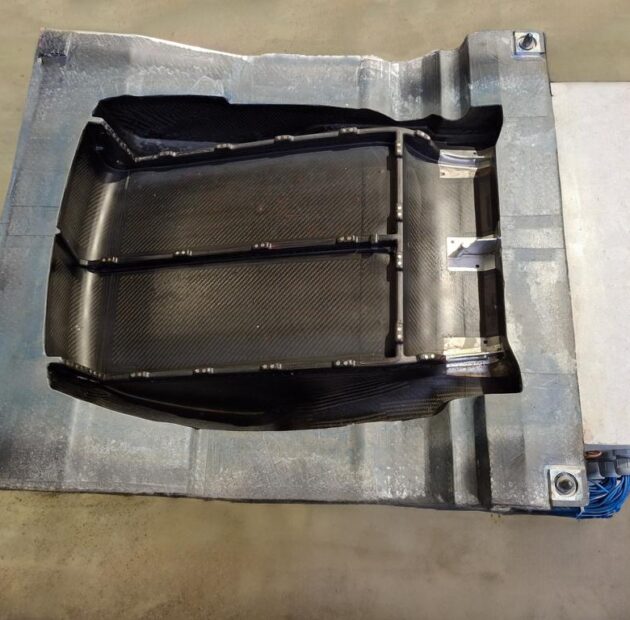
Cannon launches the Nexus system, which includes a composite mould incorporating a thermoregulation system and associated controls. This technology exploits the physical properties of composites to improve the practicality of the mould. Composites are used as heating elements integrated into the mould. This allows for extremely rapid temperature increases (up to 30°C per minute) and much more precise localised temperature control than fluid-based systems, according to the manufacturer. This makes it possible to create different zones within the mould, in which temperatures are separated by gradients of less than a few millimetres, a level of precision suited to processes in which the chemical kinetics of the material must be precisely modulated. The nature of composites also offers the possibility of giving the mould ‘tailor-made’ properties, such as specific heating speed, transverse conductivity or heat distribution, depending on the requirements of the part to be produced.
Nexus system allows for a 25% increase in efficiency compared to standard mould heating practices, says Cannon. The system thus reduces cycle times and enables new optimisation scenarios. It also aims to increase part quality and potentially cut raw material usage. Initially designed for manufacturers using PU RIM (Reaction Injection Moulding), the Nexus system is also compatible with many processes involving thermoset materials.
“In thermoset moulding, heat management is a crucial factor in achieving consistent quality, competitive cycle times and energy-sustainable processes,” said Andrea Castelnovo, Technology and R&D Manager at Cannon Tipos. “Traditional technologies, based on metal tools and thermal fluids, have reached a physiological limit. Even when optimised, they rarely exceed 75% energy efficiency and impose thermal inertia that affects the entire production process. These considerations led to the creation of Nexus, offering a completely new approach to mould temperature control, based on the intrinsic properties of the composite materials. The goal was simple in theory but revolutionary in practice: to heat only what is needed, in the shortest possible time, thus minimising energy waste and dispersion.”
Developing the Nexus system took Cannon over ten years of experimentation, beginning in 2015 with the aim of improving efficiency for RIM and HP-RTM processes.
Nexus is aligned with Sustainable Development Goal 12 for Responsible Consumption and Production.
The POSSIBLE project for mechanically recycling rigid polyurethane and GFRP composites
Besides, Cannon will also present the POSSIBLE project (for “PrOduce SuStainabLE Industrial Bodies”), which aims to recycle and reuse polyurethane (PU) and PU-glass fibre composites, using them as secondary reinforcement materials in new composite formulations, at JEC World 2026. Cannon has developed the process in close cooperation with PU processor MAP S.p.A. and the University of Bergamo, with co-funding from the Italian strategic plan for the EU recovery fund NextGenerationEU.

Thermosets account for about 12% of global plastic production, with over 40 million tonnes per year. Polyurethane foams alone account for about 17 million tonnes of these, i.e. over 42%. But recycling them with traditional methods is almost impossible, and other methods are often too slow, too expensive or incompatible with existing PU manufacturing processes. Cannon thus decided to try to reintegrate pure or composite rigid PU waste through two complementary methods, both compatible with their high-pressure systems.
“In the plastics industry, sustainability and end-of-life discussions have taken centre-stage, especially when it comes to reinforced thermosets,” said Maurizio Corti, Corporate R&D Director at Cannon. “However, rigid polyurethane foams and glass fibre reinforced polyurethane (GFRP) composites are indispensable materials for the energy efficiency goals of automobiles, buildings or technical equipment, even though they remain among the most difficult to recycle. This is due to their cross-linked structure, which ensures stability and durability, but makes remelting and remodelling impossible. At present, landfilling and incineration are the most common end-of-life solutions, but these methods are becoming less acceptable, both from a regulatory and an environmental point of view.”
“It is in this context that the POSSIBLE project emerged,” said Dario Pigliafreddo, Mobility and Specialties Sales Manager at Cannon. “It provides the framework for targeted experimentation on rigid polyurethane foams and PU/GFRP composites recycling. The underlying idea was not to disrupt the system’s chemistry, introduce complex process steps or require completely new lines, but to apply to a well-known and well-performing application of glass fibre impregnation flexibility and modularity to add both recycled granulate and powder, adapting a high-pressure foaming platform that some PU manufacturers already use.”
During the project, the team explored two complementary approaches. The first involved transforming rigid foam waste into micrometric powders, which were then dispersed into the polyol to form a slurry and dosed as a liquid component using a mixing head. The second involved using rigid PU granulate and polyurethane-glass fibre composite, introduced as a solid filler into the mixture using dedicated dosing systems combined with the FPL 36 IW mixing head for Interwet-LFI (Long Fibre Injection) technology patented by Cannon.
After testing these methods, the researchers concluded that it was possible to recycle rigid polyurethanes and GFRP composites by integrating them into production lines without having to implement invasive processes or radically modify formulations. The POSSIBLE project therefore represents a concrete step towards circularity in the field of thermosets, and Cannon is currently working on recycling solutions for PU and GFRP that will be brought to market.
Cover photo: Cannon Nexus composite mould with integrated heating system (source: Cannon)

You can create a free technological watch and keep you updated about all these subjects.
