









Eco-friendly composite recycling and disassembly solutions
In collaboration with Cirimat and Softmat, Expleo, a global engineering, technology and consulting service provider, developed a mild solvolysis process that enables the recovery of high-quality carbon fibres and polymer residues while preserving their morphology and mechanical properties. A novel gel-based solution for the eco-friendly disassembly of parts bonded with structural adhesives was also developed, further advancing circular economy goals. Dr. Louis Meunier, Innovation project manager and Dr. Philippe Ponteins, Innovation program manager, Expleo Group, Dr. Emile Perez, Research director, Softmat laboratory (CNRS), Pr. Eric Dantras, University professor, Cirimat (University of Toulouse), tell us about it.
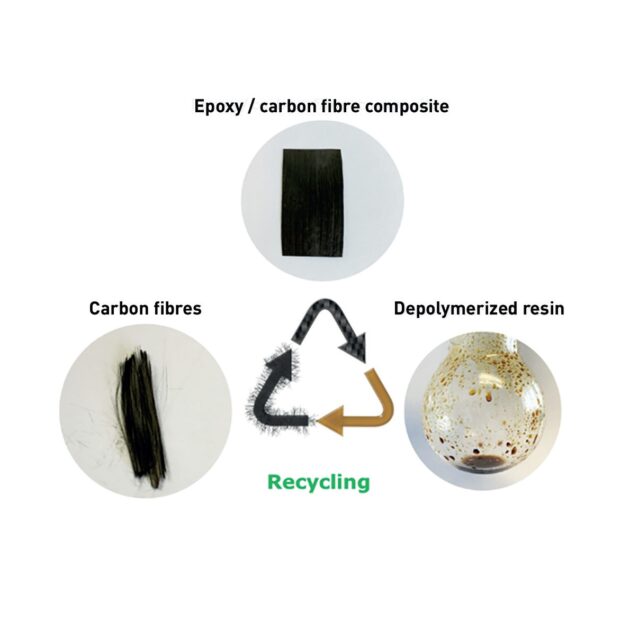
The widespread use of carbon fibre-reinforced composites (CFRCs) in the automotive, aerospace and energy industries is driven by the need for lightweight, durable materials. However, the limited recyclability of CFRCs is a growing concern as waste volumes increase. When using conventional methods such as mechanical recycling (typically a downcycling process that results in degraded fibre length and properties) and pyrolysis, the potential for fibre reuse is often limited. Recent research is seeking solutions to recover fibres while preserving their performance through a solvent approach.
The sustainability challenge
In partnership with CIRIMAT (University of Toulouse and CNRS, France) and the CNRS Softmat laboratory (Toulouse, France), Expleo developed a selective mild solvolysis process that uses a tailored solvent and optimised conditions to depolymerise epoxy-amine matrices (used in high-performance CFRCs, especially in aeronautics) while maintaining the integrity and original length of the fibres. The objective was to engineer a recycling solution that is environmentally sound, economically viable, and scalable to industrial needs, overcoming the limitations of current mechanical and thermal approaches while contributing to the circular economy.
This solution was a laureate at the 2023 “Manifestation of Interest” organised by Aerospace Valley, Airbus, and Tarmac Aerosave, and received the 2024 Aeroforum Award in the Research & Development category.
Development and efficiency of the solvolysis process
At the core of this process is a REACH-compatible three-component solvent formulation that combines an eco-friendly organic co-solvent, a reactive solvent, and a catalytic agent (Figure 2). The co-solvent modulates the system’s polarity, facilitating effective interactions between the reactive solvent and the composite’s polymer matrix. The reactive solvent promotes targeted cleavage of the carbon-nitrogen (C-N) bonds in epoxy-amine resins (Figure 3). This makes it possible to depolymerise the matrix into soluble, recoverable fragments, while preserving fibre length and surface. The acid catalyst accelerates the reaction by forming in situ super-oxidants, allowing the chemistry to proceed efficiently at moderate temperatures (50-80°C) under atmospheric pressure. Under these optimised settings, the process results in over 99% matrix degradation on epoxy-based composites in less than 24 hours.
The mechanical characterisation of recycled carbon fibres (rCF) – using whole carbon fibre tows recovered from 5 mm wide unidirectional CFRP tapes – revealed a promising performance profile: while 87% of the Young’s modulus (stiffness) of the virgin fibres (vCF) is retained, tensile strength increases by 14% and elongation at break by 35%. This indicates enhanced ductility and stress redistribution, likely due to optimised fibre-matrix debonding during recycling. These features make rCF attractive for demanding applications where both durability and flexibility are valued, such as automotive crash structures and sporting goods. Moreover, scaling up the process could further improve mechanical retention by minimising handling-induced fibre misalignment.
Sequential recycling shows that the bath remains effective across several cycles (4 to 10), after which its reactivity diminishes. In addition, solvent recycling is achieved quite easily. The thermomorphic properties of the co-solvent system allow easy post-reaction separation of the solvolysis by-products (mainly soluble matrix fragments). At the operating temperature, a single homogeneous phase is formed, while cooling to room temperature triggers spontaneous phase separationinto organic and aqueous phases. Afterwards, the organic phase is distilled to recover the solvents and valuable resin by-products, while the aqueous phase can be processed or reused, facilitating both polymer and solvent recovery.
Read the rest of the article in JEC Composites Magazine n°166, pp 53-56.


You can create a free technological watch and keep you updated about all these subjects.
