









France reinvents the life cycle of composites with the PEPR Recycling programme
Through the PEPR Recycling programme, which includes RecyComp and Nextgen, France aims to enable the circular transformation of high-performance organic matrix composites. This approach will be showcased at JEC World 2026 with the creation of a dedicated Circularity Village.
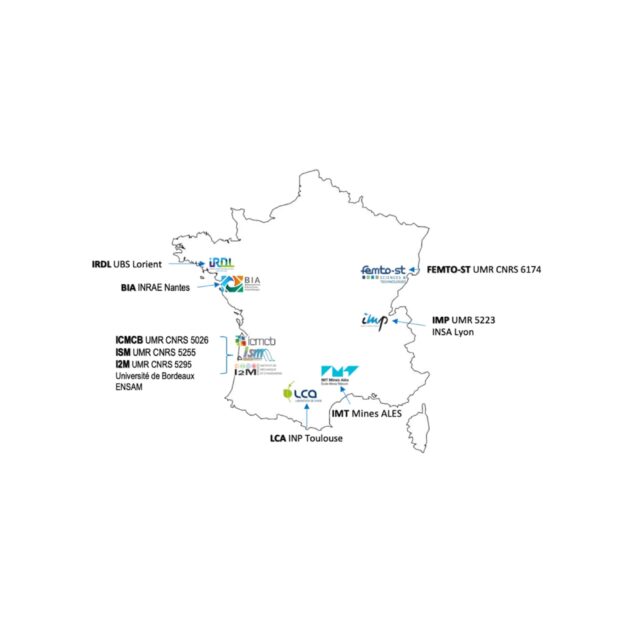
Through the PEPR Recycling programme, France is structuring a national response to one of the composites industry’s most pressing challenges: enabling the circular transformation of high-performance organic matrix composites. With RecyComp and Nextgen, the initiative connects molecular design, fibre recovery and scalable recycling technologies: a momentum that will be visible at JEC World 2026 with the rise of a dedicated Circularity Village.


Circularity in motion
Circularity is rapidly becoming a defining force in high-performance composites and JEC World 2026 marks a new step in that transformation with the rise of a dedicated Circularity Village. For the first time, recyclability, fibre reintegration and scalable recovery technologies are brought to the forefront as a central industry theme rather than a peripheral discussion.
In this context, France entered a new phase in composite circularity in 2026 with the launch of Nextgen. Its ambition is clear: to move beyond recycling as a corrective action and integrate reusability and recyclability directly into the molecular design of high-performance polymers. The heart of Nextgen focused on a “functional materials” strategy, developing innovative ionic liquid-based architectures to create durable, reusable and multifunctional composite networks, alongside green-chemistry routes for recycling thermosetting systems. However, Nextgen is only one component of a broader national architecture.
From national strategy to composite circularity
Nextgen operates within the national Priority Research and Equipment Programmes (PEPR), a €3 billion strategic framework designed to reinforce scientific and technological leadership in key transition domains. Within this structure, the PEPR Recycling programme addresses the industrial and environmental shift toward a competitive circular economy.
Bringing together more than 50 research teams across France, PEPR Recycling is structured into 11 research axes: five dedicated to materials, four to industrial sectors and two transversal axes. This organisation reflects a holistic view of the recycling landscape, targeting key material families including plastics, composites, textiles, strategic metals and paper/cardboard, alongside key sectors such as batteries, new energy technologies, WEEE and household waste.
Within the materials cluster, composite recycling is structured around a dedicated axis. RecyComp represents the origin of the programme started in 2023 while Nextgen marks the next stage of the materials cluster axis dedicated to composite recycling.
RecyComp: structuring circular organic matrix composites
RecyComp addresses the circular transformation of Organic Matrix Composites (OMCs) at a system level. Rather than focusing solely on polymer chemistry, the project works on real industrial end-of-life components, including wind turbine blades, marine structures, automotive parts and sandwich panels, representative of some of Europe’s most complex composite waste streams.
Its strategy aligns with the EU waste management hierarchy and operates across three complementary dimensions:
- Prevention: designing composites with sustainable, stimuli-responsive or depolymerisable adhesive systems.
- Preparation for reuse: reducing structural complexity and maximising the share of recyclable constituents.
- Recycling: implementing advanced separation technologies such as subcritical/supercritical solvolysis and twin-screw extrusion solvation.
High-quality fibres, recovered monomers and polymer matrices are reintegrated into the manufacturing of a “new generation of recyclable composites”, combining improved interfaces, reduced carbon footprint and robust mechanical performance. Industrial integration is a critical pillar of this strategy. The involvement of companies such as Arkema and Ecotechnilin reflects the programme’s objective: enabling scalable adoption across the composite value chain.
To guide technological pathways and compare recycling routes, Life Cycle Assessment (LCA) plays a transversal role within the consortium, providing quantitative environmental indicators to support informed decision-making.
A glimpse into RecyComp’s ongoing work
Beyond its institutional structure, RecyComp reveals a clear shift in composite engineering.
The case studies detailed in the print feature make one thing clear: composite circularity is moving from recovery to reintegration. Fibre extraction, whether from natural or carbon-reinforced systems, is now coupled with mechanical requalification and interfacial assessment to ensure structural reuse, as demonstrated by tensile and indentation testing at IMT Mines Alès or UBS and interface investigations at FEMTO-ST. At the same time, recyclability is being engineered upstream. INRAE’s fibre functionalisation strategies introduce design-for-separation concepts at the reinforcement level, while IMP Lyon develops solvolysable ionic liquid-based epoxy systems embedding chemical recovery directly into the resin network. In parallel, subcritical solvolysis routes explored at ICMCB Bordeaux and continuous twin-screw solvation processes developed in LCA Toulouse signal the transition toward scalable recycling pathways for both natural and carbon fibre composites.
Together, these advances reflect a clear trend: chemistry, interface performance, process intensification and environmental assessment are being integrated into a single circular design logic.
This momentum will materialise at JEC World 2026, where RecyComp partners, including INRAE (Hall 5, booth D49-09), UBS/Compositic (Hall 6, booth A89), Ecotechnilin (Hall 5, booth B64) and Arkema (Hall 5, booth U40), will engage with industry stakeholders to discuss scalable circular solutions. Some members of the consortium can also be met at the European Flax and Hemp Alliance booth (Hall 5, booth B71).
Stay tuned : Full technical data and experimental methodologies will be presented in JEC Composites Magazine n°168, “Technology” section.
This article reflects the collective work of the RecyComp partners, including:
- FEMTO-ST, Besançon France: Microdroplet debonding tests: Xavier Gabrion, Adam Leveziel, Florian Boutenel, Vincent Placet and Sébastien Thibaud.
- ICMCB, Bordeaux, France: Solvolysis extraction : Jing Wang, Anthony Chiron et Cyril Aymonier.
- LCA, Toulouse, France: Twin-screw solvation process: María Patricia Rodriguez Rojas, Marie Doumeng, Guadalupe Vaca-Medina et Philippe Evon.
- IMP, Lyon, France: Development of a solvolysable ionic liquid resin Sébastien Livi and Kanykei Ryskulova.
- IMT Mines Alès, France: Single fibre tensile testing : Martian Asseko-Ella, Jamila Taibi, Nicolas Le Moigne, Romain Leger, Stéphane Corn, Monica Pucci, Didier Perrin and Patrick Ienny.7
- INRAE, Nantes, France: Functionalisation of flax fibres: Isabelle Capron, Baptiste Buet and Johnny Beaugrand
- UBS, Lorient, France : SEM and mechanical characterisation of plant cell wall : Alain Bourmaud, Coralie Buffet and Anthony Magueresse, UBS, Lorient, France
- ISM, Bordeaux, France: Life Cycle Analysis: Kamal Kamali and Guido Sonnemann.


You can create a free technological watch and keep you updated about all these subjects.
