









Ilaria Ardizzoia, co-founder of 3ntr
JEC Composite Magazine spoke to Ilaria Ardizzoia, the founder of 3ntr and CFO of Jdeal-Form srl, a family company founded by her father. Strongly interested in corporate production, she followed product developments for major brands (Fila, Trussardi, Versace, Moschino, Les Copains, Ungaro, Dior, Simone Perelle, Chantelle, etc.) before creating 3ntr. As a member of the Italian organising committee of Women in 3D Printing, she is committed to transmitting the potential of additive manufacturing (AM) to young people.
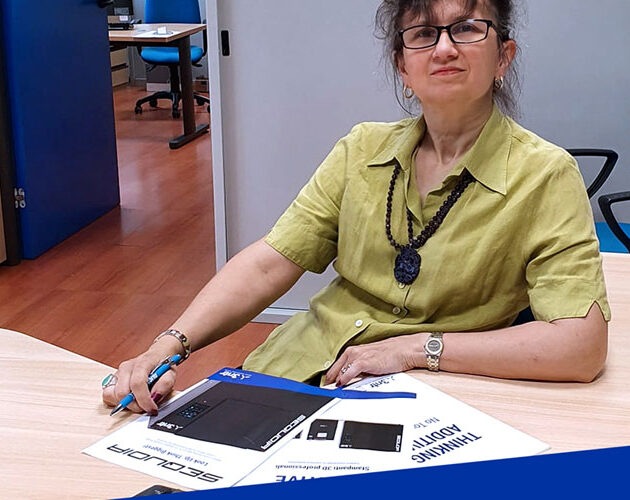
JEC Composites Magazine: How did your interest in additive manufacturing bring you to establish a company?
Ilaria Ardizzoia, the founder of 3ntr and CFO of Jdeal-Form srl: It was not the interest in 3D printing that stimulated the birth of 3ntr but the exact opposite. It was the interest in the growth of our company that led to the creation of the additive business. Jdeal-Form was founded in the 1950’s by my father Josè Ardizzoia, who specialised in the production of technical components for clothing. All the machinery used in our production was created and developed in-house, under the supervision of my brother Davide. In 2010, it became necessary to use rapid prototyping machinery, so we created our first FFF 3D printer. 3ntr was created in 2013, from one of Jdeal-Form’s departments completely dedicated to additive manufacturing. Today, with more than 1,200 systems installed all over the world, additive manufacturing represents 100% of our production.
JEC Composites Magazine: Does polymer 3D printing remain your sole focus? Do you think metals will complete your offer in the future?
Ilaria Ardizzoia: For us, fused deposition modelling/fused filament fabrication (FDM/FFF) systems remain the focus as they are safer for the user, less cumbersome and less expensive than other technologies. This is why we are constantly investing in R&D also on metal replacement, with the use of “super power polymers” and technopolymer coprinting. These are more sustainable solutions, with the same mechanical characteristics as metal and a lower weight leading to energy and fuel savings for transport and logistics.

JEC Composites Magazine: How do you see the current state of the AM industry and its future in the coming years?
Ilaria Ardizzoia: AM is a rapidly growing and continuously expanding technology. Compared to consolidated technologies, especially subtractive ones, there is a lot to implement and discover starting from increasingly high-performance materials and increasingly large printing volumes as the market requires. Now that we have overcome the belief that additives are only used for prototyping, we are talking about industrial production. There is no sector where 3D printing cannot be used. However, thinking in a new “additive way” is still missing.
JEC Composites Magazine: What role will SMEs play in the AM industry over the years?
Ilaria Ardizzoia: The multiple applications of AM leave plenty of room for different players, especially those who have foresight and the ability to specialise in a specific area. The industry needs to grow. Industrialising production processes does not mean distorting or denying company traditions, but simply improving what they do well, trying to have true and concrete respect for the environment.

JEC Composites Magazine: Do you think that 3D printing reduces plastic waste? Which materials are environmentally friendly for 3D printing?
Ilaria Ardizzoia: Getting back to basics, additive means “to add” where needed; subtracting means “to remove”, therefore creating waste. Stepping from this definition, AM limits the use of plastics to functional parts only. We need to push a “plasticare” culture and not a “plastic-free” one. The correct use of plastics materials, in the industrial sector and through additive manufacturing, can be a valid ally, not an enemy to be defeated. Plastics, when properly disposed, like glass, paper and aluminium, can be recycled.
Education is the only solution if we really want to change habits and shift to a cleaner and truly green world. Biodegradable plastics, that dissolve in a short time if abandoned in the sea or on the ground, currently do not exist.
Eco- and bio- are just beautiful prefixes, artfully used by ruthless marketing that aims only at sales, regardless of the product’s real content. Even PLA (polylactic acid), although it is produced with natural materials, is not biodegradable, but compostable. And it can only become compost through industrial processes from specific companies. When (and if ever) the market offers us biodegradable packaging or objects, it will be fantastic. However, this will not give us the right to abandon waste everywhere. For this reason, I repeat, we need to educate.

JEC Composites Magazine: 3D printing, due to the reduction of CO2 emissions and the use of recycled materials, has multiple positive impacts on the environment (approximately 70% less environmental impact compared to traditional production). How do you see future evolutions?
Ilaria Ardizzoia: I consider myself extremely lucky to be able to work in this rapidly growing, and yet to be discovered, sector. I would assert that we are all extremely lucky to live in this historical time. We recently passed from the 3rd to the 4th Industrial Revolution, which focuses on the adoption of certain technologies defined as enabling.
The use of intelligent machines, interconnected and connected to the Internet and thus bringing mass customisation, has become of interest to the entire manufacturing sector. Finally, thanks to Industry 4.0, we can concretely talk about sustainability and circular economy.
Here, AM is fundamental because there is no sector where it is not present. Mind you, it is not enough to own a 3D printer. The important thing is to make full use of its capabilities. We need to change our way of thinking to do so. “Thinking additive” is not just a claim, it must be applied. We must use innovation to grow. Whatever 3D technology is used does not matter: powder, resin, filament, or metal.
Sustainability means more recyclable materials and less defects in production, and consequently less waste.


You can create a free technological watch and keep you updated about all these subjects.
