









Innovation Awards: BMW natural fibre composites win in the Automotive parts category
The BMW Group won JEC Composites 2026 Innovation Award in the “Automotive & Road Transportation – Parts” category with the natural fibre composites used in its BMW M racing cars, which can be exported to other mass-produced models.
“Born on the racetrack, made for the streets” seems to be BMW’s motto for the series-ready natural fibre composites used for the roofs and various body parts of its BMW M4 GT4 Motorsport car. The renowned car brand developed a new resin and prepreg system based on renewable flax-based raw materials through cross-industry collaboration. In vehicle roofs, for example, these materials can replace conventional carbon fibre components – and reduce the CO2e footprint from production by about 40 percent, including end-of-life considerations – while maintaining durability and visual quality. Extensive testing confirms UV, climate and mechanical performance, supported by diffusion barriers and coatings. Dr. Herbert Negele, Head of Materials Development & Lightweighting, BMW Group, answers our questions.
JEC Composites: Why did BMW make the strategic choice to introduce natural fibre composites into high-performance vehicles, traditionally associated with carbon fibre?
Herbert Negele: Carbon fibre-reinforced plastics have a relatively high CO2e footprint and their end-of-life handling is unsatisfactory. Following extensive conceptual development, we critically reassessed the use of carbon fibre in our cars and replaced it with high-performance flax fibre wherever technically feasible. This supports our goal to reduce the CO2e footprint of our vehicles and contributes to our lightweight efforts, while preserving resources.

Which major technical challenges, such as moisture sensitivity, durability or mechanical performance, had to be overcome to make flax fibre composites compatible with series automotive production?
The transition of natural fibre materials from semi-structural fillings to fully load-bearing structural components presented a real challenge. Complex development was necessary from the very beginning, including the production of natural fibre, resin, composites, coating, painting and more. Ensuring long-term resistance to environmental influences throughout the entire product life cycle was another difficulty. Finally, a precise, premium-segment visual appearance had to be achieved. We have eventually succeeded in obtaining a high-performance, lightweight material approved for Class-A large-scale series production and offering excellent adaptability to colour variations as well as a distinctive woven texture.
Do you believe these bio-based materials can become a credible, widely adopted alternative to carbon composites in the automotive sector, beyond BMW M models?
Our development is not limited to BMW M models. We are already exploring numerous alternatives for additional applications—so stay tuned. We believe natural fibre can be a viable alternative to carbon, depending on the specific application.
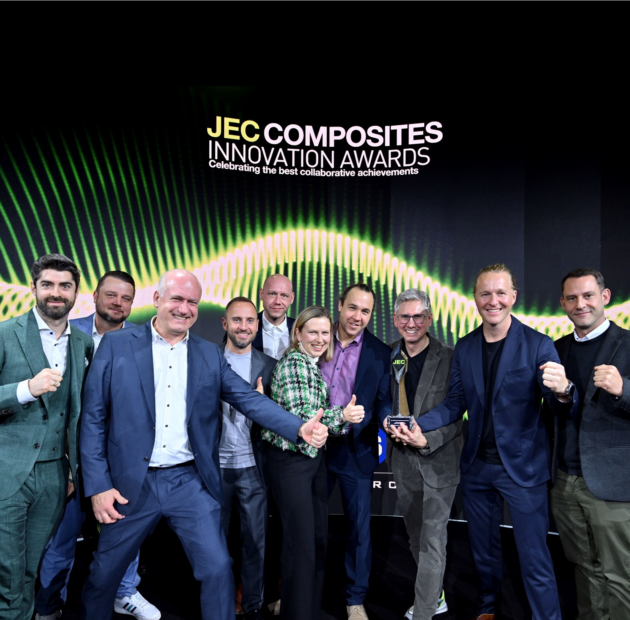
Cover photo: The BMW team receiving its Innovation Award at the JEC World Premiere


You can create a free technological watch and keep you updated about all these subjects.
