









Innovation Awards: CTC recognised for its LeiWaCo lightweight tank for liquid hydrogen in the Pipes, Tanks and Hydrogen category
On Monday 12 January 2026, CTC GmbH – An Airbus Company won a JEC Composites Innovation Award in the Pipes, Tanks & Hydrogen category for its LeiWaCo lightweight tank for liquid hydrogen. Tim Frerich, Cluster Manager Education, CTC GmbH – An Airbus Company, answers our questions.
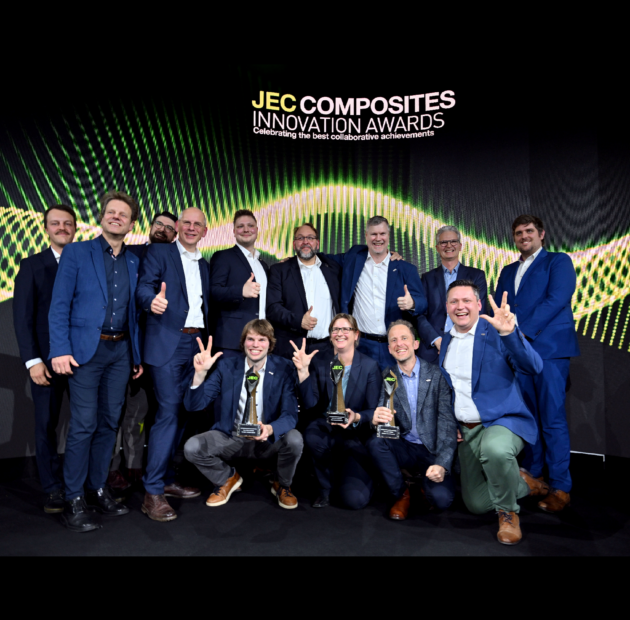
When they realised, while talking to a customer working on hydrogen-powered lorries, that a significant proportion of the current costs associated with hydrogen came from transporting hydrogen gas, the CTC team involved in the project saw an opportunity to reduce these costs by transporting hydrogen in liquid form in lightweight, modular tanks. Liquid hydrogen offers highly efficient energy storage, but carbon fibre-reinforced polymer (CFRP) tanks have been limited by cryogenic microcracking at −253 °C. The CTC team thus conceived LeiWaCo, the first composite LH2 tank solution to eliminate cryogenic microcracking. LeiWaCo overcomes the problem through a holistic solution: a tough thermoplastic matrix with higher cryogenic strain capacity, thinner materials to reduce internal stresses, optimised layups balancing mechanical loads and thermal contraction and an all-composite liner eliminating Coefficient of Thermal Expansion (CTE) mismatch. The project delivers a cryogenically tested subscale demonstrator and a conceptual LH2 logistics container to be presented at JEC World 2026.
Why is solving the issue of cryogenic microcracking critical to the development of liquid hydrogen mobility?
Lightweight hydrogen tanks store hydrogen in liquid form. This way, hydrogen has a high density but the pressure in the tank can be kept at low levels, keeping structures light. For carbon fibre-reinforced polymers (CFRP), the low temperatures required for liquid hydrogen pose a problem: the fibres and the matrix contract differently, causing failure on a microscopic level. Due to the resulting crack networks, hydrogen, the smallest of all atoms, leaks. Therefore, most liquid hydrogen tanks in the past failed due to microcracking caused by thermal cycling. Reducing microcracking is therefore crucial for using CFRP in hydrogen tanks.

What key synergies between thermoplastic materials, design and processes made it possible to overcome this technological barrier?
The thickness of the material had to be reduced to increase the microcracking resistance compared to off-the-shelf materials. To determine the best thickness, we had to look at micro-scale and macro-scale simulations simultaneously, optimising the thickness together with the stacking and the fibre direction in the later ones. The automated processes also had to be adapted to work with the material with reduced thickness, and at the same time be efficient to make the tank affordable.
Only materials, designs and processes that are tailored to each other have made it possible to achieve this resistance to microcracks.
In which sectors (aerospace, maritime, logistics) could this LH₂ tank technology have the greatest medium-term impact?
Our technology can have an impact on all these sectors. Our goal is not only to make thermoplastic CFRP viable for the aerospace sector, where we are talking about 40 hot-cold cycles, but also for other sectors where endurance to thousands of such cycles is required. That is why we decided to approach the development in a cross-sector project. In the aerospace sector, CFRP liquid hydrogen tanks and components could reduce the weight and make hydrogen aircraft more competitive. In the maritime industry, CFRP has the advantage of being corrosion resistant. Additionally, liquid hydrogen tanks have to be placed on top of other structures for safety reasons. They have to be lightweight not to impact the stability of ships negatively. Finally, in logistics, a durable lightweight container with a great hydrogen capacity has huge potential to simplify hydrogen transportation efforts and costs. It should be noted that CFRP liquid hydrogen tanks are expected to be 30% lighter than metal tanks.
CTC GmbH – An Airbus Company was present at JEC World 2026 at the Composite United booth.
The following companies and institutes have been partners of the project:
AFPT GmbH (Germany)
Argo-Anleg GmbH (Germany)
CompriseTec GmbH (Germany)
Composite Technology Center / CTC GmbH (An Airbus Company) (Germany)
Deutsches Zentrum für Luft-und Raumfahrt e.V. (DLR) (Germany)
eCap Marine (Germany)
Faserinstitut Bremen (Germany)
IDVA GmbH (Germany)
FHNW (Switzerland)
Schunk Group (Germany)
Suprem (Switzerland)
Teijin Carbon Europe (Germany)
The LeiWaCo project has been funded by the German Federal Ministry for Economic Affairs and Energy and the Innosuisse.
Cover photo: The CTC GmbH – An Airbus Company team at the JEC World Premiere for the Innovation Awards 2026


You can create a free technological watch and keep you updated about all these subjects.
