









Innovation Awards: CTC’s RTM for large, structural aircraft structures wins in the Aerospace process category
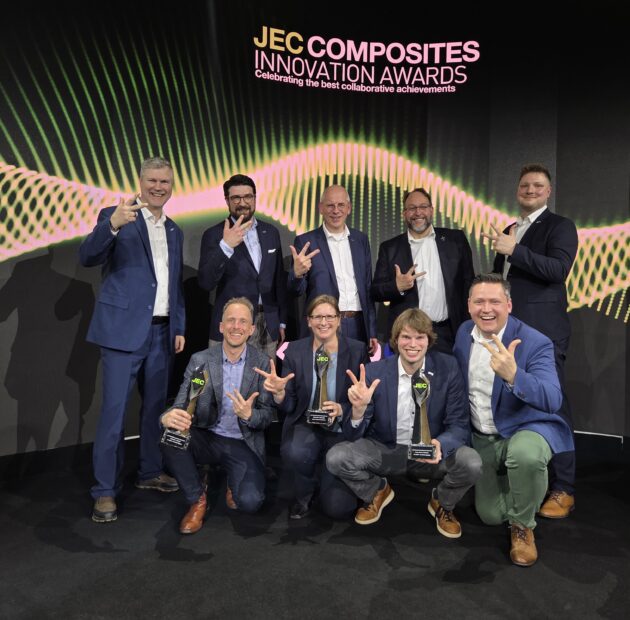
At the JEC World Premiere on 12 January 2026, CTC GmbH – An Airbus Company won an Innovation Award in the Aerospace – Process category for SAUBER4.0, a holistically networked manufacturing approach for RTM that can be applied to large, complex, structural aircraft components. The technology is meant to be both more sustainable and more competitive. Alexander Gillessen, Cluster Manager Manufacturing Technologies, CTC GmbH – An Airbus Company, answers our questions.
CTC GmbH – An Airbus Company has won a JEC Composites Innovation Award for SAUBER4.0, a holistically networked manufacturing approach which aims to make large composite aircraft structures, including complex, high-rate structural components such as aircraft wings, more sustainable, energy-efficient and competitive. The manufacturing technology takes equal account of ecological and economic criteria.
The idea of the project emerged during the first year of Covid-19, in a period during which the future of the aviation industry was extremely uncertain. However, the CTC team was convinced of the importance of component manufacturing to the overall emissions balance. The key element of SAUBER4.0 is the combination of RTM technology with the possibilities of digitisation, innovative preforming and tool technologies.

What role does SAUBER4.0 play in Airbus’s and CTC’s roadmap to make the manufacture of aerospace composite structures both more sustainable and more competitive?
The next generation of single-aisle aircraft, with a targeted production rate of up to 100 aircraft per month, requires solutions in terms of cost and energy efficiency. One driver of energy consumption in prepreg processes is the air conditioning of the production hall. This accounts for around 75% of total energy consumption of part production. The RTM process significantly reduces this, as strict humidity requirements, for example, are eliminated.
With SAUBER4.0, this potential can now also be leveraged for large and complex components. The results, findings and experiences of the project are currently being directly incorporated into the industrial validation and maturation of complex and large-scale composite structures for the next generation of civil and military aircraft at Airbus.
The project SAUBER4.0, funded by the state of lower Saxony in Germany, delivered key technology bricks for the production of large, integral structural components. This includes the innovative RTM tooling, whose inductively heated cavity made of a thin invar casting shell enables fast, homogeneous and energy-efficient temperature control. The application of the Tailored Fibre Placement (TFP) and Dry Fibre Placement (DFP) processes in combination with 3D-printed moulds enables the cost-effective and easily modifiable production of the preforms.
A knowledge model and a data ontology were developed, which formally link the distributed information. A central input parameter is the recording of the energy requirements of individual systems in the process chain. Furthermore, an analysis methodology for material and energy flow recording has been developed specifically for fibre-reinforced plastic (FRP) component production.
This holistic approach was successfully demonstrated by the fully reproducible production of five WingTip demonstrators.
Cover photo: CTC – An Airbus Company at the JEC World Premiere 2026.


You can create a free technological watch and keep you updated about all these subjects.
