









Innovation Awards: fenix’s repairable road bike wins in the Sports, Leisure & Recreation category
On Monday 12 January 2026, fenix (Germany) and its partners won a JEC Composites Innovation Award in the Sports, Leisure & Recreation category for their repairable road bike. Philipp Huber, founder, fenix composites, answers our questions.
fenix and its partners Alformet, herone and hyJOIN noticed that over the past two years, various players produced bike prototypes made from recycled carbon fibre. However, the use of recycled fibres does not necessarily mean that bicycles can ultimately be recycled. For this reason, they wanted to build a frame that ideally used recycled carbon fibres, but more importantly, was designed with the end of its life cycle in mind. Many bike frames being made of composites integrating thermoset polymers, which are difficult to recycle, the team decided to take advantage of the properties of thermoplastic composites to make their bike more recyclable but also more easily repairable. Moreover, they used induction joining instead of adhesive bonding to join the composite tubes and the titanium lugs.
The bike frame combines 3D-printed Ti6Al4V lugs with thermoplastic composite tubes. Titanium lugs are produced by DMLS, machined for bearing seats, and laser-structured for joining. The front triangle uses braided preforms of recycled carbon fibre/PA6 consolidated by herone, while the rear triangle uses Alformet’s LATW-manufactured CF/PA6 tubes. Assembly relies on thermal direct joining: we heat the metal via induction, and the heat conduction into the polymer causes the polymer to melt. It then flows into the lug’s micro-structure, creating a strong (50+ MPa) adhesive-free joint. Tubes and lugs can be repeatedly separated and replaced, enabling full recyclability and repairability.
Why has repairability become a central pillar of your approach to composites in high-end sports equipment?
Sports equipment made from carbon fibre-reinforced polymers (CFRP) tends to be very expensive. High performance bicycle frames, for example, can cost between one and five thousand euros. Even though many manufacturers offer crash replacement discounts, the replacement of the frame will still be expensive. Additionally, the manufacturing of a new frame comes at a high ecological cost, as the manufacturing of a new CFRP frame can be estimated with ca. 65kg of CO2 emissions.
On the other hand, the direct knowledge about composites in the general public is still limited. Discarded (thermoset) frames are considered non-recyclable and trust in repaired frames is limited. The replacement concept in combination with a recycling strategy (like using the broken parts for injection moulding) is a good way to raise consumer awareness of the situation regarding composite recycling, helping them maintain confidence in repaired products and reducing overall carbon dioxide emissions.

How does adhesive-free induction joining represent a breakthrough compared with traditional carbon bike frames?
Traditional carbon (monocoque) frames are usually produced using very labour-intensive hand layup processes with a very energy- and time-intensive cure cycle at the end. Most of the time, only the front triangle is produced in a monocoque design and the rear triangles are bonded onto the frame. In custom manufacturing, filament wound tubes are often bonded onto the carbon fibre or metal lugs. The preparation of the bonding surface needs to be very precise to avoid premature failure. Both manufacturing of the CFRP parts and bonding need extensive cure cycles at the end of the process.
The induction process, conversely, is very fast. The joints are heated for max. 10 seconds and require, depending on the part size, between five to ten minutes to cool down to ambient temperature. The joints are not only created faster, but they are also much stronger than traditionally bonded joints and allow the unjoining and replacement of defective tubes by repeated induction heating. The replacement of a broken seat stay can probably be performed in a manner of 20 to 30 minutes, after which the frame is ready for use again. This isn’t possible with any other manufacturing strategy.
Do you think this modular, reversible approach could durably transform the design of sports composite equipment?
Yes, we will probably see more designs that are thought out from the end of the life cycle. These designs will not necessarily always be modular. Modular design makes sense for large assemblies, also from a manufacturing and development perspective. For example, if you are optimising the riding characteristics of a bicycle and find that the seat tube is too stiff and the riding experience is uncomfortable, you can remove the old seat tube and replace it with a new one with a different (less stiff) composite structure. Otherwise, you would have had to manufacture a completely new frame to find out whether your change had achieved the desired result.
Recyclability has become an important consideration for consumers. This, along with the value retention and cost efficiency of this approach, will outweigh the weight disadvantages and provide a competitive advantage.
fenix has two parts exhibited on the Innovation Planets: the tension strut on Innovation Planet 6 (D119) and the bike on Innovation Planet 5 (E148). Alformet will be present in Hall 5, booth K122 and herone in Hall 5, booth 5D97.
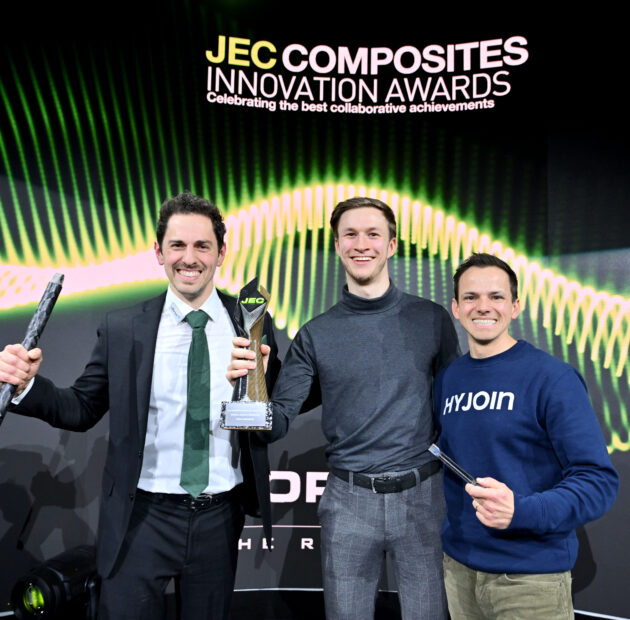
Cover photo: The repairable road bike team receiving its JEC Composites Innovation Award at the JEC World Premiere — from left to right: Lucas Ciccarelli, managing director, Alformet, Alformet; Philipp Huber, founder, fenix composites, and Jan Krollmann, engineering lead, HyJOIN


You can create a free technological watch and keep you updated about all these subjects.
