









Innovation Awards: the Chemnitz University of Technology’s plastic EV battery housing wins in the Automotive process category
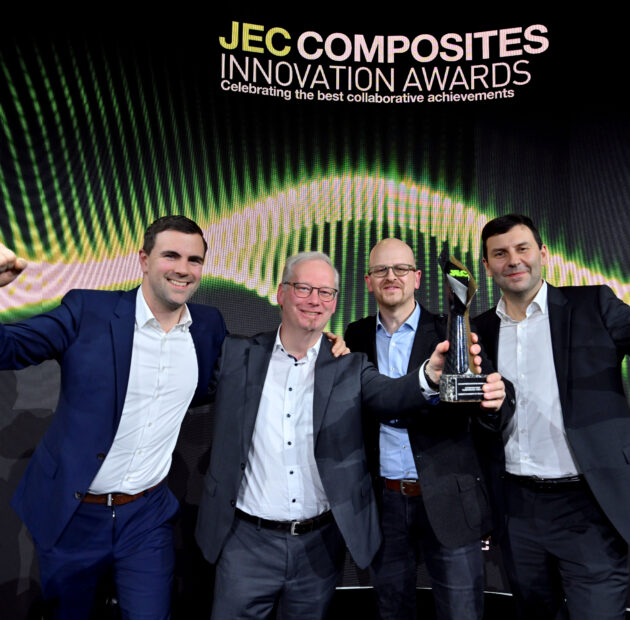
On Monday 12 January 2026, the University of Technology of Chemnitz (Germany) won a JEC Composites Innovation Award in the Automotive – Process category for its plastic EV battery housing for mass production. Rüdiger Knauss, Head of Plastics Processing, Mahle International, answers our questions.
The transformation in the automotive industry towards battery electric vehicles changes the requirements of the car body structure itself and of the components, which also serve as structural parts, particularly in case of crash. Fibre-reinforced plastics (FRP) offer several advantages, including ease of processing, lightness, design freedom, thermal and electrical insulation. Additionally, with the appropriate combination of different fibre reinforcements, this material can dissipate the impact energy better than metals. This is why the Chemnitz University of Technology and its partners Mahle International (project coordinator), Wickert Maschinenbau, Formenbau GF, Gerlinger Industries, in2p and Fraunhofer ICT launched a project whose goal is to demonstrate the attractiveness of the FRP for battery housings, regarding the mechanical/technical performance on the one hand and the economic and CO2 saving processing on the other hand. The core achievement of the project was the development and production of a thermoplastic, glass-fibre-reinforced traction-battery housing by using and combining commercially available long and continuous fibre- reinforced semi-finished products in an automated compression moulding process suitable for large-scale production.
What elements were developed as part of the project?
In addition to the thermoplastic, glass fibre-reinforced traction-battery housing, which leads to a reduced weight and increase structural rigidity, the team also developed a multimaterial system. This made it possible to manufacture a flawless part from just one single organosheet via compression moulding. Moreover, new lightweight grippers have been engineered to handle lofted, preheated blanks. A nearly waste-free production was achieved using rectangular blanks and a controlled pre-draping mechanism.
How does this academic project fit into an industrial transfer pathway to meet the massive needs of e-mobility?
This academic project closely aligns with an industrial transfer pathway because it directly addresses scalability and manufacturability. Using a fully automated compression moulding process with cycle times below two minutes each and commercially available semi-finished materials enables rapid industrial adoption and fast market penetration to meet the growing demand for electric mobility. The battery housing developed also meets the requirements of the Euro NCAP pole impact test.

In what ways does automated compression moulding of thermoplastics reinforced with long and continuous fibres represent a breakthrough compared with current aluminium solutions?
Aluminium battery housings, which are state-of-the-art in battery electric vehicles, usually are welded constructions consisting of extruded profiles; only few examples are die-cast parts. In comparison with both variants, our thermoplastic solution shows advantages in the production process.
Firstly, this process is ideal for high-volume, fully automated production with short cycle times. It allows quick and affordable scaling.
In addition, compression moulding consolidates and integrates functions, eliminating the need for many separate metal parts, fasteners and secondary assemblies. This reduces assembly time, complexity and overall system mass.
Moreover, continuous fibres provide a superior stiffness-to-weight ratio and predictable fatigue performance. The thermoplastic matrix allows less post-forming, easier joining and repair strategies that increase lifecycle value.
Finally, thermoplastic composites offer improved corrosion resistance and recyclability at the end of their lifecycle. They also have a lower embodied CO₂ footprint than aluminium solutions in series production.
These factors can move advanced composite battery housings from their niche market to a mainstream market within a reasonable timeframe.
How do you assess this technology’s potential to reduce the carbon footprint and the cost of batteries across the wider electric vehicle market?
The life cycle assessment (LCA) that we conducted as part of the project revealed the potential for reducing CO2 emissions by up to 25% compared to an aluminium battery housing. The main factors behind this reduction potential are weight saving (impact during the use phase) – which is about 15% – and reduced energy consumption during production (including material production).
Cover photo: The team (from left to right: Steve Büchner, Wickert Maschinenbau; Rüdiger Knauss, Mahle International; Frank Schettler, Chemnitz University of Technology; Martin Dietze, Formenbau GF) receives its Innovation Award at the JEC World Premiere 2026


You can create a free technological watch and keep you updated about all these subjects.
