









Japan continues its transition to renewable energy thanks to the Proteus tidal turbine
Proteus Marine Renewables has installed the AR1100 tidal turbine in Japan. The tidal energy company is helping Japan to accelerate its decarbonisation process.
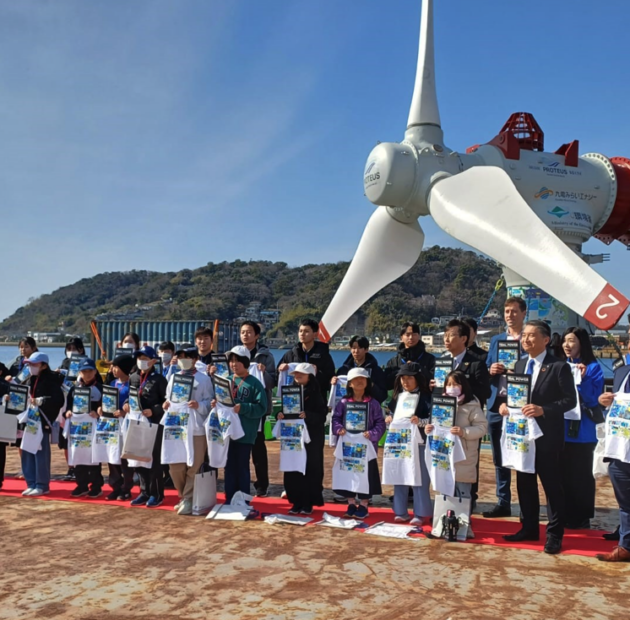
In the Naru Strait, in the south of the Japanese archipelago, British company Proteus Marine Renewables has installed the AR1100, a tidal turbine with a capacity of 1.1 MW. Thanks to tidal power, the turbine is accelerating the decarbonisation of the electricity supply to the Goto Islands located near the strait, and marks an important step for renewable energies in Japan.
“Tidal power is exploitable in Japan with great opportunities there thanks to medium to strong coastal currents. It offers similar tidal opportunities like France (Raz Blanchard), the UK (Pentland Firth), or Canada (Bay of Fundy). With its growing focus on marine energy innovation and renewable energy expansion it is an important player in the global energy sector”, says Drew Blaxland, CEO Proteus Marine Renewables.
The AR1100 tidal turbine has a horizontal axis rotor with three blades made of advanced composite materials, designed for optimum efficiency in tidal currents. The blades of the AR 1100 are approximately 7.7 m long. The maximum chord, from leading edge to trailing edge, is 1.9 m and the thickness varies from around 0.8 m at the root of the blade to almost nothing at the tip. The blade angles are independently controlled by electromechanical pitch systems housed in the turbine hub, allowing real-time control for maximum energy capture and minimising hydrodynamic loads.

The unit incorporates a drive train that transmits the mechanical power extracted from the rotor to a permanent magnet generator. An electrically-operated hydraulically-locked yaw mechanism is used to rotate the nacelle so that the rotor faces the flow of the tide, which reverses four times a day.
The turbine is connected to land by a submarine cable, transmitting the energy directly to a land station, where it is converted for distribution to the grid.
Exploiting the properties of composites

In the tidal turbines installed by Proteus, composites are mainly used for the blades. “The carbon and resin composite offers several key advantages, including high strength and stiffness, high fatigue life, corrosion resistance, relatively lightweight and the material will sink if broken, preventing floating debris hazards”, says Nigel Hopley, Head of Product Component at Proteus. “Tidal turbine blades are shorter and stubbier than wind turbine blades, yet they experience similar reaction forces at the blade roots. However wind turbine blades are much thicker, which increases their second moment of area (a key factor in bending resistance, so the strength of the material for a wind turbine blade can be lower”, he explains.
The manufacturing process involves several stages. The main components are first placed in moulds and infused with resin, usually in a single infusion process. Some parts are then machined for greater precision, and the components are glued together using f alignment fixtures to enable correct attachment to the rotor hub. A hand-finishing stage is required the strengthen the bonded joints. The final components are painted for protection and aesthetics. “The primary advantage of using molded composites is their ability to create complex shapes at a lower cost compared to traditional materials,” says Nigel Hopley. Proteus works with local composite manufacturers to produce the blades and entrusts the detailed design of the structures to composites experts.
A preparatory pilot phase
The installation in the Naru Strait follows the successful operation in 2021 of an off-grid AR500 demonstration system in the same location. Building on the success of the pilot project, where a 500 kW unit operated with 97% turbine availability, Proteus’ customer Kyuden Mirai Energy (KME) was awarded a contract in 2022 by the Japanese Ministry of the Environment to upgrade the turbine to a grid-connected, MW-class capacity.
Proteus then signed an equipment supply and works contract with Kyuden Mirai Energy (KME) in November 2022, upgrading the unit to a 1.1 MW capacity. The UK company has improved the performance and efficiency of that existing turbine by building on its modular architecture. It has incorporated advanced pitch and yaw systems and other improvements to achieve this .
International reach
Proteus is currently working with customers in France, Scotland and the United States to deploy the AR series turbine generation systems and help them achieve their production targets.
In France, Normandie Hydroliennes (NH) is developing its first tidal power plant in the Raz Blanchard race at the tip of the Cotentin peninsula. It is part of the European strategy to accelerate decarbonisation and achieve 1GW of marine energy by 2030. It also contributes to commercially viable marine renewable energy in France, and meets France’s targets for reducing greenhouse gas emissions. In 2026/27, a 12 MW pilot network will be deployed, consisting of four horizontal axis, single-rotor 3 MW tidal turbines with blades made of advanced composite materials. The tidal turbine model used is the AR3000, developed by Proteus Marine Renewables. The combined electricity generated from these four turbines will be exported to shore in a single cable.

Scotland also operates megawatt-scale facilities. The MeyGen tidal power project in the Pentland Firth is one of the largest in the world. Since 2018, its 6 MW network has been accumulating a wealth of operational data and has generated over 70Gwh to date.
“Proteus has a long-term offshore services agreement for the existing 6MW array and recently signed an MOU with SKF and GE Vernova to supply an additional 59MW to MeyGen PLC, bringing the project to at least 65MW this decade. As part of this expansion, Proteus will deploy the AR3000—the world’s largest and most powerful tidal turbine. Each of these turbines can generate enough electricity to power over 3,000 homes in high-flow sites further unlocking the potential of ocean energy and advancing renewable innovation”, enthuses Drew Blaxland.
Proteus was formed in 2022 from the acquisition of the tidal power division of Simec Atlantis Energy, and to date its technology has generated more than 20 GWh of clean energy worldwide. The company has projects and established contacts in the US and Indonesia, but its main markets, the UK, Japan and France, will remain its priority in the coming years.
Photos: Proteus


You can create a free technological watch and keep you updated about all these subjects.
