









lntroduction of composite research and development at JAXA
Through JAXA, the Japan Aerospace Exploration Agency, Japan has created its own institution dedicated to research and development of technologies and processes applied to space and aeronautics, like numerous other countries. Since 2003, the agency has pooled its resources into reaching ambitious goals, particularly through the use of composite materials. This article has been published in the JEC Composites Magazine N°151.
The Japan Aerospace Exploration Agency (JAXA) was created in 2003 through the merger of three institutions, namely the Institute of Space and Astronautical Science (ISAS), the National Aerospace Laboratory of Japan (NAL) and the National Space Development Agency of Japan (NASDA). JAXA’s mission is to conduct research, development, and use of space and to promote technological advancement in the fields of aviation, space science, and space technology. JAXA became a National Research and Development Agency in April 2015, and taking a new step forward to achieve optimal R&D achievements for Japan, according to the government’s purpose of establishing a national R&D agency.
Research and collaboration as keys to success JAXA has 7 R&D directorates and 19 administrative departments, each responsible for specific areas of the agency’s work (Figure 1). There are 19 research centres or facilities across Japan, and 5 overseas offices (Figure 2). JAXA’s corporate slogan is “Explore to Realise” which reflects its management philosophy of using space and the sky to achieve a safe and affluent society. JAXA has established partnerships with various aerospace agencies and organisations around the world for aerospace exploration and scientific research. Some of those international partnerships include NASA (National Aeronautics and Space Administration, USA), ESA (European Space Agency), CSA (Canadian Space Agency), CNES (Centre National d’Études Spatiales, French space agency), DLR (Deutsches Zentrum für Luft und Raumfahrt, German aerospace centre), ROSCOSMOS (Russian space agency), ISRO (Indian Space Research Organisation) and ASI (Italian Space Agency), among others.

Through these collaborations, JAXA has contributed to many joint missions and programmes such as the International Space Station (ISS), the Hayabusa asteroid sample-return missions, and the Venus Climate Orbiter AKA TSUKI mission. JAXA also provides a broad range of opportunities to industries to support private companies entering the aerospace business, broadening the base of the aerospace industry and enhancing global competitiveness. The opportunities include programmes to share the intellectual property acquired through aerospace research and experience, allow industries to use our test facilities, and off er a system for cooperative research. In addition JAXA has many cooperations in place with universities and off ers educational activities aiming to “foster broad-minded youths that are taught about a wide range of views”.

Composite research and development at JAXA
JAXA conducts composite R&D activities mainly under its Aviation Technology Directorate (JAXA Aviation) at the Chofu Aerospace Centre Aerodrome Branch, which is located in Mitaka city, in the Tokyo metropolis. JAXA Aviation works toward a “sustainable aviationintegrated society”, which is friendly to both people and the environment. It as 4 R&D visions as follows:
- contributing to the environment and user-friendly sustainable air transport;
- bringing aviation closer to people in daily life and disaster relief;
- driving digital transformation of the entire life cycle of aircraft;
- strategically supporting research and development activities with expertise in aeronautics.
To bring these visions to fruition, JAXA Aviation promotes several R&D programmes, such as emission free aircraft, silent supersonic aircraft and aircraft life cycle DX technology, based on government policies and meet societal needs (Figure 3). The directorate also focuses on R&D of advanced composite materials and structures for use in aviation applications. This includes developing new composite materials with improved properties, as well as designing and testing novel composite structures to ensure their safety and reliability. The directorate has several structural testing facilities where a variety of strength evaluations, from coupon level to full-scale size, are carried out composite structures. These facilities are used not only for research purpose, but also for industrial collaboration and support.

Wide-ranging research interests applied to composites
JAXA, as a core space development agency which supports the Japanese government’s space development, keeps firmly promoting research and development for satellites, launch vehicles, space exploration and other aerospace areas. In order to reach these goals, composite materials are the topic of wide research aiming to optimise manufacturing, use and fine-tuning. The main lines of research are organised around the points developped below.
Composite optimisation and biomimetic composite structure
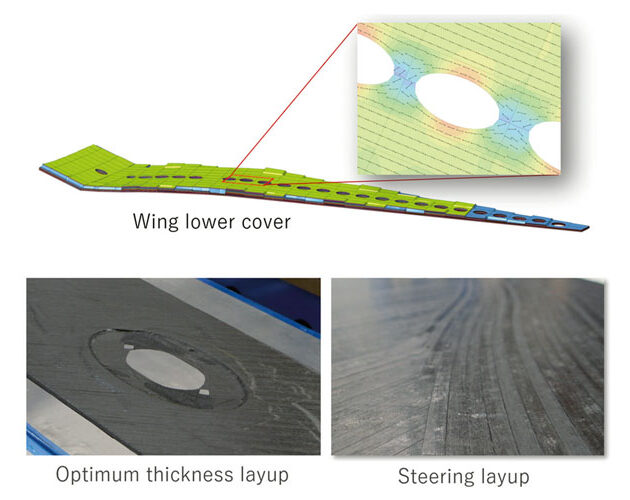
The agency has established an optimisation design approach for lightweight composites aircraft structures, and to change the current traditional “black metal” design approach using both simulation and automated fibre placement. The key technologies used are the method of achieving optimum panel thickness and the application of steering layup technique. The optimum thickness distribution obtained by simulation is converted into complex ply shapes and steering stacking direction of fibres is defined as the same direction as the principal strain direction, which can then be accurately fabricated by AFP. In a study of optimised laminated panels simulating a portion of the lower wing panel, it was demonstrated that 40% weight reduction could be achieved while maintaining the same strength (Figure 4).

JAXA’s teams plans to create a “bionic airframe” or novel aircraft structure, combining engineering design and biomimetics approach. Aiming to apply the approach to the future blended wing body airframes design, we focused on the layout of veins of biological skeletons and insect wings, and created an unconventional structure by combining topology optimisation and the theoretical method of Voronoi Tessellation patterns. Those complex reinforcement structures were prototyped by AFP with thermoset carbon fibre prepregs and in situ consolidation using thermoplastic prepregs (Figure 5).

Through its research on highperformance polyimide composites, the goal here is to improve lightweight, highly heat-resistant, and high-strength polyimide/carbon fibre composite materials to a practical level. Researchers are striving to apply them to hightemperature components such as aircraft engine structures and spacecraft heatresistant components mainly comprising conventionally used Ti alloys.
CFRP technology, manufacturing and end-of-life
Thin-ply prepregs offer several advantages over thicker laminates. The thinner layers have excellent damage tolerance and allow for greater control over the stacking and fibre orientations, which can result in stronger and more durable composite parts. Additionally, the thinner layers can be used to create more complex shapes. We have been studying the application of this toughened thin-ply prepreg to liquid hydrogen composite tanks since 2021 through basic physical property evaluations, optimisation simulations, and AFP prototypes. The agency also evaluates new curing methods for CFRP by assessing the…
Want to read the end of this article?
Subscribe for free now and access to the entire article published in the JEC Composites Magazine N°151.
Available in print, digital and via the mobile application.


You can create a free technological watch and keep you updated about all these subjects.
