









Low-footprint epoxy with tunable latency enables recycled carbon fibre mat adoption
As net-zero and Scope 3 targets reshape material priorities, carbon footprint has become a critical barrier for composites. This article presents a low-footprint epoxy system for HP-RTM and wet pressing with tunable latency that not only reduces emissions directly but also enables the use of recycled carbon fibre mats – materials previously limited by poor permeability. By overcoming impregnation challenges, Olin presents new pathways for sustainable, high-performance composite manufacturing.
Over the past 20 years, composite materials have been instrumental in reducing fleet emissions, largely due to their remarkable strength-to-weight ratio. By enabling vehicles to shed excess mass, composites have directly contributed to improved fuel efficiency and reduced CO₂ emissions. The US Department of Energy’s “Lightweight Materials for Cars and Trucks” report, published in 2013, highlights that a 10% reduction in vehicle weight can yield a 6-8% improvement in fuel economy.
With the rise of electrification, composites have become even more critical. Lightweight structures directly impact battery range, which is a key performance metric for electric vehicles. According to the McKinsey report, “Lightweight, heavy impact: How lightweight materials will shape the future of automotive,” published in January 2022, every 100 kg of weight reduction can increase EV range by up to 10%, making composites indispensable in next-generation vehicle design.
Scope 3 emissions and OEM targets
As OEMs pursue net-zero goals, Scope 3 emissions – those generated across the supply chain – have come under intense scrutiny. According to Deloitte’s 2023 report “Automotive’s Carbon Dilemma: Decarbonizing the Supply Chain,” Scope 3 emissions can account for up to 98% of an automotive company’s total carbon footprint. Yet, despite their significance, a joint analysis by the World Economic Forum and Boston Consulting Group in the 2022 publication “The Drive Toward Net-Zero: Accelerating Supply Chain Transformation in the Automotive Sector” found that OEMs have only reduced upstream Scope 3 emissions by about 2% since 2017, while Tier 1 suppliers have actually increased them by 5% during the same period. To address this gap, the Science Based Targets initiative (SBTi) recommends a minimum 2.5% annual reduction in Scope 3 emissions – amounting to a 25% reduction over a decade – to remain on track with global climate commitments.
Carbon footprint: a new barrier for composites
While composites offer clear benefits in lightweighting and performance, their production – especially of virgin carbon fibre and epoxy resins – is energy-intensive and carbon-heavy. This presents a barrier to adoption in a market increasingly driven by Scope 3 reduction targets. To remain viable, composites must evolve to meet both performance and sustainability demands.
The industry needs a resin system that supports mass production of lightweight composites while minimising carbon footprint. Such a system must also enable the use of low-footprint reinforcements, like recycled carbon fibre mats and natural fibres, which are often challenging to impregnate due to their structure and variability.
Read the rest of the article freely in JEC Composites Magazine n°167, pp. 66-68.
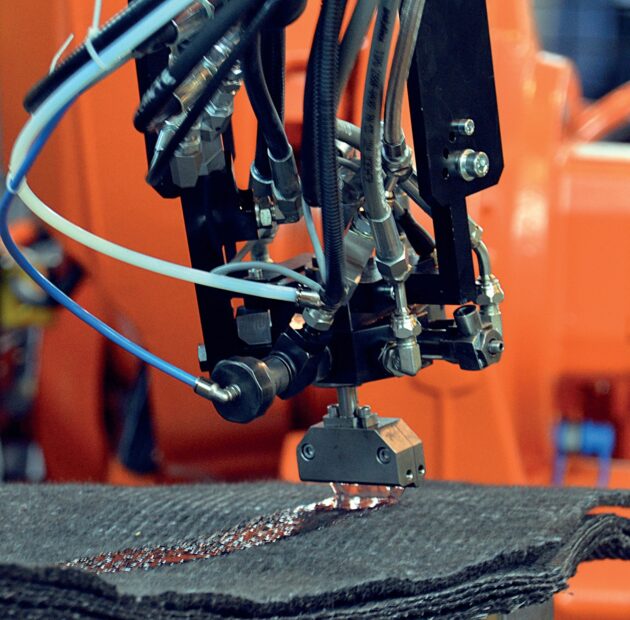
Cover photo: Wet pressing of a recycled carbon fibre mat (courtesy of Cannon)


You can create a free technological watch and keep you updated about all these subjects.
