









“Our NAWAStitch technology helps create a virtually unbreakable new composite material”
Polish-German wheel manufacturer Fibratech is on the good way to achieve the cost-efficient manufacturing of carbon fibre wheels for electric vehicles, and to deliver a real mass-production alternative to aluminium technologies. Becoming the supplier for one of the biggest Tier 1 wheel suppliers, the holy grail in the automotive sector is close within reach. This interview has been published in the JEC Composites Magazine N°153.
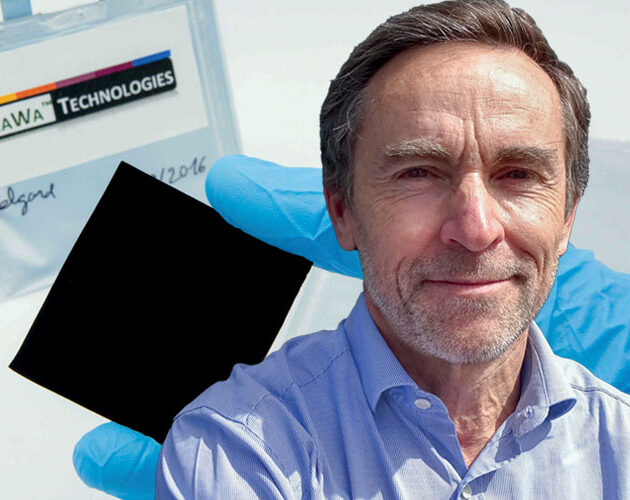
JEC Composites Magazine: Could you introduce NAWA Technologies to us?
Antoine Saucier: Headquartered in Aix-en-Provence, France, with a second high-tech facility in Dayton, USA, NAWA is at the vanguard of carbon fibre-reinforced composites development. Following a thorough research and development (R&D) programme that lasted for more than a decade, NAWA has now reached the industrialisation stage for its pioneering vertically-aligned carbon nanotubes (VACNT) technology set to positively impact key global industries.
During these years of R&D, we optimised a revolutionary 3D carbon-based nano-material technology that enables breakthrough performance improvements across multiple application domains, from advanced composites to energy storage systems and fuel cell stacks.
JEC Composites Magazine: NAWA is seen as a pioneer in its fi eld. Could you tell us more about the company’s vertically-aligned carbon nanotubes?
Antoine Saucier: Our pioneering VACNT technology forms the core pillar of all our revolutionary products. A nanotube is a very tall, very thin column – a bit like a piece of spaghetti. Yet, it is at nano-scale, and we arrange them vertically like a toothbrush head but billions of times over, similar to creating a carpet. These VACNT ‘carpets’ have so many uses that we have barely scratched the surface of their vast ranging potential.
However, one prime application area for VACNT is advanced composites, where the technology can be used to drastically increase the material’s strength. This is thanks, in part, to a solution called ‘NAWAStitch’, which sees VACNT act like a ‘nano-velcro’, solving one of the biggest issues with common composites today: interlaminar cracking and delamination.

improvements across multiple application domains from energy storage to advanced composites
JEC Composites Magazine: What type of applications (and in which sectors) can this technology be applied to?
Antoine Saucier: The scope for our technology is truly globally vast, both in terms of sectors and actual applications, including automotive, aerospace and sports sectors. Using the world of composites as a prime example, NAWAStitch, which is essentially developed from VACNT, results in game-changing performance enhancing innovations, bringing enormous advantages for the next generation of high-tech material products across multiple sectors and technologies.
Our NAWAStitch breakthrough, which allows VACNT to act like a ‘nano-velcro’ technology, is applied as a universal or localised interlaminar reinforcement composite on a new (or even existing) technology, system, machine and/or product application. Applying NAWAStitch in this way prevents cracks from bridging across the interface surface area. This is the traditional weakness point of composite materials, thereby it creates a virtually unbreakable new material.
Studies have shown that NAWA Stitch results in a composite with a 900% increase in impact damage tolerance, while also offering a reduction in weight of up to 30%. In effect, the customer benefits from a lighter, stronger and more advanced composite material.
JEC Composites Magazine: Some new material breakthroughs, such as graphene for example, are encountering various challenges in reaching a point where they are deemed to be commercially mature. How is NAWA overcoming these same technical hurdles with its innovative materials?
Antoine Saucier: We have a state-of-the-art solution that offers the composite world a complete step-change in technological material science progress with applications everywhere, from sporting goods through to automotive and aerospace. We are fully confident that the technologies we have developed will fulfil their potential and deliver game-changing solutions to customers in the composites arena.
This unwavering belief in our technologies is threefold. Firstly, it comes from the fact that we have not rushed development. A key factor that can be very tempting. As mentioned previously, our R&D phase spanned over more than a decade, during which time 11 PhDs were delivered and 26 patents secured.
Secondly, various studies have substantiated our claims. For example, we can prove that NAWAStitch creates a composite with a 900% higher impact damage tolerance, while offering a weight reduction of up to 30%.
The third factor underpinning our belief is that, as a company, NAWA is brimming with engineering excellence and innovation. Our high- level engineering-, technology and design-focused approach ensures we are at the vanguard of change that is better for the environment, society and industry, starting with advanced composites.

carbon nano tubes (VACNT) and acts as ‘nano-velcro’, reinforcing the weakest parts of the composite
JEC Composites Magazine: NAWAStitch clearly has a lot to offer for multifunctional composites. How sustainable is this technology?
Antoine Saucier: Every element of NAWA’s core objective (from R&D through to production) is focused on sustainability enhancement. After all, the principal technology which underpins all our products, VACNT, is based on abundantly and naturally occurring carbon, which is clean and green.
JEC Composites Magazine: A startup not so long ago, NAWA has now become a global leader. How was this transition managed?
Antoine Saucier: Our journey has been one that is organic, patient and driven purely by innovation. Much like the R&D programme showcases, at NAWA we will take the right amount of time to achieve perfection. We want our technology – not marketing, advertising or social media – to establish the company’s leadership qualities and credentials, showcasing to global industries how and why we have become the leader in nano-technology development. The fact that we sit at the vanguard in our sphere makes me truly proud.
JEC Composites Magazine: You recently joined NAWA as CEO. What are your future goals?
Antoine Saucier: When I joined NAWA earlier this year, I immediately set to work with our team to focus the business around key areas. In this respect, our primary focus is on further developing and delivering next-generation multifunctional ultra-strong nano-based composite solutions.
This is what we can bring to market quickly. And by quickly, I am talking within this year. These composite materials can transform a wide spectrum of industries, including the hydrogen and battery technology sectors, providing greater performance, longevity and safety.
Want to read more interviews?
Subscribe for free now and access to the whole JEC Composites Magazine N°153.
Available in print, digital and via the mobile application.


You can create a free technological watch and keep you updated about all these subjects.
