









Rise of AI: Jushi has put into operation its largest electronic glass fibre production line
China’s glass fibre giant acknowledges the strategic value of electronic glass fibre under the global AI computing power boom. Its manufacturing base aims for zero carbon and circular economy.
China’s leading glass fibre producer Jushi has put into operation its 100,000-tonne-per-year electronic glass fibre and 390 million-metre-per-year electronic cloth production line at its Huai’an ‘zero-carbon intelligent manufacturing base’ located in Jiangsu province. Zhou Yuxian, chairman of China National Building Materials Group (CNBM), Jushi’s parent company, Liu Yan, chairman of China Jushi, and Yang Guoming, general manager of China Jushi, were among the executives who jointly launched the production line.
In his address, chairman Zhou Yuxian pointed out that the new Huai’an production line is “an important component of the world’s first zero-carbon intelligent manufacturing base for glass fibre.” It will provide high-end electronic information materials for emerging industries such as consumer electronics, 5G communications and industrial control, laying a solid material foundation for the construction of the nation’s new information infrastructure. He stated that as a backbone force in the new materials sector, the group CNBM will continue to support Jushi’s development, providing comprehensive guarantees in resource allocation, capital operation and innovation integration.

As a global leader in glass fibre, China Jushi currently holds a 23% market share in the global electronic glass fibre market. The group boasts that the newly commissioned 100,000-tonnes-per-year electronic glass fibre production line in Huai’an is the world’s largest single production line for electronic-grade glass fibre. After its commissioning, China Jushi’s electronic glass fibre production capacity will account for approximately 28% of the market.
The project integrates and applies technologies independently developed by the company, such as high-performance glass formulations, ultra-large pool furnaces and intelligent manufacturing, and possesses 100% independent intellectual property rights, according to Jushi.
With the rapid development of emerging industries such as AI computing power, 5G/6G communications, and intelligent connected vehicles, electronic substrates are evolving towards ultra-fine, ultra-thin and high-frequency applications. The product structure of this production project already includes high-end electronic substrate varieties such as ultra-fine yarn and ultra-thin cloth, which will effectively meet the urgent demand for high-performance PCBs (printed circuit boards) substrates in emerging fields such as high-end servers and automotive electronics.
At JEC World 2026, Edwin Shen, deputy section manager of international sales and marketing at Jushi, announced that the glass fibre giant aims for a total capacity of one million tonnes of electrical glass fibres by around 2028, prioritising market share gains amidst supply shortages and price volatility.
Multi-energy supply system
One of the biggest highlights of the Huai’an base is its innovative approach to solving the carbon emission problem of glass fibre production from the source—using green electricity to manufacture glass fibre, and then using glass fibre to create green electricity, forming an industrial micro-cycle.
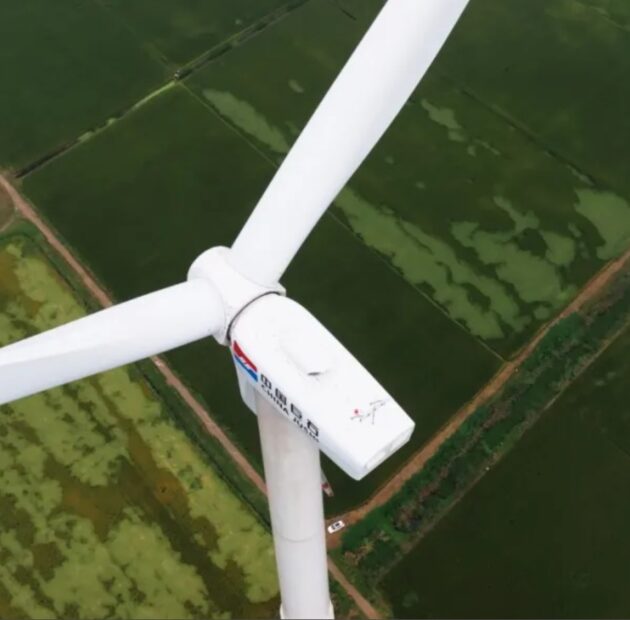
On the North Jiangsu Plain, rows of white wind turbines, over 180 metres tall, turn in the wind. The turbine blades are made of Jushi glass fibre and the green energy they generate is continuously supplied to the Huai’an manufacturing base. This is part of the wind power project of the base: the first phase, a 233 MW project, is already connected to the grid, with 47 units generating over 600 million kilowatt-hours annually, achieving carbon emission reductions of over 400,000 tonnes; the second phase, a 500 MW project, is expected to generate 1.24 billion kilowatt-hours annually, reducing carbon emissions by 1 million tonnes annually, equivalent to planting approximately 9 million trees. Jushi underlines that the base has truly achieved a green cycle from “producing glass fibre” to “using glass fibre” and then to “green energy feeding back to glass fibre.”

Furthermore, Jushi Huai’an has undertaken the construction of building-integrated photovoltaics (BIPV), built energy storage facilities in conjunction with wind farms, and pioneered the use of hydrogen blended with natural gas combustion technology in kilns within the industry, thus establishing a multi-energy complementary green energy supply system. Currently, according to Jushi, the base uses 100% green electricity. On the green product side, four types of glass fibre products from the base have passed SGS carbon footprint certification, proactively preparing for future green trade barriers such as EU carbon tariffs.
Guided by China’s “dual carbon” strategy, Jushi ‘Huai’an zero-carbon intelligent manufacturing base’ is using new energy to drive new materials and new materials to support new energy, exploring a new path of sustainable development for the glass fibre industry: “advanced production capacity replacing outdated production capacity and zero-carbon manufacturing empowering high-end manufacturing,” and contributing to a replicable and scalable “Jushi solution” for the global glass fibre industry.
Cover photo: On the North Jiangsu Plain, Jushi’s turbine blades, which are made of Jushi glass fibre, supply the Huai’an Zero-Carbon Intelligent Manufacturing Base in green energy (source: Jushi)


You can create a free technological watch and keep you updated about all these subjects.
