









SolidSail Mast Factory inaugurates its giant composite mast factory for sail propulsion
Inaugurated on 12 February in Lanester (Brittany), France, the SolidSail Mast Factory (SMAF) aims to take the manufacture of XXL composite masts from the artisanal stage to industrialisation. Supported by six French manufacturers, this 4,000 m² factory aims to produce masts for the SolidSail sail propulsion system designed for cargo ships and large cruise ships.
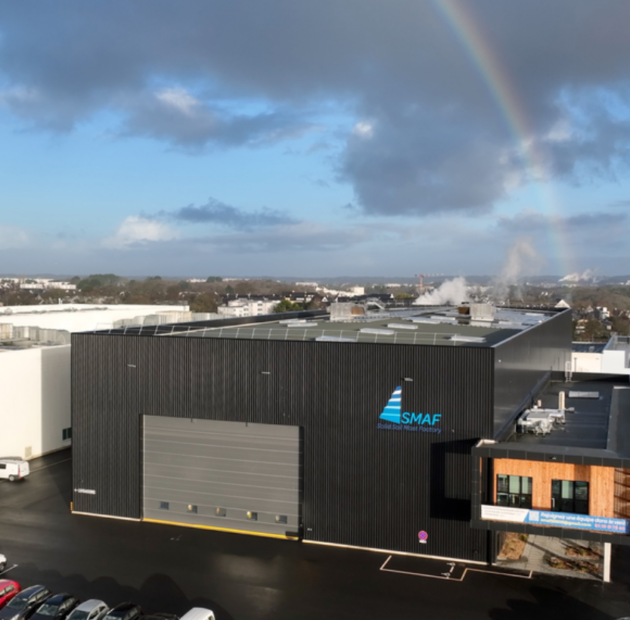
The SolidSail Mast Factory (SMAF) was officially inaugurated on 12 February in Lanester, near Lorient, in France during a ceremony attended by government representatives, local elected officials and industrialists involved in the project. The result of a partnership between Avel Robotics, CDK Technologies, Chantiers de l’Atlantique, Lorima, Multiplast and SMM, the company draws on the complementary expertise of these companies to create a new production capacity dedicated to large composite structures. The factory, whose foundation stone was laid in January 2024, represents an investment of more than €18 million, financed in part by the State through the France 2030 plan and by the European Union as part of Next Generation EU.

A few days after the inauguration, we were able to visit the site, welcomed by Nicolas Abiven, SMAF’s director of operations. From a design office overlooking the workshop, he observes the activity of this factory designed to manufacture non-standard composite structures. ‘SolidSail Mast Factory has a design office overlooking the factory, from which you can see everything that goes on there. It’s a highly automated company,’ he explains.

Housed in a single 4,000 m² nave with no interior pillars so that very large parts can be handled, the factory has been producing SolidSail carbon masts since summer 2025. These masts are central components of the sail propulsion system developed by Chantiers de l’Atlantique. This technology is used in particular on the Neoliner sailing cargo ship, as well as on the Orient Express Corinthian and Orient Express Olympian cruise ships, which are billed as the largest sailing ships in the world.
With sail areas ranging from 800 to 1,500 m², SolidSail is one of the most powerful wind propulsion solutions currently available. Used as primary or auxiliary propulsion, it significantly reduces fuel consumption and CO₂ emissions for ships, whether cargo vessels or cruise liners.

Beyond the technology itself, the project is part of a regional industrial strategy. By the end of 2026, more than 35 jobs are expected to be created in the region. The factory currently operates with a team of around 30 people, mainly from the composites sector. ‘The operators we have recruited are selected primarily for their composites skills and their ability to work with human-machine interfaces,’ emphasises Nicolas Abiven.
For him, mechanisation is also a lever for industrial sovereignty. ‘Our goal is to keep jobs in France, and to do that we need to mechanise and automate,’ he insists. The creation of a site dedicated to large composite parts also responds to a simple observation: “We noticed that what was costing us money was the lack of a suitable location for manufacturing large parts.” The aim is also to open up the industrial facility to other sectors such as aeronautics, space and energy. Discussions are already underway with certain players.
A robotised factory for industrialising large composite parts

The organisation of the factory reflects this industrial ambition. The site is structured around four main areas: robotic draping, assembly, machining and painting. Three overhead cranes, each with a capacity of 15 tonnes, serve the entire factory. They are named after meridians, in reference to the north-south orientation of the building, which serves as a reference point for the teams in this vast production hall. Nearby, 300 m² of cold rooms are used to store pre-impregnated carbon fabrics, while mobile ovens, coloured ‘South Seas’, are used to cure long composite parts.

One of the major challenges of the project was automating the draping process, which had historically been carried out almost entirely by hand. ‘Initially, 95% of the draping was done manually. Today, 90% of it is robotised,’ explains Nicolas Abiven. The draping robot, developed with Fives, moves along a rail over 70 metres long, while machining is carried out by a robotic cell designed with Creno, in Annecy. The firing kilns come from Denios, near Rouen. All of these technology partners are part of the French industrial fabric.

In practice, the process begins with the robotic draping of the mast’s half-shells, made from pre-impregnated carbon fabrics. After baking, the two half-shells are scanned to create a digital twin, then glued together before lamination and post-baking. ‘When we open the conformer, we have the two half-shells that we scan to create a digital twin, then we carry out the bonding,’ explains Nicolas Abiven.
The mast then undergoes robotic machining without being moved, thanks to long rails. ‘There are almost 600 holes to drill in a mast,’ he explains. This process achieves the necessary precision while maintaining industrial production rates.
SolidSail Mast Factory ultimately aims to produce one mast per month, or approximately 20 tonnes of composite per unit, with an annual capacity of up to fifteen masts. This industrialisation marks the transition from a largely artisanal manufacturing process to true mass production of XXL composite structures.
You can also find our detailed report on the factory in the next edition of JEC Composites Magazine.
Photos: SMAF / DR


You can create a free technological watch and keep you updated about all these subjects.
