









The lnnovative lnfusion Airframe Manufacturing System (llAMS)
Along with Airbus Defence and Space, MTorres developed an AFP lay-up system for dry fibre that can be used with high-temperature hot forming and infusion technologies. This project was recognized as the most innovative in the Aerospace – Process category in this year’s JEC Composites Innovation Awards, which were announced during JEC World 2022. This article has been published in the JEC Composites Magazine N°148.
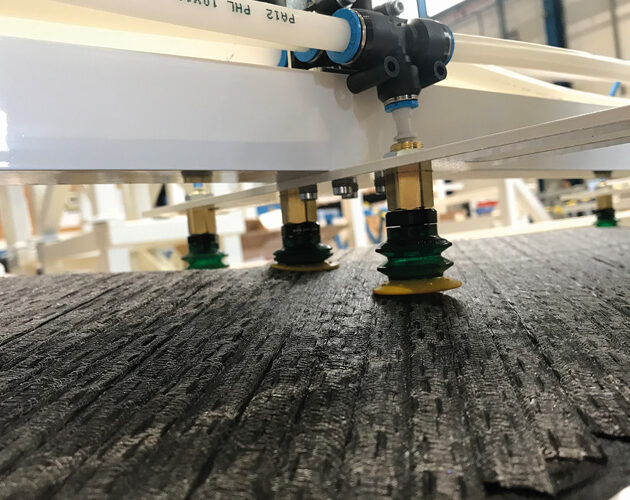
The IIAMS (Innovative Infusion Airframe Manufacturing System) project was a challenge from the start. Airbus, under the Cleansky 2 programme, wanted an AFP (automated fibre placement) lay-up system for dry fibre that would be compatible with high-temperature hot forming and infusion, lightweight, portable and energy saving, among other high-level requirements. The final purpose was to demonstrate that a lower-cost alternative technology to prepreg/autoclave could reduce lead times and environmental footprint while achieving similar design tolerances and quality levels.
It was a challenge, without any doubt, but MTorres decided to apply for this project by themselves. If they had the capabilities to do all on their own, why not? After all, not so long ago the company had developed the Torreswing Fuselage, which was a clear precedent of this proposal. The team knew it would be risky as it meant facing the real challenges of manufacturing large primary structures by Liquid Resin Infusion (LRI) using dry carbon fibres, and also using an out-of-autoclave technology (OoA).

Due to its expertise in the composite field and confidence in their capabilities, MTorres was awarded the Innovative Infusion Airframe Manufacturing System (IIAMS) project, funded via the European Union’s Horizon 2020 programme under grant agreement No 820845.
The project
The IIAMS project is related to advanced low-weight, high-performance structures. More specifically, this innovative system had to enable the manufacturing of flyable components for a wing box carbon fibre composite structure, which had to be manufactured by infusion. Moreover, all the structural elements had to be manufactured by AFP lay-up for higher quality. And all this without forgetting the main aim: achieving a significant cost reduction.

As can be seen in the figures, the team developed everything but one of the skins for a 4m long outer torque box without fasteners, using vacuum bag-only resin infusion for both the left and right wings of a C-295 turboprop demonstrator. It was a one-shot process, including the skin, spars, stringers and stiffeners, where all the components had different shapes and thicknesses.

The wing box used narrow (12,7 mm wide) dry carbon fibre tapes and high-temperature (180°C Tg) curing resins, with energy-saving tools, low-cost heating systems and sensor- based digital control and simulation to predict and manage the processing step.
One of the project’s most demanding requirements was portability. It was critical that all the tooling and manufacturing equipment were portable and flexible in order to facilitate an easy deployment at any manufacturing site. In addition, the manufacturing process could not make use of existing means, such as overhead cranes, in order not to interfere with existing manufacturing processes. The Automated Centre for Thermo Infusion (ACTI) was designed for this purpose, performing hot drape forming of the stringers and spars, including their stiffeners; infusion of the stringers, spars, stiffeners and skin altogether; and cure cycles without resin sure application, just vacuum. Moreover, also looking for lightweight and tolerance accuracy, the tooling was made of CFRP materials.

One of the leverage points when the company applied for this project was its experience in making its own materials and technology for dry fibre tapes.
During the development phase, they used their 12.7mm wide, 300g/m2 TorresTape® dry carbon fiber tape for process set-up and tuning, made from Mitsubishi Rayon 50K high-strength (HS) fibre, as it was engineered to facilitate and perform well during infusion, but also during lay-up using their AFP heads, so it was easier and less expensive for the project.
Last, but not least, the team had to deal with the challenging one-shot infusion process. They used positioners, caul plates and digital technology to monitor everything, and placed them altogether into the ACTI where the tooling was heated to 120°C. The Hexcel RTM6 epoxy resin was heated to 70°C and degassed before infusion through a single resin feed location. Despite the complexity of the process, the infusion was relatively quick, followed by a two-hour cure at 180°C using only hot air, sharing the same equipment used for Hot Drape Forming (HDF).


The results
The first prototype was built in less than 16 months (engineering, process definition, tests, tooling and prototype manufacturing). Lower cover, front and rear spars were integrated into the unitized flying demonstrator using a one-shot, low-cost portable process.
The IIAMS project represents the first product case of flyable and potentially certifiable carbon fibre wing box made using LRI and OoA composites in Europe.

This article has been published in the JEC Composites Magazine N°148.
Want to enlarge your composite knowledge?
Register now and access to the latest JEC Composites Magazine.


You can create a free technological watch and keep you updated about all these subjects.
