









Sweden’s carbon-fibre electric ferry takes off
Candela’s first commercial vessel, the Candela P-12 — with its inaugural unit named Nova — has proven a success both in terms of passenger uptake and environmental impact. As a result, the city is planning to operate it daily by May.
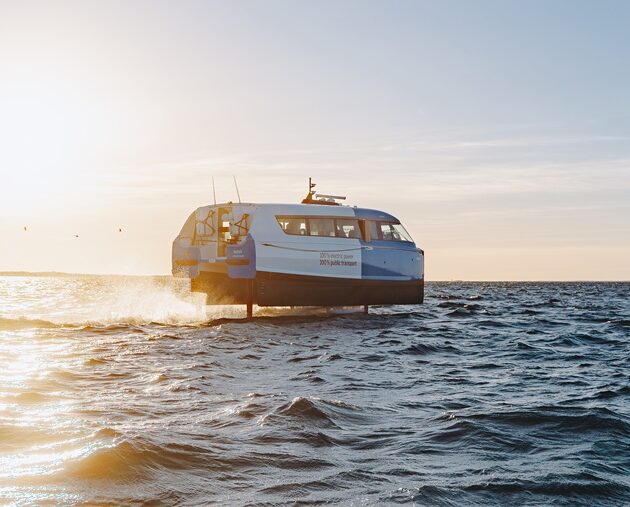
The Nova, the first Candela P-12 unit, entered service in Stockholm’s public transport system in fall 2024. Initially running 5 days a week, it will now operate daily starting in May, thanks to its strong performance — recently confirmed by new figures from Region Stockholm. Nova will return to service on April 15 after the winter break. Candela already counts customers for the P-12 across the globe, from Saudi Arabia to New Zealand and the United States.
The Nova has proven to be an exceptionally efficient mode of transport. It connects commuters from Tappström (Ekerö center) to Stockholm City Hall in just 30 minutes — compared to about an hour by car or bus, and 45–55 minutes by conventional boats on the same route.
“Nova is drawing commuters to the other vessels as well. That’s especially exciting, since one of our goals is to show that with fast, comfortable waterborne transport, we can get car commuters to switch to waterborne transport,” says Gustav Hasselskog, CEO and founder of Candela.

The “secret” behind the Candela P-12 lies in its unique combination of electric propulsion and hydrofoil technology, allowing it to “fly” above the water surface. This enables higher speeds with far lower energy use. Nova emits only 23 grams of CO₂ per passenger-kilometre (pkm), compared to an average of 439 g/pkm for conventional diesel-powered vessels Lux and Sunnan operating the same route — a 95% reduction. It also consumes just 0.39 kWh/pkm, compared to the average of 3.31 kWh/pkm for other ferries — an 84% drop. The P-12’s hull, made of carbon fibre, is produced in-house by Candela, along with its proprietary C-POD motor and control systems.
With a top speed of 30 knots and cruising at 25 knots, the Candela P-12 is the world’s fastest electric ship — and it even outpaces Stockholm’s quickest diesel-powered archipelago ferries. It also boasts the longest range of any electric ship ever built: 40 nautical miles at 25 knots. Thanks to its speed and minimal wake, it’s ideal for use in both urban areas — where wake restrictions are in place to protect infrastructure and shorelines — and ecologically sensitive zones. The P-12 is also the most energy-efficient high-speed vessel ever created in its class. Candela projects significant operational cost savings compared to diesel vessels.

The Candela P-12 already has international customers — from Saudi Arabia’s NEOM project to ferry operators in the US, Asia-Pacific and Europe — with deliveries scheduled to begin in 2024/2025.
“Demonstrating that the technology is mature and fit for demanding public transport use is important. This is the third generation of our foiling technology, and with lessons learned from producing over 100 leisure vessels, we’re scaling up production to meet demand,” says Gustav Hasselskog, CEO and Founder of Candela. “We are incredibly happy that Region Stockholm has enabled us to demonstrate the hydrofoil technology in the city’s public transport. We see that waterways in most cities have enormous potential for fast, low-cost, and emission-free transport that can relieve road networks and connect communities. This is just the beginning,” says Gustav Hasselskog, CEO and Founder of Candela.
Nova, flying at 25 knots from the Ekerö suburbs to downtown Stockholm, is the fastest electric vessel in public transit — proving it can reduce commute times while boosting ridership on the city’s waterways.

Cover photo: The Candela P-12 Nova


You can create a free technological watch and keep you updated about all these subjects.
