









Ukraine seeks to strengthen aerospace cooperation with Europe
On Thursday 12 March 2026, at JEC World 2026 in Paris – Nord Villepinte, a panel discussion was organised with several speakers from the Ukrainian delegation from the aerospace and unmanned systems sectors, with the aim of highlighting the country’s needs in terms of partnerships, equipment and technology.
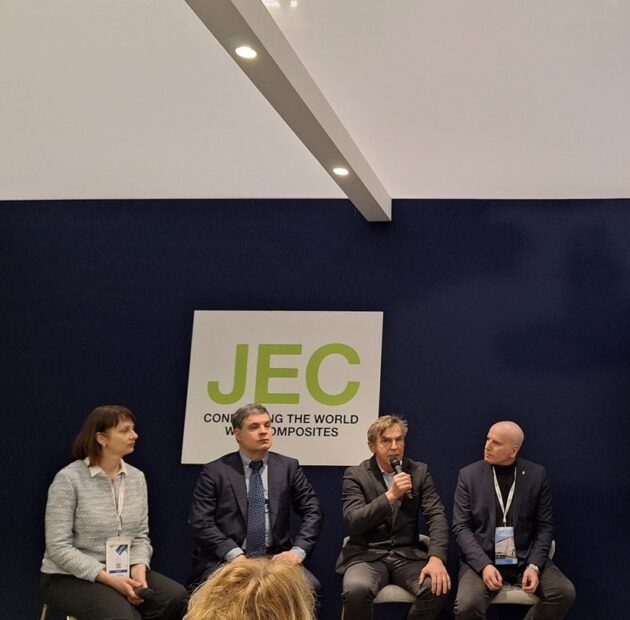
A delegation comprising 15 business leaders, researchers and representatives of competitiveness clusters from the aerospace and unmanned systems sectors attended the JEC World 2026 exhibition to represent Ukraine and its desire to strengthen cooperation with France and its European partners in the field of composite materials. In this context, a round-table discussion was organised on Thursday 12 March to present and explain what Ukraine expects from Europe in terms of cooperation in these fields. The event, themed ‘Fostering technical and industrial cooperation between Europe and Ukraine in aerospace and unmanned systems’, featured presentations from three speakers followed by a discussion. Uncrewed, a platform facilitating direct contact between industry players and 80 public and private sector decision-makers involved in the deployment of unmanned solutions, facilitated the Ukrainian delegation’s visit and organised the conference. François Jullien, the founder of Uncrewed, moderated the discussion.
Ukraine already had expertise in the fields of aerospace and rocketry, said Taras Popelniuk, First Secretary for Economic Affairs at the Ukrainian Embassy in France, by way of introduction. However, the war with Russia has redirected these efforts towards the war effort. Today, the country manufactures many types of drones, with current production standing at 4 to 4.5 million units per year.
Oleksandr Yurchak, CEO of the Ukrainian Cluster Alliance, an association of Ukrainian organisations for cluster movement development and economic growth of Ukraine, highlighted Ukraine’s need for ‘dual-use’ equipment, capable of meeting both military and civilian requirements. Mr Yurchak detailed the challenges Ukraine faces in relation to composites, such as the technological setback caused by the war and production facilities damaged by the fighting. He explained that, among other initiatives, Ukraine needed pilot projects supported by the European government, joint R&D and incentives to integrate foreign companies into Ukrainian firms, also mentioning the possibility of public-private partnerships. The aim is to transform the value chain of the country’s composites ecosystem by shifting from a model reliant on Chinese imports and processing in Europe to ‘pilot corridors’ supported by government initiatives, in which the critical links remain European. In terms of materials, Ukraine needs carbon, glass and aramid fibres as well as advanced systems, Mr Yurchak said.
Yevgen Rokytskyi, chairman of the board of the All-Ukrainian Association of Innovative Space Clusters, whose main objective is to bring together entrepreneurial structures with scientific and educational institutions, public organisations and local authorities, stated that Ukraine had moved from import dependency to rapid industrial mobilisation, its production capacity in the aerospace, shipbuilding and defence sectors having increased sixfold since 2023 and 94% of producers preparing for exports to the European Union. Currently, there are more than 800 defence manufacturers in the country, mostly private SMEs, representing over 300,000 employees and $12 billion output in 2025. He emphasised the importance of rebuilding whilst meeting the country’s needs in aerospace, defence and critical infrastructure. He also highlighted the growing demand for composite materials. Like Oleksander Yurchak, he stresses the need to build the EU-Ukraine Materials Bridge through upstream partnerships (clusters and certification), co-production and supply chain collaboration, the aim being to bridge the structural gap between research and production.

Planning ahead for sustainable reconstruction
Finally, Maryna Storozhenko, head of the Department of International Cooperation and Technology Transfer at the Frantsevich Institute for Problems of Materials Science, spoke of the need to bridge the gap between science and industry. The institute is a leading centre for scientific and technological developments in the field of theoretical foundations of creating new materials, technologies for their production and the manufacturing of products with special properties. Its 450 members study metallic, ceramic and composite materials, in particular ceramic matrix composites (CMCs). They develop materials but also manufacture components for the aerospace industry. Ms Storozhenko noted that the research also looked to the future, which they wished to focus on sustainable development, for example by conducting research into hydrogen technologies, and outlined the areas in which they were working, including the production of basalt fibrous materials from rocks.
During the closing panel discussion, Emmanuel Lowe, a French entrepreneur and international ambassador to the Ukrainian Dual-Use Technology Cluster, also shared his insights. Having lived in Ukraine for 15 years, he remained there after the war began. He emphasised the benefits of doing business with Ukraine, where, in his view, not all regions are particularly dangerous, citing Kyiv and Lviv as examples. He also added that collaborating with the country could provide valuable solutions for international players.
In conclusion, the speakers emphasised that it was easier to do business with Ukraine because, unlike many other countries, it is not a protected market. The country represents a tremendous opportunity for research, but also for supporting the pursuit of innovative ideas. The speakers also added that the country needed cooperation, not competition, and that investing in Ukraine was also an investment in Europe’s security.
You can watch the Ukrainian panel discussion on catch-up.
In addition, watch the panel discussion with Yevgen Rokytskyi, co-chair of the Supervisory Board of the Association of Innovation and Space Clusters in Ukraine, and Oleksandr Yurchack, CEO of the Ukrainian Cluster Alliance, hosted by JEC’s global content advisor and editor Jeff Sloan:


You can create a free technological watch and keep you updated about all these subjects.
