









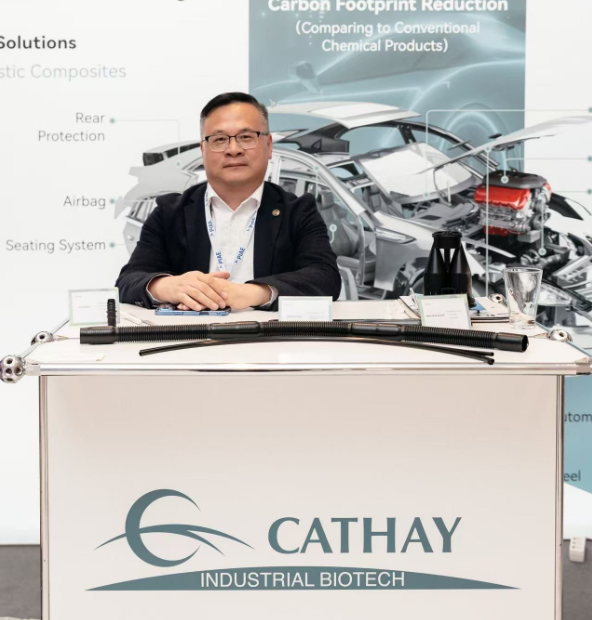
“We want to make widespread use of bio-based composites to really replace steel or aluminium”, Benjamin Pan, Cathay Biotech
Cathay Biotech, a major producer of bio-based polyamides, listed on the Shanghai stock exchange, plans to open by the end of 2026 an integrated industrial complex in Hefei, Anhui province (China), to scale bio-based composites capacity. Benjamin Pan, vice president Engineering Plastics & International Business, Cathay Biotech answered our questions.
JEC Composites: Cathay Biotech has a more than 15-year history in bio-based polyamides. You expanded in 2021 into compounds and composites, what motivated your decision?
Benjamin Pan: We developed a unique polyamide labeled PA5X (5 refers to a diamine with five carbons; X denotes copolymer variations). Produced exclusively via biotechnology by using bacteria as catalysts in fermentation, PA5X offers very high melt flow, enabling excellent impregnation and compatibility with continuous fibres (glass, carbon, basalt). This processing advantage motivated downstream expansion into composites, as PA5X behaves “like water” during fibre wet-out, improving composite consolidation.
What percentage of these biomaterials make up the composition of the bio-resin?
Our product bio content could be variable and mostly are not 100% from biomass for the moment.
Compared with traditional resins like epoxy, aren’t bio-based resins more costly to produce?
Our bio process uses significantly less energy, enabling costs to be largely comparable to epoxy resins and traditional polymers. This parity that we have achieved in terms of cost, and also in terms of durability and compatibility, is essential for market entry, positioning our bio-based composites beyond niche, artisanal parts and toward mainstream, high-volume applications.
What are the primary applications of your bio-based resins?
Lightweight EV battery covers that meet relevant standards, including heat resistance (around 1,000°C direct gas flame) and flame retardancy. In construction, our bio-composite window frames and rebars generate a lot of interest in Europe, where they don’t have enough steel. In consumer electronics, some of our phone back covers are the result of our collaboration with leading brands. Hydrogen tanks and broader new energy components are other application areas. For all the applications, we can offer the same performance with at least 50% lower PCF (product carbon footprint).
Can you detail your industrial project in Hefei?
It is a four-project industrial complex. The Hefei site includes: BioPA compound facility; Bio PA composite facilities; Battery case cover joint venture with CATL affiliates and an application development center. The complex serves as a vertically integrated hub, from molecule to finished composite parts.
Marie-Hélène Corbin, Editorial contributor
Heading photo : Benjamin Pan, vice president Engineering Plastics & International Business, Cathay Biotech (source: Cathay Biotech)


You can create a free technological watch and keep you updated about all these subjects.
