









XB-1, Boom’s carbon fibre demonstrator, achieves supersonic flight
On January 28, Boom’s XB-1 jet broke the sound barrier in Mojave airspace. It is the first civil supersonic jet made in America, and a demonstrator providing the foundation for Overture, Boom’s supersonic airliner. Both are ou will be almost entirely made from carbon fibre composite materials, making them especially aerodynamic thanks to their strong, lightweight structure.
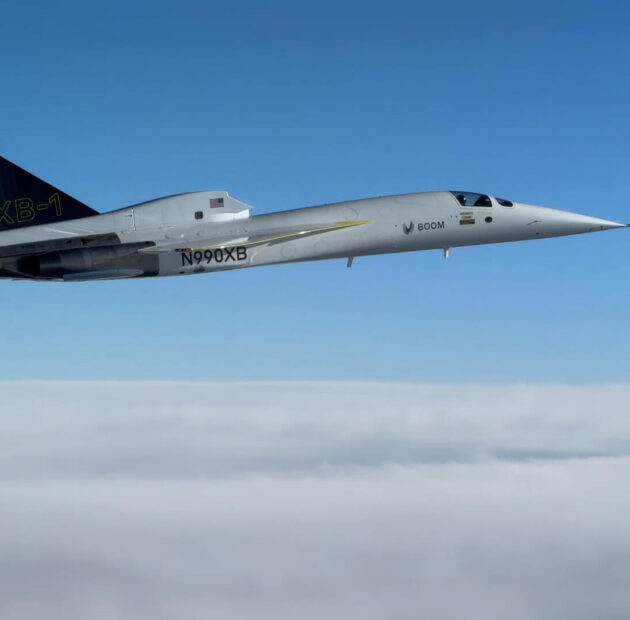
Yesterday, Boom Supersonic announced the successful first supersonic flight of its XB-1 demonstrator aircraft, the world’s first supersonic jet developed by a private company and not a government. Boom designed, built and flew it at the Mojave Air & Space Port in California, the historic airspace where Chuck Yeager broke the sound barrier for the first time in 1947. It is the first human-piloted civil supersonic flight since Concorde’s retirement over 20 years ago, paving the way for the return of commercial supersonic flight.
XB-1 has been flown by Boom Chief Test Pilot Tristan “Geppetto” Brandenburg. It entered the supersonic corridor and reached an altitude of 35,290 feet before accelerating to Mach 1.122 (652 KTAS or 750 mph).
“XB-1’s supersonic flight demonstrates that the technology for passenger supersonic flight has arrived,” said Boom Supersonic founder and CEO Blake Scholl. “A small band of talented and dedicated engineers has accomplished what previously took governments and billions of dollars. Next, we are scaling up the technology on XB-1 for the Overture supersonic airliner. Our ultimate goal is to bring the benefits of supersonic flight to everyone.”
After its inaugural flight in March 2024, XB-1 underwent 11 human-piloted test flights under increasingly challenging conditions. The jet passed through subsonic, transonic and supersonic speeds. The team’s goal was to maintain safety first.
A lot of key technologies validated with XB-1, including carbon fibre composition
As a demonstrator providing foundations for Overture, XB-1 has been built from airliner technology. It features many of the main characteristics of future Overture, namely its carbon fibre composition but also digital optimisation, supersonic intakes and the use of augmented reality. The carbon fibre structure enables the aircraft to be both lightweight and strong, improving its aerodynamic properties. As for the digital optimisation, it has resulted in a design that enables safe, stable take-off and landing at supersonic speeds. Besides, XB-1 has a specific intake system converting kinetic energy into pressure energy, thus enabling it to be powered by conventional jet engines though it is supersonic. Overture’s exclusive turbo engine, named Symphony, will be inspired by these principles. As for the augmented reality vision system, its purpose is to enable pilots to get an excellent runway visibility despite the aircraft’s long nose and high angle of attack for takeoff and landing.
“It has been a privilege and a highlight of my career to be a part of the team that achieved this milestone—every single member of this team was critical to our success,” said Tristan “Geppetto” Brandenburg, Chief Test Pilot for Boom Supersonic. “Our discipline and methodical approach to this flight test program created the safety culture that made a safe and successful first supersonic flight possible. With the lessons learned from XB-1, we can continue to build the future of supersonic travel.”
Overture will carry 64-80 passengers at Mach 1.7 – about twice the speed of today’s subsonic airliners, using more than 600 global routes. 130 orders and pre-orders have already been placed for it, coming from American Airlines, United Airlines and Japan Airlines. In 2024, Boom completed construction of the Overture Superfactory in Greensboro, North Carolina, which will produce 66 Overture aircraft per year. The aircraft will run on up to 100% sustainable aviation fuel (SAF).
Cover photo: Boom


You can create a free technological watch and keep you updated about all these subjects.
