









Xenia Materials and Politecnico di Milano develop a humanitarian drone
Xenia Materials partners with Fly-Mi Euroavia Milano, the student association of the Politecnico di Milano to co-develop of O.L.I.V.I.A. (Optimised Lightweight Intelligent Vehicle for Immediate Assistance), an autonomous drone.
For the second consecutive year, Xenia and the Fly-Mi Euroavia Milano team, the student association of the Politecnico di Milano, have collaborated. They have developed O.L.I.V.I.A. (Optimised Lightweight Intelligent Vehicle for Immediate Assistance), an autonomous drone designed to participate in the UAS Challenge 2025, which will be held in the United Kingdom.
As part of the UAS Challenge, university teams from around the world are invited to design and fly unmanned aircraft in humanitarian scenarios. O.L.I.V.I.A. enabled the students to achieve third place thanks to their technical skills, teamwork and, above all, their rigorous approach to engineering.

O.L.I.V.I.A. is a fixed-wing drone with a V-shaped configuration and a high semi-elliptical wing, capable of performing fully autonomous missions from take-off to landing while carrying up to 1.75 kg of payload. It was developed using advanced composites, giving it structural efficiency, lightness and high aerodynamic performance. It was also recognised for its emphasis on safety thanks to its dual battery system and redundant positioning and communication links.
Material properties suited to the final part
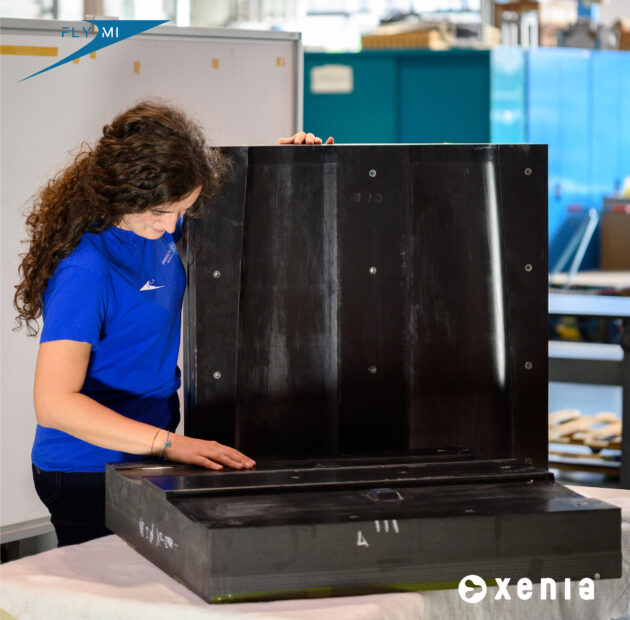
The students used Xenia’s registered trademark Xecarb 40-C20-3DP, a high-performance 3D-printable polycarbonate reinforced with 20% carbon fibre, to make the moulds that were used for the high wing. The material’s machinability, dimensional stability and thermal resistance helped them to ensure the moulds were precise enough to meet the aerodynamic efficiency and structural requirements needed, says Xenia. In particular, the moulds had to be able to endure multiple autoclave cycles at 120 °C and 2 bar without deformation.

“Xenia’s Xecarb 40-C20-3DP material allowed us to create moulds that were precise, strong and easy to work with during the autoclave lamination process,” said the Fly-Mi Euroavia Milano team. “Having reliable moulds was crucial to achieving the aerodynamic performance and structural quality needed for O.L.I.V.I.A., and it played a major role in helping us secure third place in the competition.”
All photos: Xenia and the Fly-Mi team


You can create a free technological watch and keep you updated about all these subjects.
