









A badminton racket made of recycled carbon fibre
National Chung Hsing University (NCHU) used Swancor’s “microwave pyrolysis technology” to recycle carbon fibre extracted from retired wind turbine blades and create the first badminton racket made of recycled carbon fibre”, becoming a landmark example of the high-value application of composite materials, according to Swancor.
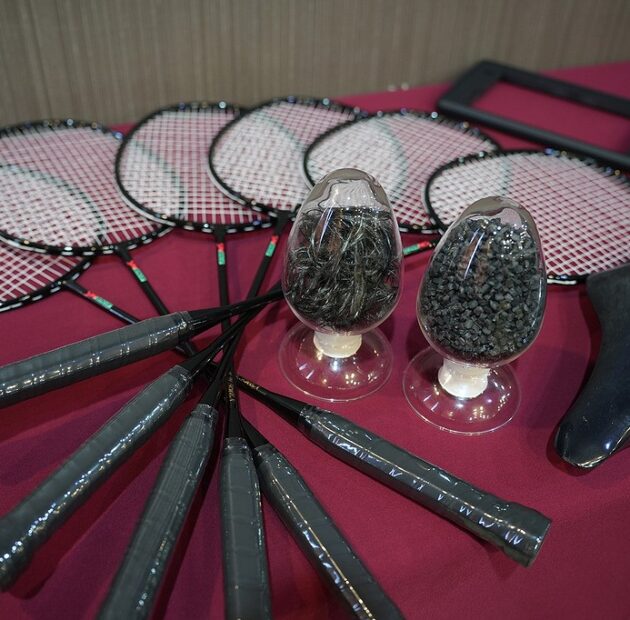
In the past, retired wind turbine blades were mostly disposed of by incineration or burial, which not only put pressure on the environment but also wasted valuable carbon fibre resources. National Chung Hsing University (NCHU), in collaboration with Swancor Holding, has put the concept of a circular economy into practice. Using Swancor’s “microwave pyrolysis technology,” they recycled carbon fibre extracted from retired wind turbine blades. Combined with technologies from NCHU’s Institute of Circular Economy Research, they created “the world’s first badminton racket made of recycled carbon fibre.” Swancor considers that this makes it “a landmark example of the high-value application of composite materials.”
Wind turbine blades are made of robust composite materials, but recycling them presents a significant challenge. Swancor’s proprietary “microwave pyrolysis technology” can precisely process the carbon fibre pultruded carbon plates in the blades. “Compared to traditional pyrolysis methods, it processes the material faster and consumes less energy, achieving breakthroughs in both recycling efficiency and carbon reduction benefits, laying the groundwork for the reuse of used blade,” Swancor said.
Shen Ming-yuan, associate professor at the NCHU’s Institute of Circular Economy Research, pointed out that traditional badminton rackets use thermosetting materials made of carbon fibre and epoxy resin. Although these materials are strong, they cannot be recycled, limiting the application of recycled carbon fibre. Shen Ming-yuan explained that the team broke through the previous framework of “hot pressing” and developed the world’s first “injection-moulded” professional-grade badminton racket using two patented technologies: “recycled carbon fibre modification technology” and “reinforcing thermoplastic composite mixing and granulation technology.” All materials in this racket are recyclable, possessing not only excellent mechanical properties but also truly embodying environmental, social and governance (ESG) principles and possessing a complete “green DNA.”

Towards mass market
Swancor Holding general manager Tsai Hsiao-te stated that the company has long invested in the research and development of wind power materials and green technologies, and this achievement demonstrates the enormous potential of waste composite materials to be transformed into high-value-added products. Although large-scale commercialisation still faces challenges in terms of equipment and cost, Swancor is actively seeking partnerships with like-minded brands and companies, hoping to promote the widespread application of recycled composite materials.
At the results release conference, Tsai Hsiao-te, representing the Swancor Group, donated 100 recycled carbon fibre badminton rackets to National Chung Hsing University, symbolising the deepening of the concept of sustainability and its roots in education, and marking an important milestone in the development of green technology.
In the field of recycling, Swancor is already known for having recently developed recyclable thermosetting epoxy resin, EzCiclo, that addresses the historical challenge of non-degradable recycling in thermoset composite materials. A few months ago, Swancor announced with partner Ama Tech the launch of recyclable composite ceiling fan blades.
Cover photo: “The world’s first recycled carbon fibre badminton racket,” co-developed by National Chung Hsing University and Swancor Holding with microwave pyrolysis technology to recover carbon fibre from wind turbine blades (source: Swancor)


You can create a free technological watch and keep you updated about all these subjects.
