









A use case by Envalior: Anisotropic creep – Prediction of injection-moulded shortglass-fibre-reinforced parts
Discover this Envalior use case about anisotropic creep.
Summary
Creep is a time dependent deformation process that happens to materials under a certain stress level. However, with proper design and material choices, thermoplastics can be a suitable material for parts with a creep load.
Our goal is to evaluate the creep deformation as a function of time, load and temperature in the first and second creep regime. For fibre-reinforced parts a fourth dimension comes into play: the local fibre orientation.

Introduction
Predictability is key when designing load-bearing components. Predictability reduces development time, enables first-time- right design and ensures part performance in service. In this Use Case we evaluated an example of creep of a compression limiter. Focusing on the modelling of creep as function of time of injection-moulded short-glass-fibre-reinforced plastics (SFRP).
Dedicated setup and simulation
Results can be compared, leading to an accurate prediction of pre-tension load as a function of time & temperature for a thermoplastic compression limiter.
Elements
Anisotropic strain-rate dependent creep material model
Anisotropic stress-strain curves are measured at various strain-rates. To take the fibre orientation into account, samples are milled at 0°, 45° and 90° from injection-moulded plaques. Via a non-linear viscoelastic model and short-term validation measurements a full anisotropic creep material can be engineered. This multi-mode modelling approach requires limited time and effort, and includes measurement of stress- strain curves at different strain rates. For example, between 1E-2/s and 10-6 s-1 (see top left graph) a series of short term creep measurements, typically in the range of 3-15 hours (10000 and 50000 seconds; see top right graph). After the model is calibrated the long-term creep performance (e.g. 1000 hours = 6 weeks; see bottom left graph) can be predicted instead of measured.
When combining this with anisotropic thermal expansion measurements, temperature dependency can be included in the material model.


In both above graphs, solid lines are measured and dashed lines are predicted.

Validation
Experiment
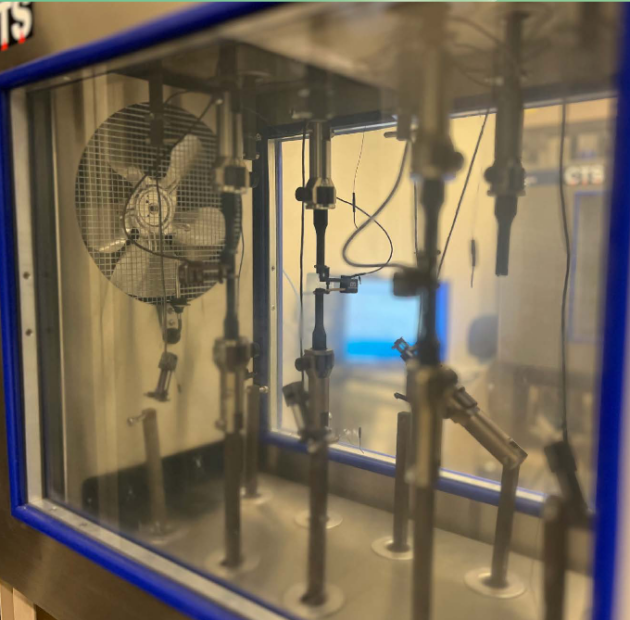
To validate the models, a validation setup with a thermoplastic compression limiter is used. The thermoplastic compression limiter reduces the loss of pre-tension in a bolt connection due to creep. This loss in pre-tension can be measured in situ with a setup as shown below, whereas creep deformation in complex 3D assembly is hard to measure, especially if temperature and moisture are involved, which also contribute to the overall deformation.
The whole setup (shown below) can be placed in an oven, and via thermocouples local temperature information can be obtained as a function of time.


Finite element
Simulation and validation
Using experimental input, a full 3D FEA model of the test setup was built. The measured results of ForTii MX53 compression limiters are taken from a dedicated setup and directly compared to results obtained from a detailed simulation model. This leads to an accurate prediction of the pre-tension load as a function of time and temperature for a thermo- plastic compression limiter.
Transient heat transfer simulations are performed to obtain temperature information as a function of time for every individual node in the finite element analysis. This, combined with the local fibre orientation as predicted via injection-moulding simulation software, are coupled to the anisotropic structural simulation.

Comparison
Comparison
Pre-tension (initially 10 kN) and temperature (initially 23°C/73°F) as a function of time are plotted for both experiments and simulation, see graph below.
To speed up the process, the compression limiters were put into an oven at 120°C/248°F from time (t=1-9) hours, which can be clearly seen from the solid, dark green line. Both during heating and during cooling, the model slightly overpredicts the rate of heat transfer.
Due to the creep load, the tension levels off at around 7.5 kN. Although the model predicts a slightly higher tension, the general agreement between model and experiment is very good.
Final result
In this comparison of simulations to an experimental validation, it was found that with a workflow based on short term creep calibration data the loss in force retention can be predicted within an accuracy of 5%.
The approach with assumed uniform heat transfer coefficients is accurate enough for temperature predictions within this setup.
The influence of thermal expansion data is crucial for accurate predictions.

Bottom line
Envalior, a global leader in thermoplastic material science, offers a full portfolio of best-in-class thermoplastic material solutions and global application development support. Through innovation and market-leading sustainable products, the company makes ideas come to life. It drives progress for a better and more environmentally friendly world. This can only be achieved through deep collaboration with customers and stakeholders who share their vision for a better future.
Their products and innovative pipeline of new materials are sustainable, purposeful and circular and are designed to make the world a better place. Many challenges lie ahead to be tackled in an evolving environment, but they are confident their high performance, safe and lightweight solutions will shape the future in new mobility, advanced electrical and electronics, and many other industries.
All pictures and graphs: Envalior.

You can create a free technological watch and keep you updated about all these subjects.
