









Aimplas develops sustainable flame-retardant coatings and composites
There is growing concern about the environmental impact generated by key industrial sectors, especially in areas such as construction and mobility, where achieving materials with good mechanical performance, lighter weight, and greater fire resistance plays a crucial role. In this context, Aimplas, the Plastics Technology Centre, is working on 2 projects funded by the Valencian Institute for Competitiveness and Innovation (IVACE+i), with support from the European Regional Development Fund (ERDF), to sustainably develop new flame-retardant coatings and composite materials that enhance safety in homes and transportation.
On one hand, the main objective of the Refugi project is to develop phosphorus-based flame retardants using mechanochemical processes, representing a step toward more environmentally friendly methods. These flame retardants are being integrated into varnish formulations specifically designed for use on wood. This strategy aims to improve the fire-resistant properties of coatings used in the construction sector.
Carolina Acosta, lead researcher in Mechanochemistry and Reactive Extrusion at AIMPLAS, explained: “The use of flame-retardant varnishes has increased in recent years, as they offer a finish virtually identical to any wood coating, with the added benefit of greater fire resistance, delaying its spread and effects in the event of a fire. We are focusing on exploring different material sources to produce these flame retardants, prioritizing those that are renewable and recyclable.”
This research, carried out in collaboration with the companies Omar Coatings and Decomader, aims not only to improve the efficiency of flame-retardant production but also to reduce the environmental impact associated with their manufacture and application.
“The application of mechanochemistry for the production of these compounds represents an innovative and promising approach that expands the possibilities of green chemistry and sustainable manufacturing. We are looking for innovative ways to synthesise flame retardants using processes that minimise solvent use, require fewer resources and reaction times, and maximise efficiency. Additionally, we are also researching coating application technologies that allow for uniform and efficient distribution of flame retardants on wood substrates,” added Acosta.

High-performance flame-retardant composite materials
The Neocomp project, on the other hand, focuses on developing high-performance flame-retardant composite materials using advanced manufacturing technologies. This involves producing various parts through innovative industrial processes such as Dry Fibre Placement (DFP) and additive manufacturing. These composite materials must not only offer high performance in terms of mechanical strength, durability and flame resistance but also significantly contribute to reducing the environmental impact in construction and mobility.
Jaime Lozano, researcher in Construction and Renewable Energies at Aimplas, emphasised: “We are working on new composite materials designed to meet energy efficiency, circularity, mechanical performance, and flame-retardant requirements, thus contributing to reducing the environmental impact of industrial activities and advancing toward a greener, circular economy.”
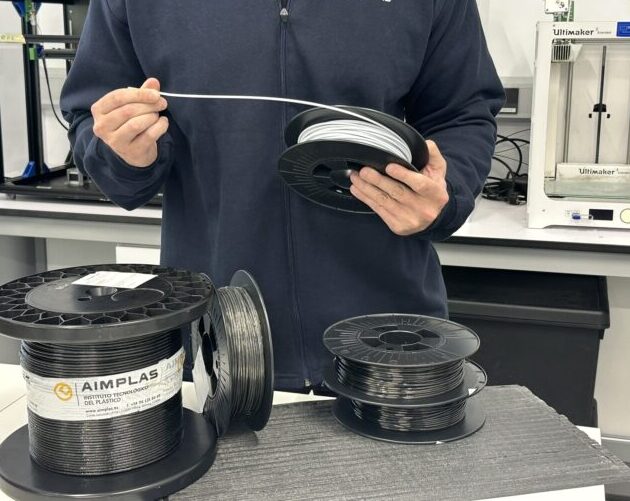
Specifically, Neocompwill develop flame-retardant thermoplastic binders for dry fibre, unidirectional dry fibre tapes for DFP and continuously reinforced 3D filament. These new manufacturing approaches will enable, on one hand, the efficient production of preforms with complex geometries and, on the other, the production of customised composite parts with improved mechanical properties, greater fatigue resistance and excellent fire resistance. This will open new opportunities in sectors such as construction, automotive and aerospace.
The companies Ziur Composites and IT3D are collaborating on this research, which aims to significantly reduce environmental impact and improve fire safety in critical mobility and construction infrastructures.
Both projects are part of the IVACE+i grant program for non-economic R&D projects carried out in collaboration with companies by technology centers in the Valencian Community for the year 2024, funded by the European Union’s ERDF under the 2021–2027 Operational Program.
Cover photo: Neocomp project (source: Aimplas)


You can create a free technological watch and keep you updated about all these subjects.
