









Airline safety center departs Sandia Labs after 30 years
A 30-year program that made flying safer through continued innovations in airplane inspection, maintenance and airworthiness research has ended its tenure at Sandia National Laboratories.
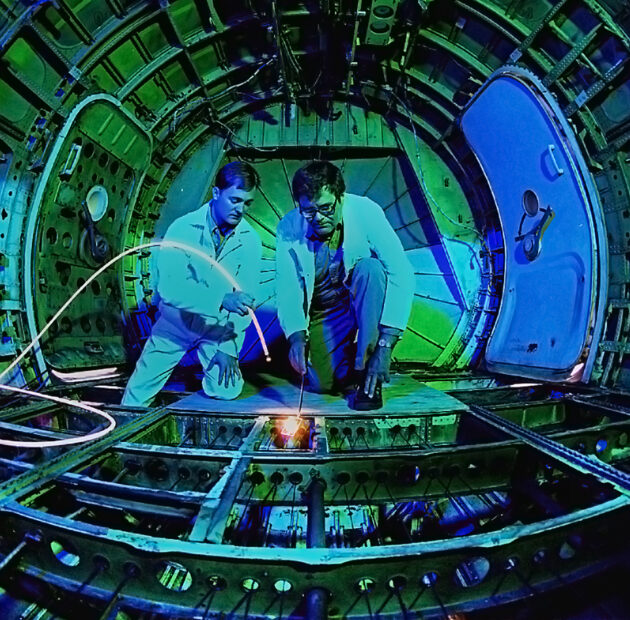
The Federal Aviation Administration Airworthiness Assurance Center, or AANC, operated by Sandia for the FAA, is moving to the National Institute of Aviation Research at Wichita State University to combine with another long-standing FAA center. The planned move supports shifts in structure at both Sandia and the FAA.
At the center, Sandia researchers partnered with staff from aircraft manufacturers, airlines, regulatory agencies, universities and industry to develop inspection and maintenance systems for airplanes. The original focus was on developing nondestructive inspection techniques for aging airplanes and then grew to include airworthiness assurance needs throughout the lifetime of all aircraft systems.
Senior Scientist Dennis Roach, Sandia’s lead engineer at the center said:
“Our goal was to develop the technology, prove the technology and, just as importantly, transfer the technology to industry so it could be used routinely to ensure flight safety. The AANC at Sandia became a trusted source of unbiased technology development and validation for an array of programs.”
The center supported a wide range of airplane safety and reliability and new technology application concerns, including operations, structural repair, advanced materials, corrosion monitoring and control, human factors, engine and fuel systems, landing gear, mechanical and electrical systems, structural modeling and analysis, sensor and instrument development, crashworthiness, aircraft certification, information processing and analysis, accident investigation, regulatory and advisory oversight requirements, failure analysis and systems safety.
The center also collaborated with other industries and all branches of the military on multiple engineering system and reliability needs.
Roach said the center staff adapted to and created many changes in the aviation industry. For example, the sole focus on metallic structures shifted into research in composite structures as the next generation of aircraft used these materials as their primary structure. Similarly, hand-deployed nondestructive inspection methods gave way to automated Structural Health Monitoring as the center led the way to the introduction of on-board sensors and use of smart structures to improve damage detection on aircraft.


