









An innovative bicycle handlebar for Canyon Bicycles made by Engel
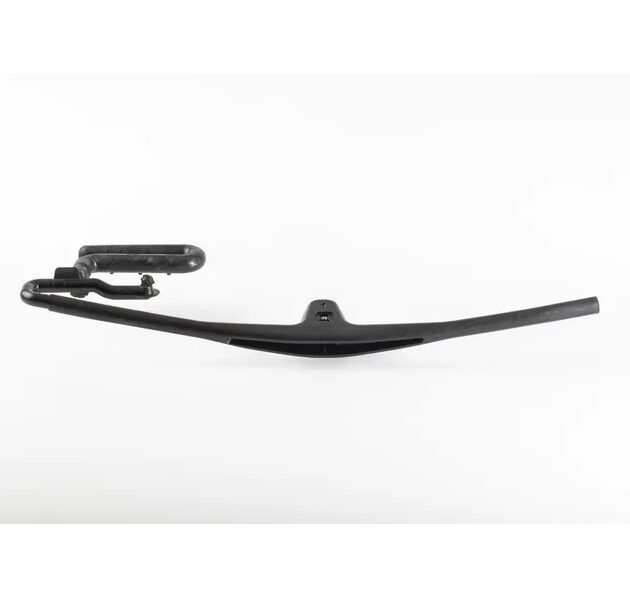
At this year’s JEC World, which took place from 4 to 6 March 2025 in Paris, Engel, a global leader in plastics processing technology, showcased 3 products that had been selected as finalists for the JEC Innovation Awards. The Austrian injection moulding machine manufacturer, headquartered in Schwertberg, demonstrated the capabilities of its innovative injection moulding technologies for lightweight construction. Among the highlights was the live production of an innovative bicycle handlebar for Canyon Bicycles, manufactured using the fluidmelt process with localised fibre reinforcement on a tie-bar-less Engel victory injection moulding machine.
Innovative bicycle handlebar production with a powerful combination of technologies
One of the main attractions at the trade fair is the live production of a newly designed bicycle handlebar, developed in collaboration with Canyon Bicycles. This handlebar is manufactured on a tie-bar-less Engel victory 180 injection moulding machine, combining the fluidmelt and organomelt technologies with continuous fibre-reinforced semi-finished products.
With fluidmelt for technical and design flexibility

The fluidmelt process enables the production of hollow structures by injecting water or nitrogen. During the process, the molten core of the component is displaced into an overflow cavity or back into the plasticising unit, creating a hollow space within the part. At JEC World, the process has been demonstrated using gas injection and overflow cavities. Once the cooling phase is complete, the hollow handlebar can be removed from the mould. Thanks to its geometry, this method allows for the production of extremely lightweight structures that also offer high bending and torsional stiffness. Indeed, fluidmelt is the perfect option when it comes to forming hollow areas, complex pipe structures or avoiding shrinkage contraction. Fluid injection technology helps you produce moulded parts with greater wall thickness or considerable wall thickness differences without unwanted surface disturbances.
Stability in lightweight construction with organomelt
The use of continuous fibre-reinforced semi-finished products further enhances the mechanical properties of the bicycle handlebar. The components themselves are made of glass fibre-reinforced polyamide 6 to ensure the necessary stiffness and strength. By integrating 4 UD carbon fibre tapes, which are placed into the mould during the injection moulding process, the part withstands high loads despite its thin-walled and hollow structure. This innovation represents a significant advancement over traditional aluminium and thermoset handlebars, making production in Europe economically viable while also reducing environmental impact.
Technological advantages of the Engel victory machine series
The Engel victory 180 Wide-Platen machine, showcased in production on the fairground, is an injection moulding machine specifically designed for large and complex components or moulds. Thanks to its tie-bar-less design with a spacious, open mould area, the victory series enables the use of large and intricate moulds within compact machine dimensions. This is a particular advantage for high-volume and demanding applications such as the bicycle handlebar.

With its enlarged platen, the machine offers an additional 100 mm in width compared to standard models. As no higher clamping force is required, manufacturers can avoid investing in a larger machine, thereby saving on floor space and additional energy consumption. This reduces costs and reinforces Engel’s commitment to sustainable production processes.
Project partners and their roles
Canyon Bicycles, known for its innovations and high design standards in bicycle manufacturing, played a key role in the development of the new handlebar. Their expertise in conceptualisation and functional design ensured that the handlebar meets the high demands of professional cyclists.
Artefakt Design was responsible for the aesthetic design of the handlebar. They created a design that is not only functional but also visually appealing, seamlessly integrating into the modern look of Canyon bicycles.
Domo Chemicals supplied the injection moulding compound and the necessary tapes for production – a crucial contribution to achieving the high performance of the handlebar.
Plastic Innovation handled the mechanical component design as well as process and structural simulation. Their expertise in this area was instrumental in realising the innovative design.
Simoldes, as the toolmaker and series producer, contributed its extensive knowledge in mould manufacturing and component production to ensure the high quality and reproducibility of the handlebar manufacturing process.

Cover photo: Bicycle handlebar for Canyon Bicyles by Engel


You can create a free technological watch and keep you updated about all these subjects.
