









Cathay Biotech’s bio-based composite materials help control temperature in aviation containers
The RAP-AT1 aviation temperature-controlled container of Qingdao Honghu Aviation Technology Co., Ltd., a subsidiary of Haier Biomedical, has passed the airworthiness review of the Civil Aviation Administration of China and obtained the Technical Standard Regulations Project Approval (CTSOA), allowing it to officially enter the commercial stage.
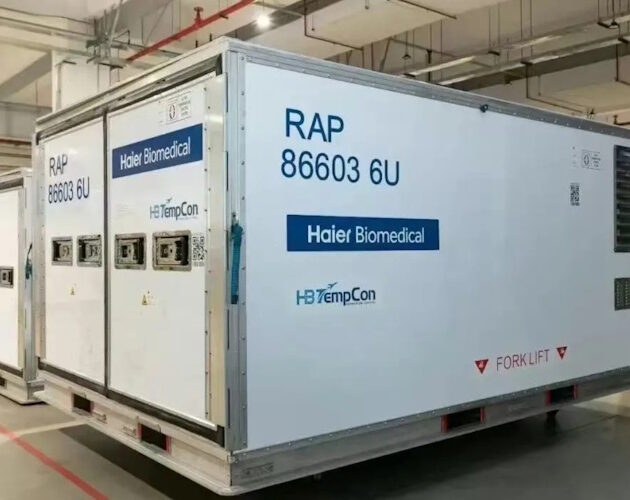
This achievement is not only a major technological breakthrough in the field of aviation cold chain equipment in China, but also an achievement in the implementation of the “14th Five-Year Plan for Aviation Logistics Development” for the research and development of modern professional transportation equipment.
As one of the core suppliers of Qingdao Honghu’s aviation temperature-controlled containers, China’s Cathay Biotech provides it with low-carbon, high-performance continuous fibre reinforced thermoplastic bio-based polyamide composite, helping RAP-AT1 to excel in lightweight, thermal insulation, strength and other aspects. It can effectively reduce the energy consumption and carbon emissions of air transportation under the premise of high efficiency thermal insulation, high strength and wear resistance, reduce energy consumption and carbon emissions of air transportation and provide strong support for the green and sustainable development of the aviation cold chain.
Cathay Biotech’s bio-based composite material is a new type of high-performance bio-based thermoplastic composite material. Its matrix resin can be made of different types of bio-based polyamides such as low-temperature long-chain, medium-temperature and high-temperature bio-based polyamides. Based on excellent melt fluidity, it can be compounded with high proportions of continuous glass fibre/carbon fibre. Its strength/modulus can replace metal, and its density is only 1/4 of steel and 2/3 of aluminium, and its carbon emissions are lower. It has broad application prospects in new energy, construction, transportation, logistics and other fields. It is expected to achieve “plastic instead of steel, plastic instead of aluminium, thermoplastic instead of thermosetting materials” in large structural parts, while providing cost-effective products and bringing green and low-carbon technology solutions to traditional industries.
The application of bio-based composite materials in aviation temperature-controlled containers provides a material foundation for technology upgrades and product innovation. In the future, Cathay Bio will continue to work closely with partners in various fields to provide low-carbon, high-performance green and sustainable solutions.
Cover photo: Cathay bio-based composite materials drive technological innovation in aviation temperature-controlled containers (source: Cathay Biotech Inc.)


You can create a free technological watch and keep you updated about all these subjects.
