









Envalior showcases sustainable materials at “Plastics in E&E Applications” SKZ conference
Envalior, a global leader in engineering materials, will showcase sustainable thermoplastics, along with a new halogen-free flame-retardant PBT at Booth #1 during the “Fuse Box Meets Dryer – Plastics in E&E Applications” conference organised by the South German Plastics Center (SKZ). The conference, which focuses on material innovations for global trends, including electromobility, autonomous driving, 5G mobile communications and more, will be held May 14 – 15, 2025, at the Vogel Convention Center in Würzburg, Germany.
“During the conference we are focusing on Envalior’s broad portfolio of engineering plastics, which consist of sustainable raw materials. This portfolio is designed to help our customers worldwide to reduce the carbon footprint of their products, become less dependent on fossil raw materials, preserve resources and contribute to the development of material cycles. Another key topic is our new generation of halogen-free, flame-retardant PBT compounds Pocan®. In addition to high flame retardancy, we have equipped them with other properties that are advantageous for E&E applications. For example, we are featuring Pocan® BFN4221Z, which is characterised by excellent mechanical properties,” said Alexander Radeck, Manager of E&E in Technical Marketing at Envalior.
Sustainable material solutions without compromising on material properties
Envalior plans to offer its entire portfolio on a bio-based and/or recycled basis by 2030. At the SKZ conference, Envalior is featuring Durethan® ECOBKV30FN04 and BLUEBKV30FN04 to show the opportunities that such products create in terms of sustainability. The 2 halogen-free, flame-retardant polyamide 6 compounds reinforced with 30% glass fibres by weight are a sustainable alternative to the purely fossil-based Durethan® BKV30FN04, which has established itself in the E&E industry, in the manufacture of high-voltage connectors. They contain 30% and 86% sustainable raw materials respectively, including glass fibres in which mineral raw materials have been replaced by industrial glass waste.
The sustainable proportion in the compounds is certified according to the ISCC (International Sustainability and Carbon Certification) mass balance method. The CO2 footprints of both compounds are 7% and 61% lower respectively compared to their fossil-based counterparts.
The use of sustainable raw materials does not mean compromising on the mechanical properties of the compounds. Both compounds have the same chemical, physical and processing properties and the same quality as their fossil equivalents. They comply with the same technical specifications and certifications.
“Our customers can therefore use them directly as a drop-in solution and substitute the fossil-based product counterpart in the ongoing production process. There are no major costs for material replacement, such as the construction or reworking of tools,” explained Radeck.
A material solution that is ideal for overmoulding metal parts
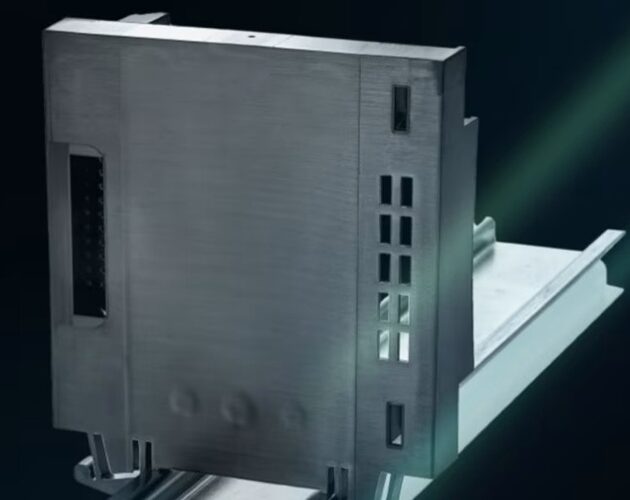
Envalior’s new material, Pocan® BFN4221Z is reinforced with 20% by weight of short glass fibres. Particular advantages of this PBT compound are its high elongation at break of 2.9% (ISO 527-1,-2) and good Charpy impact strength (ISO 179/1eU) of 45 kilojoules per square meter. The elongation at break is even higher than that of comparable PBTs with halogen-containing flame retardants.
Components made from the new material are more resistant to cracking, plus connecting elements such as snap fits are easier to design. Due to its high elongation at break and temperature resistance, the material is also particularly resistant to thermal shock. It is therefore ideal for overmoulding metal components that are exposed to rapid and large temperature changes. Thus, components made of the material have little tendency to form stress cracks in the event of frequent temperature jumps.
The high flame resistance of the PBT compound is evident in the V-0 classification in the UL (Underwriters Laboratories Inc.) 94 test. This classification applies to all colours with test specimen thicknesses of just 0.4 millimetres. Compared to PBT grades with halogen-containing flame retardants, Pocan® BFN4221Z is significantly more resistant to tracking with a stable Comparative Tracking Index (CTI) of 600 (IEC60112).
“In general, the high tracking resistance enables greater freedom in component design. This is because electrical assemblies can be designed with smaller distances between the metal contact pins. This results in greater component compactness without having to worry about short circuits and device defects caused by leakage currents,” explained Radeck.
With its good electrical insulation properties and low water absorption, the compound is particularly suitable for direct current applications, for example in electromobility. Other possible applications include housings for power capacitors, connectors and plug connectors.
Cover photo: Test housing for E&E applications made of Pocan® BFN4221Z – source: Envalior


You can create a free technological watch and keep you updated about all these subjects.
