









Industry partnership enhances aerospace manufacturing training
For more than a decade, Jamco and the Washington Aerospace Training & Research (WATR) Center have been involved in a unique and very fruitful partnership. Over the years, Jamco has provided donations of equipment, parts, and supplies for the Center’s aerospace manufacturing training programs.
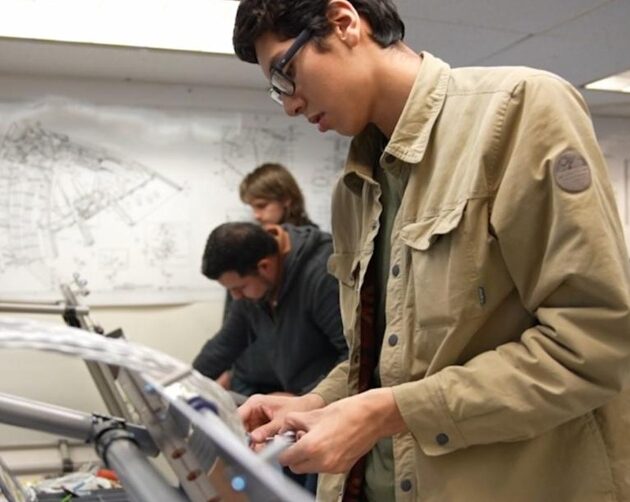
The donations mean that WATR Center students gain access to high-quality, aircraft grade materials so they can learn from real-world scenarios utilizing industry equipment. In return, Jamco has access to a pool of skilled employees trained in critical aerospace manufacturing skills.
WATR Center meets the demands of the fast-paced aerospace industry
The WATR Center, established as part of Edmonds College in 2010, offers five specialized aerospace manufacturing training programs. With a strong track record of success, the Center has trained nearly 5,000 students, preparing them for high-demand, living-wage careers in aerospace-focused roles – and beyond. The Center boasts a remarkable graduate placement rate; 90 percent of graduates tracked were offered industry jobs.
The 12-week hybrid program is 60 percent online, and self-paced, with the final 40 percent consisting of in-person labs at the WATR Center’s state-of-the-art facilities. According to Shelia Dersham, Associate Director for the WATR Center, the lab portion of the program is intensive and immersive, allowing a maximum of 10-12 students per class. Classes run 5 days a week and 8 hours per day, much like a real job site. This level of training gets students up to speed on industry safety and procedures so they become productive employees faster.
Students at the WATR Center begin by completing the pre-requisite 4-week online Manufacturing Core course, after which they can then enroll in the 8-week Specialty Certificate in such areas as electrical assembly mechanic, assembly mechanic, tooling mechanic, manufacturing composites, and quality assurance (QA). QA is a more advanced skill set that requires either industry experience or an earned certificate from one of the other specialties.
Allen Gipson, Jamco’s Vice President of Corporate Planning, has been on the WATR Center’s Advisory Board for more than ten years and provides industry guidance and support for workforce training and development initiatives. He, as well as other board members, were instrumental in the WATR Center’s launch and continue to review existing curriculum to assure they meet industry needs. Jamco and the WATR Center also collaborate at the state level to secure funding for educational initiatives championed by the Aerospace Futures Alliance (AFA).
Gipson applauds the WATR Center’s efforts to train the next generation of aerospace workers, who go on to work at Jamco, Boeing, or other related manufacturers. “There is a real shortage of that type of talent. Employees often either have to be hired off the street and trained internally, hired from somewhere like the WATR Center to come in with skills, or hired away from the competition,” explains Gipson. “We really appreciate the work they do to push more assembly mechanics into the aerospace market and we usually hire a few of their graduates each year.”
Gipson notes that the WATR Center’s certificate program is relatively low-cost and quick, so students do not spend years in training. He also applauds the Center’s high placement rate and collaboration with industry. “We have reached out to several STEM programs to attract talent into our industry. Supporting these efforts supports the entire industry and the WATR Center program is among the finest.”
Positive relationship leads to partnership
Based on the industry focus of the program, Gipson initiated a partnership with the WATR Center a few years after its inception. Jamco then started donating materials and supplies for use by students in the aerospace manufacturing program, which continues today. The original “excess inventory donation project” was in some ways borne out of Jamco’s sustainability goals and metrics, fostered in part by its Japanese roots, and fitting within its overall good citizenship goals.
The partnership lets students get hands-on experience utilizing real materials they will be working with during their careers. This results in far more value than working only with what a professor or a teacher may have in the shop.
Shelia Dersham explains that the partnership is about people and relationships. “Allen has been on our board for a long time and what we receive from Jamco enhances our programs because these items are very expensive.” She adds, “As a self-supporting program, donations reduce our costs, and receiving actual parts helps our team train students in real-world scenarios utilizing industry-grade materials. It also allows our graduates to become familiar with local aerospace suppliers so they have employment options to meet their individual needs.”
To date, Jamco has donated thousands of excess items that have accumulated from prior aircraft programs, including many that would have been destined for recycling. Some items were identified by Jamco as having a potential training use, while others are items the WATR Center had difficulty sourcing, including aircraft wire and windows.
The first round of items donated included bolted upper fitting assemblies that the WATR Center accepted with the intention of using them along with the engineering drawings to have students practice quality assurance inspections.

The goal was to mimic a real workplace task, in which students are given a drawing and parts then asked to ensure they were built correctly. Instructors explain that parts are often packaged this way and ask students to determine how they might identify scratched parts and how many they would pull out to inspect. (In the real world, as many as 10 percent may be damaged and would be sent back to the vendor.)

Also included are scrap or remnant wire for use in the electrical assembly class, as well as electrical components like pins or connectors that are left over from making wire harnesses. The WATR Center found it difficult to find aircraft-grade wiring for use in training on soldering and working with crimps and connectors. Jamco now asks its wire shop to place the 6-inch cut-offs into a box to save for the Center’s use. WATR Center students may need only a few inches to practice with and the material would otherwise have been discarded. The wire program provides access to a full range of relatively expensive wire types because Jamco makes such a wide variety of wire harnesses.
Another donation received by the WATR Center is plastic molded vanity mirror modules that came from one of Jamco’s first seat programs. Jamco had purchased plenty of extras to have on hand if needed during installation and to sell as spares. Since the seats are no longer in service, the inventory remaining will not be sold, so the WATR Center is using them in the relaunched QA training course.
One recent donation was windows that could be installed in the tail section of a 767 fuselage donated by Boeing to the WATR Center. The “Gray Ghost,” aptly renamed “Innovation Lab” was delivered in spring 2023. The final, self-funded retrofit was completed in July 2024 and included fully encasing the forward opening of the fuselage with a custom, glass door and enclosure, installation of electrical and compressed air systems for pneumatic and power equipment, as well as HVAC and fire safety systems.


The fuselage was missing windows, which was not ideal, given the WATR Center’s location in the rainy Northwest. Jamco donated windows from a prior aircraft modification program that were a perfect match, so the fuselage could be sealed up, protecting it from the weather, and appearing more like an aircraft interior as the students work on it.
Most recently Jamco was clearing out some of its old seat structures that had been used for dynamic testing. They donated them to demonstrate how the seat is attached to the seat tracks. They also donated one full-height closet unit.

Newly received tray table seat assemblies, lighted mirror assemblies, and window panels will likely be integrated into special projects for the new Boeing 767 fuselage tanker lab. According to Dersham, “We are excited to assess the use of items Jamco delivered to us for a potential Aircraft Interiors Assembly program we are investigating as a sixth specialty. We would like more opportunities to do higher level and extensive training for interiors and this will be exciting to introduce to our students.”

Last, but not least, Jamco has donated chemicals and compounds to the WATR Center and other training facilities that could not be used in their manufacturing program before expiration. The WATR Center believes Jamco’s donations of aircraft adhesives, potting compounds, and sealants will greatly enhance their composite curriculum, including use in composite sandwiches, and edging, potting, and sealing of composite parts. This enables them to provide hands-on experience in new areas of interest.
Gipson explains that Jamco is extremely pleased to be able to donate the chemicals to an institution that can use them. He concludes, “We have gotten a lot of value from the partnership, which extends beyond the WATR Center to work to promote aerospace in the entire region.”
Adds Dersham, “We are grateful to Jamco for being a true legacy partner. They continue to be very supportive of our technical job training programs because our success allows us to be a workforce pipeline for them and other industry partners.”
Cover photo: Students working on electrical harnesses at the WATR Center


