









Madras Line – Wing Project : Inauguration of a high volume deposition & preforming line
The inauguration of this 18m long production line is a milestone in Wing project. Starting in 2017, this partnership lead by IRT Jules Verne in collaboration with Airbus, Fives Machining and Loiretech aims to evaluate the ability of textile technologies to meet production rates of 5-6 times higher for the aeronautics industry for large scale parts and complex geometry.
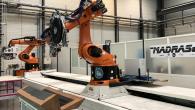
 The objective of this project is to evaluate the ability of textile technologies to meet high production rates of the aeronautics industry for large scale parts and complex geometry. Research activities include : preform architecture, tooling concepts and automated textile layup line.
Composites for aeronautical applications have been developed for several decades and their implementation has been largely mastered. Wide-body aircraft and performance-oriented programs have led to an increase in the use of composites in aerostructures.
Thus, the designs, processes and means of implementation developed correspond to this field of application. In fact, the state of the art in the manufacture of composite structures cannot be transposed in this as-is state to production rates of 5 or 6 times higher.
Discover the video which explains the Madras Line innovation regarding the WING Project:
Innovatives features
- Innovative textile architectures. Feasibility to be proven with a range of scale 1 trials.
- Design and installation of an automated textile line.
- Design of innovative tooling and definition of injection principles in order to reduce injection time and investments.
 Stephanie Houel, Vice President, Regional Councilor in charge of Innovation, Research and Higher Education, Pays de le Loire

18 meters long, three robotic islands
Industrial application
Check technical and economic viability of high performance aeronautics structure within a high cycle time and low cost. Results of the study will be transferred to wind or automotive industries.
Technical and economic impacts High deposition rate with regard to thermo-set technology material waste reduced to a minimum Investments reduction

Production rates of 5-6 times higher for the aeronautics industry for large scale parts and complex geometry


You can create a free technological watch and keep you updated about all these subjects.
