









Nanoprom launches the ‘300 km/h’ super-pencil
The company owned by Gian Luca Falleti from Sassuolo has for the first time developed a system for the complete recovery and recycling of carbon brakes from Formula 1 and Moto GP.
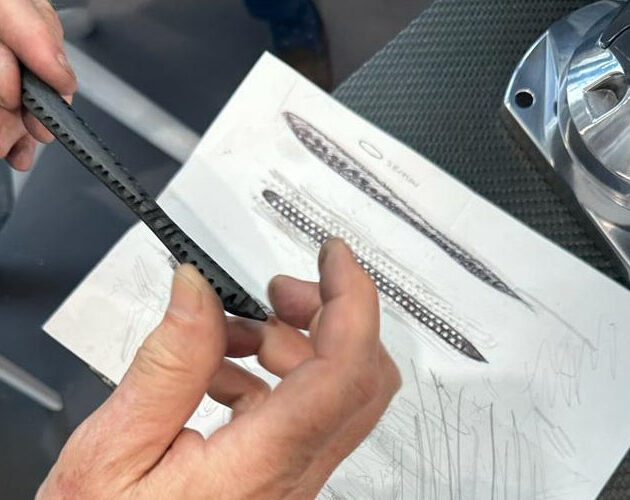
Having a pencil made entirely from elements that have experienced thrills at over 300 kilometres per hour? From today this is possible. Nanoprom Chemicals srl, a Benefit-certified company specialised in the development of nanomaterials for various sectors, from the nautical to the aeronautical, automotive and Formula 1, has presented a world preview at the JEC Forum Italy 2023 (Bologna, 6 – 7 June) of the first pencil made from the carbon-carbon brake discs of Formula 1 single-seaters and MotoGP two-wheelers.
The project is illustrated by the founder and chairman of Nanoprom Chemicals, Gian Luca Falleti, who explains: ‘This is a project that kicks off a true sustainable and circular revolution, as it allows the complete reuse of materials that until now, since they did not find purposes for other applications, were inevitably destined for disposal as special waste, to be reprocessed, moreover, with costly processes. Carbon-carbon brakes are in fact used on racing cars that go up to 340 km/h and, when in action, they reach temperatures approaching 1,200°C, becoming incandescent. Such extreme performance alters their properties, making it impossible to be used for more than one competitive session. So, at the end of each race, they cease to serve their purpose and each team sends them for disposal.

Today – continues Falleti – thanks to a project I carried out together with Michael Robinson, a car designer famous for his futuristic vision, with these exhausted brakes we are able to offer items to be collected.
Michael Robinson himself adds: “The carbon-carbon brake disc, after the race, has the ability to write by leaving a stroke on a sheet of paper like a normal graphite pencil. You can therefore put in your pocket the combination of a very high-tech material, very high design and very high environmental sustainability, i.e. a pencil that in its previous life went up to 340 km/h and 1200°C. Not only a contribution to the circular economy, but a second life to an object that would otherwise have become a special waste to be disposed of’.
Each brake disc allows a well-defined number of pencils to be machined, depending on its design. Subsequently, each piece is coated with Polysil®, a nanotechnological ‘cold vitrification’ coating patented by Nanoprom, which follows the structure of the material without changing its morphology, guaranteeing practicality, safety and durability in use. The extremely thin layer of glass (a few microns), in fact, chemically and electrically insulates the structure while maintaining the tactile feeling and transferring to the pencil’s owner the same sensations felt by a racing technician.
Always sensitive and active to issues of sustainability and circular economy, Nanoprom Chemicals, which is also part of “Emilia Romagna High Technology Network” as research centre, once again demonstrates the infinite applications of cold vitrification as an enabling technology for the green transition.
The ambitious project, called P3E40 (or 340 km/h Pencil), does not end here. This is confirmed by Falleti, who concludes: ‘Our bet is to 100% recycle the carbon-carbon brake disc. Thus, any waste resulting from machining is recovered and used for other ‘circular’ purposes: the shavings are used to make writing mines and the dust produced during machining is used as an additive for cold vitrification. Very soon, unfortunately only for a few, our pencil will be offered on the market as a collector’s sculpture, derived directly from Formula 1 and signed by Michael Robinson’. A further virtuous note of the P3E40 project is that the entire process for recycling carbon-carbon brake discs will be carried out in Modena, at the reborn company Caleffi srl, specialised in contract machining.
In the photos: Californian car designer Michael Robinson during some phases of the realisation of the ‘300 km per hour’ super pencil and Gian Luca Falleti, founder and owner of Nanoprom Chemicals


You can create a free technological watch and keep you updated about all these subjects.
