









Sustainable manufacturing in automotive and aerospace with rFC materials
In recent decades, the use of a very expensive material such as carbon fibre in aerospace and automotive has grown exponentially. At the same time, the amount of both end-of-life composite products and production waste has grown, with up to 20 percent of the material used in the first stage of processing alone. Finding new ways to reuse them is a profitable management strategy to improve the life cycle and both environmental and economic sustainability of these materials.
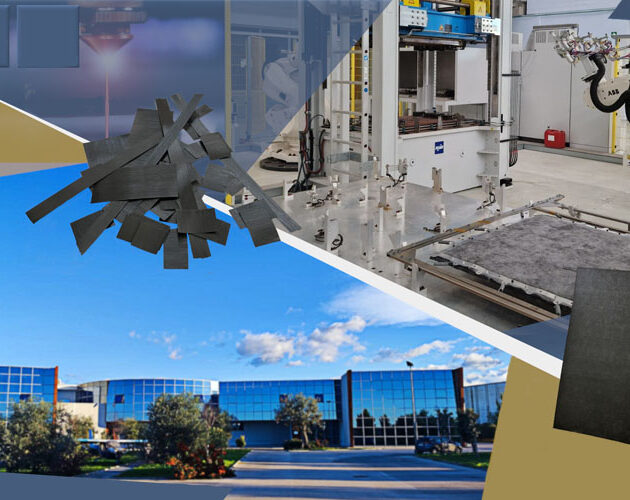
In order to create value from the disposal issue, Aerosoft decided to invest in the MARiS (Advanced Composite Materials Obtained from Recycling of Scrap Materials) project as the lead partner, calling to its side such outstanding entities as ENEA, CNR (Institute for Polymers, Composites and Biomaterials), University of Salerno (Department of Physics) and ATM srl.
The aim of MARiS is to develop new high-performance, low-cost composite materials from carbon fibre processing waste. The project was funded by the Italian Department of Enterprise and Made in Italy.
There are four phases of the project:
- Classification of recycling processes according to the variety of carbon fibre reinforced composites materials discarded by different manufacturing or processing technologies of CFRP composites;
- Study of the consolidation processes of recycled fibres (rFC) in order to obtain Pre-consolidated Laminates (rFC);
- Defining the fields of application of rFC materials in the Aerospace and Automotive sectors through realization of demonstrator prototypes: automotive car bottom and aeronautical interior panel;
- Functionalization of recycled fibres (rFC) in order to give them properties other than structural properties.
The ultimate goal will be the production of consolidated composite sheets from recycled carbon fibres.

“Being able to engage such important and qualified partners on the MARiS project is an important step for us at Aerosoft, which confirms our attractiveness for collaborative activities in strategic research areas,” comments Nicola Carannante, technical director of Aerosoft spa “The MARiS project, in fact, combines in itself several objectives positioned on the European directions of industrial development: aiming toward circular economy and industry, in order to meet the requirements of environmental sustainability with a strong reduction of waste related to the productions of carbon fibre reinforced plastics, the so-called CFRPs. In this scenario, Aerosoft wants to lay the foundations for the establishment of a supply chain that aims at the recovery of carbon fibres and subsequent reuse through a process of fibre consolidation into pre-consolidated sheets ready for uses and applications in both aerospace and automotive fields.”
Aerosoft is scheduled to produce recycled composite sheets obtained from the reuse of carbon fibre at its Capua plant, where a termo-pressoforming line is already in operation and a new line equipped with a laminating press for making consolidated composite panels obtained from the recovery of recycled carbon fibre will come on line in July.


You can create a free technological watch and keep you updated about all these subjects.
