









Turkish Aerospace continues to shift gear on new technology usage for aerostructures
Almost every year, Turkish Aerospace continues to introduce technologies on their components. At the last days of 2018, Turkish Aerospace implement two new Projects into Airbus A350XWB Ailerons.
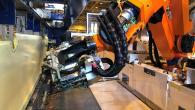
Those new technologies increased quality to top level by avoiding human errors.
A350XWB -900 Ailerons Automatic Fiber Placement (AFP) Project: The AFP is not a brand new technology for Turkish Aerospace. The Automatic Fiber Placement is being used on several products at Turkish Aerospace.
However, this project brings a new upper boundary, since it was the first time use at Turkish Aerospace on a flight control surface of a commercial aircraft with considerably higher rates.
The design of the outer skins of Ailerons were modified optimally in order to enable to manufacture them by AFP. This modification has given the advantage to avoid any potential quality problems encountered by hand lay-up which is highly dependent on human factors. The Fiber Placement Machines (2 ea) were invested in 2018.
After several trials and first part qualification process, Turkish Aerospace has started using this process on serial production from November 2018 and on.
A350XWB -900 Ailerons Mobile Robotic Drilling Project
As AFP, use of robots for drilling operations was not new for Turkish Aerospace. The former applications can be called as “Part-to-Robot” which has been used for A350XWB -1000 Ailerons successfully over the years. This “Part-to-Robot” concept requires a heavy and rather complex tooling, creates potential synchronization problems and suitable for lower rates in manufacturing.
Therefore, Turkish Aerospace engineers brought an innovative solution which may be called as “Robot-to-Part” concept. By this concept, the Ailerons remain on the assembly tooling and the robot moves in the aisles of assembly line.
Turkish Aerospace again started to apply another new hi-technology on her products without changing the manufacturing tools and overcomes any potential quality problems by eliminating hand drilling.


You can create a free technological watch and keep you updated about all these subjects.
