









Embracing random variability for more robust designs
Stochastic (probabilistic) approaches and topology optimisation open up new opportunities to optimise composite product designs that are more robust, while still lightweight, and can accommodate more variation in material properties.
In engineering design, the traditional “deterministic” modelling approach assumes fixed values for loads, material properties, geometry, etc. But in real life, every part is slightly different, no two load cases or failure modes are exactly the same. A “stochastic” approach incorporates uncertainty (randomness) in one or more of the inputs, which are represented as probabilistic distributions rather than single values. For example, loads may be applied a few degrees off-line, material properties may vary, and manufacturing imperfections can be considered at random points.
A stochastic design approach can result in a much more robust solution with reduced sensitivities, e.g. fewer stress hotspots with lower stress amplitudes. Applying Topology Optimisation (TO), which optimises the material layout and overall geometry of a part, can make parts substantially lighter while reducing reliance on a single load case and the subsequent risk of failure.
For composites, where fibre discontinuities or resin voids may occur and failure modes are often complex, this can offer significant advantages. Using stochastic variability alongside TO can give a robust yet still lightweight component, removing the need for blanket safety factors or reduction in the design material properties.
Topology optimisation
TO tools can consider a range of load cases within a defined volumetric boundary – the available space for the part – and deliver a shape optimised for the required load cases. This is excellent for additive manufacturing, where the final 3D geometry is relatively unconstrained by the manufacturing process, and often produces organic-looking shapes. For composites, these shapes may need to be modified to make the manufacturing process feasible.
Rafinex’s pan-European team has developed Möbius, a TO tool with stochastic capability, combining extremely efficient optimisation algorithms with AI assistance when needed. Möbius is delivered through an intuitive, browser-based user interface with efficient computation on state-of-the-art server processors.

The picture above shows a generative design approach carried out by British design and manufacturing company Far-UK using Rafinex’s Möbius tool for a chassis for a powered light vehicle (PLV). This did not use a stochastic approach but considered 15 different load cases, and Möbius delivered a topology-optimised solution combining these load cases.
Shifting the uncertainty from use to design phase
A finite set of deterministic load cases in TO can lead to a risk of over-optimisation – the part may perform very well in simulation but fail in service where the load cases are slightly different and material properties throughout the manufactured part are not entirely consistent. A classical response to this is to apply large safety factors to cover unknown variability, which increases weight and cost.
The alternative is to include stochastic distributions for the loads, to create a more robust solution to start with, effectively shifting the uncertainty from the use phase back to the design phase and allowing a design that is closer to the performance limit.
In TOs of assemblies, applying stochastic variability ensures that the robustness is only added where needed, as mechanisms (e.g. suspension systems) within the assembly will effectively filter out uncertainty by not transmitting variability deviations in particular directions. It is like applying a highly tailored safety factor only where needed, thus reducing weight in a safe manner.
Rafinex’s Möbius application goes beyond current market tools by accounting for real-life variability using Uncertainty Quantification (UQ) methods, which assess how input uncertainty affects outputs, and by considering manufacturability. The graph below shows a simple case where a product is designed with a deterministic load case, and then topologically optimised versions are produced with a range of different stochastic cases, in each case allowing the load angle to vary by a different amount, but keeping to a fixed volume. These designs are then modelled using Finite Element Analysis (FEA) with second order elements, with a deterministic load at varying angles.

While the stiffness is higher in the deterministic design for the 0° load case, it soon drops below the more robust stochastically optimised designs as the angle changes. Rafinex states that for any load that deviates more than three degrees from the nominal deterministic load, the stochastic shapes perform better than the deterministic one in terms of stiffness and strain energy.
Refining fibre alignment
The picture below considers an isotropic material, but Rafinex’s Möbius can analyse structural isotropic and anisotropic material types. The first picture shows two options for a quadcopter cantilever arm). On the left the arm is optimised using isotropic material assumptions, while on the right the topology and the local principal axis directions, representing the fibre orientations, are optimised at the same time. It can clearly be seen that the anisotropic variant shows a more streamlined design, actively exploiting the directionality of the composite material system.

The second picture shows the anisotropic variant from an angled view with the fibre directions coloured.

Designing with variable material properties
Designers are often deterred from using recycled or bio-based materials because they have more variable properties than synthetic virgin materials. Far-UK has used stochastic techniques to design with material variability and so valorise recycled materials. In FibreLoop, scrap carbon fibre process waste was recovered with Vartega’s chemical recovery process and compounded into pellets for further processing. The PRISM project (Plastic Recycling in Stochastic Modelling) aimed to use mixed plastic scrap that would otherwise go to landfill or incineration.
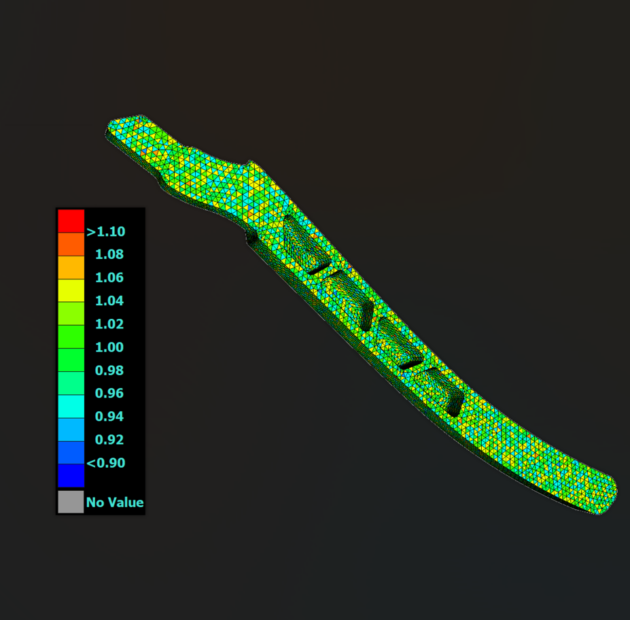
Using Ansys LS-DYNA FEA software, Far-UK engineers defined stochastic variation for yield stress and failure strain characteristics for every element in the model. Random scale factors were assigned according to probability distributions. The resulting model could be run multiple times in parallel, showing a different failure location and strain at failure in each case.

The picture above shows an example from FibreLoop for the recycled carbon fibre (rCF)-thermoplastic test coupons. The same input file for tensile testing is simulated eight times from a single LS-DYNA model, but the material properties are allowed to vary at the element level, i.e. some elements are weaker or stronger depending on a probability distribution. Each output is different, produces a different force-displacement graph and fails differently. Physical coupons showed a similar response in tensile testing. Figure 6 shows a full scale part indicating the stochastic scale factors for material properties of elements across the part.

Further challenges, future solutions
In additive processes or casting, manufacturing constraints can often be formulated as a smoothly varying metric. In composites, however, discrete rules, such as permissible fibre layer directions, create abrupt constraints that are harder to express mathematically. This makes integrating realistic manufacturability constraints into TO for advanced composites mathematically very challenging, especially where ply layups are not consistent, and it is still an area of research. However, use of this tool can provide a much faster route to a lightweight and material-efficient geometry, even if some modifications are then needed to enable full manufacturability.
Integrating recycled content is increasingly important as the industry moves towards circularity. The geometry of the product can be thought of as an input-output system transfer function converting load signals into stress fields. So robust designs are smoother and more forgiving to fluctuations in input signals (loads) and imperfections, allowing for a wider variability in material properties and enabling use of more recycled content without compromising reliability.
A different source of uncertainty is where requirements are initially unclear, and are updated late in the design process. With a deterministic design, strong assumptions need to be made where the data is missing, which may lead to a substantial and costly change once requirements are clarified later. With the stochastic TO the uncertain boundary conditions can be included as a distribution from the start, and while the performance may be slightly lower, the design is more robust and accommodating. The risk of substantial rework is much less and the project is more likely to stay on time and on budget. As André Wilmes, CEO of Rafinex, says, “The argument becomes: do you want to optimise under idealised conditions and have a theoretically perfect design, or are you willing to forego a little performance for a lot of pragmatic real life safety, reliability and business pragmatism?”
As demand grows for lightweight, safety critical structures, stochastic and TO methods have an important role to play. By embracing variability rather than ignoring it, engineers can design composite parts that are lighter, stronger, and more tolerant of uncertainty in use – bridging the gap between theoretical optimisation and real-world reliability.
Cover photo: Far-UK Ltd
Stella Job
Editorial Contributor

