









r-LightBioCom:“It’s not just about end-of-life, it’s about making sustainability intrinsic to material and product design”
Funded by the European Union, r-LightBioCom is working towards a paradigm shift where circularity is engineered from the very beginning, and becomes the principle that guides the solution. It brings together research institutes and industrial players to rethink the design, manufacturing, and end-of-life of advanced composites. From fast-curing bio-resins to clean fibre recovery technologies and digital sustainability tools, the project aims to turn circularity into a reality in demanding sectors such as aerospace, automotive, and infrastructure.
The journey towards circular high-performance composites begins with one core question: why redesign an already mature class of materials? To set the scene, we asked the consortium to describe the motivations behind r-LightBioCom and the foundations of its multi-disciplinary approach.
JEC Composites Magazine spoke with Dr. Nataliia Hudzenko, Postdoctoral Researcher at Leibniz-Institut für Verbundwerkstoffe (IVW, Germany), Inga Grigaliūnaitė, Project Leader at FeyeCon D&I BV (The Netherlands), and Dorothea Weber from the German Aerospace Center (DLR, Germany), representing the r-LightBioCom consortium.

JEC Composites Magazine: What triggered the creation of r-LightBioCom, and how would you describe its main development pillars?
r-LightBioCom was initiated in response to a growing imperative: to reconcile the exceptional performance of advanced composites with the pressing demands of environmental sustainability. Traditionally, high-performance composites have posed challenges in terms of recyclability, resource intensity, and environmental footprint, especially in sectors such as aerospace, automotive, and infrastructure. Funded under the EU’s Horizon programme, r-LightBioCom unites 15 partners (see below) across research, industry, and digital technology to address these challenges holistically.
The project focuses on four core development areas:
- Bio-based and high-performance raw materials, including bio-resins, bio-additives, and sustainable fibres;
- Process innovation, targeting fast-curing and low-energy manufacturing;
- Recyclability through clean fibre recovery and circular design principles;
- Digital sustainability tools, including LCA and advanced optimisation frameworks that embed circularity from the start.

| Partner | Role in the project |
| Aitex Research and Innovation Centre (ES) | Coordinates the project; leads textile valorisation, mechanical pre-treatment, chemical recycling of technical textiles; LCA performance evaluation; overall technical and administrative coordination. |
| Universitat Politècnica de Catalunya UPC (ES) | Provides expertise in nano-formulation of bio-based enzymatically-upgraded lignocellulosic biomass for structural and functional additives in lightweight composites. |
| Hochschule Kaiserslautern – University for Applied Sciences HSKL (DE) | Leads development and processing of sustainable bio-based resins and CANs; contributes to hybrid non-woven structures based on bast and basalt fibres. |
| Leibniz-Institut für Verbundwerkstoffe IVW (DE) | Develops curing procedures for new bio-high-performance polymers/resins; supports dispersion and scale-up of formulations; researches composite recycling methods and reuse of recyclates. |
| AEP Polymers (IT) | Develops new bio-based polymers and formulations for composites, focusing on frontal photo-polymerisation and pultrusion processes. |
| CIDAUT Foundation (ES) | Designs and optimises new composite manufacturing processes based on developed materials; leads Life Cycle Analysis activities. |
| FeyeCon D&I BV (NL) | Focuses on fibre and polymer matrix recycling technology development using supercritical CO₂ (Sc-CO₂) and related methods. |
| FECSA – Fábrica Española de Confecciones SA (ES) | Provides expertise and materials supply for aramid composite recycling; contributes to development of recycling technologies for use cases. |
| Coventry University (UK) | Develops, verifies and applies the Coupled Ecological Optimisation (CEO) framework to support sustainable HPC design, modelling and optimisation. |
| German Aerospace Centre DLR (DE) | Characterises composite properties at lab scale; develops automated material calibration processes; leads dissemination, exploitation and communication of project results. |
| Gen2Carbon (UK) | Develops sustainable prepregs and UD tapes; supplies recycled carbon fibre (r-CF) nonwovens for composite applications. |
| ACCIONA Construction (ES) | Leads validation of HPC in infrastructure use cases; provides expertise in resin formulation, composite laminating and pultrusion for civil infrastructure. |
| Centro Ricerche FIAT CRF (IT) | Contributes materials and process expertise from automotive R&D; supports composite materials and sustainability studies. |
| Aciturri (ES) | Applies aerostructure design and manufacturing expertise; defines aeronautical use case requirements and develops solutions using project materials. |
| Coventry University Services Limited (UK) | Project support, dissemination, business development & industry liaison. |
Why is it important today to rethink high-performance composites as part of a circular value chain, and what does this imply from a design and manufacturing perspective?
Composites are integral to lightweighting and performance in demanding applications, yet they are among the least circular material systems due to complex chemistries and multi-material interfaces. As environmental regulations tighten and sustainability expectations rise, the linear “make-use-dispose” model becomes increasingly untenable.
Designing for circularity implies a fundamental shift: materials, structures, and processes must be conceived not just for performance, but for reuse, repair, and recovery. This requires rethinking chemistries for recyclability, designing for disassembly, integrating lifecycle analysis early in the development phase, and establishing recycling-friendly manufacturing routes. It’s not just about end-of-life, it’s about making sustainability intrinsic to material and product design.
Because circularity must be engineered from the outset, one major challenge is to create a framework capable of guiding coherent decisions across materials, processes and end-of-life routes. How does r-LightBioCom translate this idea into a practical sustainable-by-design framework?
In practice, “sustainable-by-design” means embedding environmental intelligence into the design process in the early-design stages. This approach is achieved by coupling material product modelling, mechanical simulation, and lifecycle impact assessment into a unified decision-making framework.
The r-LightBioCom team is developing a digital ecosystem that integrates data on materials, processing, and end-of-life strategies into tools such as the Coupled Ecological Optimisation (CEO) framework. This framework enables designers and engineers to optimise not only for mechanical performance or cost but also for recyclability, carbon footprint, and resource efficiency simultaneously.
Turning this vision into reality requires strong interdisciplinary collaboration, bringing together polymer chemists, mechanical engineers, digital developers, and end-users through a continuous, iterative innovation process.
When it comes to materials, what development are being explored in bio-based resins, nano-additives, and sustainable fibres?
The basis of all r-LightBioCom results is the development of innovative raw materials that reduce weight and cost, while introducing recyclability and sustainability into the resulting High-Performance Composites (HPCs). A key goal is to significantly increase the bio-based content of thermosetting resin systems to over 50%, without compromising their mechanical, thermal, or processing performance compared to conventional fossil-based resins. One breakthrough involves the creation of vitrimer-based Covalent Adaptable Networks (CANs), which enable reprocessing, repair, and improved recyclability of thermoset bio-composites, supporting the project’s sustainability objectives.
To ensure seamless integration into existing production environments, the new bio-based resins are designed as drop-in solutions that are compatible with conventional resin systems. Overall, the resin development aims to deliver technically robust, bio-based matrix systems that meet the stringent requirements of HPC applications without compromising sustainability targets or industrial scalability.
Additionally, the development includes nano-structured additives derived from functionalised lignocellulosic biomass, such as lignin nanoparticles with enhanced thermal and mechanical stability, UV resistance, and protection against fungal and bio-corrosion. Advanced functionalisation and nano-formulation technologies enable the efficient production of these highly reactive nanomaterials, which improve composite performance while replacing mineral and synthetic additives with high environmental impact.
Finally, the project also explores more sustainable fibre options by selecting and characterising natural and recycled materials. Recent developments include the creation of hybrid non-wovens combining flax, hemp, and basalt fibres within a polypropylene matrix. These materials have demonstrated significant improvements in bending strength and impact resistance, outperforming composites made solely from natural fibres. Furthermore, early recycling trials have successfully recovered both natural and basalt fibres with minimal loss of quality.
Redesigning manufacturing routes is another major part of the project. What innovations are being developed in intermediate products and fast-curing technologies?
Reducing energy consumption during production is essential for both environmental and economic reasons. r-LightBioCom addresses this challenge by redesigning production processes with a focus on innovative intermediate materials. A central element of this approach is the integration of more sustainable fibres – including both natural and recycled types. This is requiring significant adaptations in textile processing to produce high-quality intermediates such as yarns, rovings, honeycombs, nonwovens, and woven fabrics, all specifically developed for composite applications.
In addition, fast-curing technologies play a central role. By reducing curing times from hours to minutes, these technologies not only cut down energy consumption but also allow for more efficient tooling use and shorter production cycles. Two novel process developments are being pursued in r-LightBioCom:
- A Resin Transfer Moulding (RTM) system based on frontal UV curing of bio-based resins, enabling rapid polymerisation with precise control;
- A hybrid vacuum infusion process supported by microwave-assisted curing, offering a thermal pathway that heats the resin volumetrically from within.
Both approaches are being developed with the aim of ensuring compatibility with bio-resins and natural fibres, while maintaining the required mechanical performance.
Advanced tools such as the CEO framework are being developed to guide material and component design. What is the added value of this type of digital method for the industry?
The CEO framework brings sustainability and performance together into a single, data-driven decision-making environment. By integrating environmental impact analysis and finite element simulations of multiple combinations of sustainable materials into AI-driven methods, the tool enables multi-objective optimisation of the final product. It facilitates the identification of solutions that balance technical requirements, cost-effectiveness, and ecological responsibility.
For industry, this digital method adds significant value in supporting better-informed design decisions, faster development cycles, and compliance with emerging sustainability standards. Furthermore, it enhances traceability and transparency throughout the product life cycle, which is vital in sectors facing growing demands for green regulation and public scrutiny.
When it comes to end-of-life, which recycling routes are being explored within r-LightBioCom, and how do they differ from current industrial practices. Looking at end-of-life, what are the most promising recycling routes explored in the project, and how do they differ from current practices?
Current industrial recycling approaches for thermoset composites are often limited to mechanical grinding or energy recovery, which result in significant loss of material properties or value. r-LightBioCom is investigating routs that both fibres and resins can be recovered and successfully re-used. The project is covering technologies such as solvolysis and novel techniques such as Microwave (MW) and supercritical CO₂ Assisted recycling that preserve fibre integrity for reuse in high-performance applications.
Dr Nataliia Hudzenko: Microwave-assisted recycling was investigated as one of the approaches for treating different composite systems. The studies were carried out on several types of composites, including bio-based epoxy composites reinforced with natural fibres, with basalt and carbon fibres, as well as thermoplastic composites such as polyamide reinforced with carbon fibres. The use of a microwave reactor enables rapid and homogeneous heating of the composite material, which accelerates matrix degradation or dissolution compared to conventional thermal processes.


N.H.: Microscopic analysis (SEM) of the materials before and after recycling confirmed effective matrix removal while preserving fibre morphology and surface integrity. The recovered fibres remained continuous and free from significant damage, indicating their suitability for further reuse, for example in the manufacturing of new laminates or composite components.
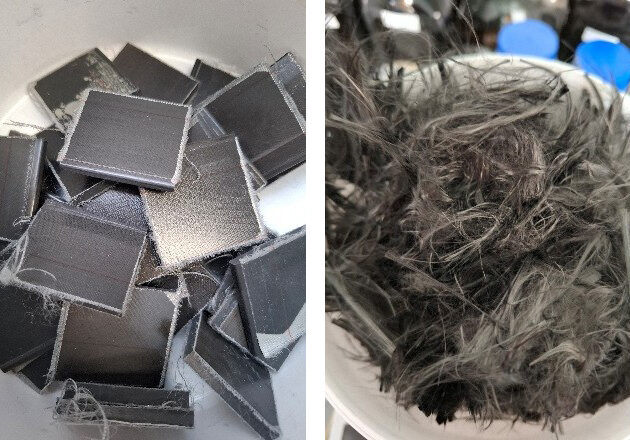
Inga Grigaliūnaitė: The investigation of Sc-CO₂ assisted recycling resulted into successful aramid, carbon and natural fibres recovery from thermoset and thermoplastic composites. Figure below shows carbon fibres recovered from carbon fibre- polyurethane laminates used in wind industry and natural and basal non-woven fabric recovered from polypropylene matrix and polypropylene (the composite developed within the project).


The project brings together partners from different fields. could you give us an overview of who is involved and what complementary expertise they bring?
r-LightBioCom is a multidisciplinary collaboration spanning chemistry, materials science, mechanical engineering, data science, and industrial manufacturing. Research institutions contribute deep expertise in resin chemistry, fibre development, and modelling. Industry partners bring application knowledge from sectors such as aerospace, automotive, and infrastructure, ensuring that developments are grounded in real-world needs.
Digital partners are responsible for developing the modelling and optimisation tools, while recyclers and sustainability experts contribute to the end-of-life strategies. This cross-sectoral structure is critical for delivering a truly integrated and practical circular composite solution.
Can you tell us more about the recycling of ballistic helmets, from the choice of material to the dismantling and recycling stages?
A recent development focuses on recycling ballistic helmets made from aramid/phenolic composites for several reasons. Firstly, aramid fibres are high-value materials, and it is wasteful to send them to landfill once the helmets no longer meet operational specifications (usually shelf life for the ballistic protection equipment is 10 years). Secondly, there have been limited options for recycling thermoset composites in a way that preserves fibre quality — until now.
Ballistic helmets made of aramid phenolic resin composites, while highly durable, are traditionally difficult to recycle due to their thermoset resin matrix. The helmets have the exceptional mechanical resistance properties and resistance to cut provided by the aramid fibres. In this use case, helmets are first manually dismantled to remove non-composite parts like padding and straps. The remaining aramid/phenolic shells cut to size and undergo supercritical CO₂ facilitated recycling processes, which breaks down the phenolic resin, allowing fibre recovery. The recovered aramid fibres retain much of their original strength, enabling reuse in secondary applications such as fire protection woven and non-woven blankets or as special reinforcement for high friction plastic parts. This method offers a sustainable alternative to incineration or landfilling of ballistic gear.


FeyeCon led the development of a clean recycling process using supercritical carbon dioxide. Why this technique and how does it work?
I.G.: The development of a clean recycling process using supercritical carbon dioxide (Sc-CO₂) was driven by the need for an environmentally friendly method to recover valuable materials from thermoset composites without harsh chemicals. Sc-CO₂ is non-toxic, chemically inert with tuneable solvent properties and has an ability to penetrate polymer matrices effectively. In practice, the process involves exposing composite waste to Sc-CO₂ with a co-solvent, selectively breaking down the resin while preserving reinforcing fibres.
Sc-CO₂ facilitated recycling is an innovative process used to recover materials from composite systems, such as those made from aramid/phenolic-based helmets. Sc-CO₂ is CO₂ held at high pressure and temperature, where it behaves like both a gas and a liquid. In this state, it penetrates materials effectively. When combined with a suitable co-solvent, Sc-CO₂ selectively dissolves or degrades the resin in the composite without damaging the aramid fibres. This allows clean separation and recovery of high-quality fibres for reuse.
Could you detail the key performance results achieved in this recycling process?
I.G.: The overall yield of the recycling process is 85-90%. Nearly 100% of the fibres are recovered. Recovered aramid fibres were evaluated, and mechanical performance characterisation was done by project partners. The fibres were compared with virgin aramid. Results showed that the recovered fibres retained 90% of their original properties. Moreover, the recovered aramid fibres underwent defibrillation, carding, and spinning, and were compared to commercially available recycled fibres. It was concluded that our separated fibres demonstrated superior quality, with higher mean fibre distribution, 50% span length, and overall fibre mechanical properties. The resulting yarns/rovings produced from these fibres exhibited higher quality and strength comparing with commercially available equivalents.

Could you tell us more about the recycling equipment used for the Sc-CO₂ process?
I.G.: The Sc-CO₂ process operates under high pressure and temperature conditions, typically between 75–300 bar and 70–200°C. The setup includes high pressure reactors, CO₂ pumps, separation units, and CO₂ recovery systems. For safety, the system is equipped with pressure relief valves, gas detectors, and other monitoring devices. While the process shows strong potential for adaptation to different composite systems, further investigation is required to optimise the parameters for each specific material type.
One aspect with « chemical-based » recycling techniques lies in the valorisation of the organic matrix – a key factor for making the process economically viable. Is the by-product resulting from the solvent extraction process amenable to further treatment or valorisation?”/ What do you do with the byproduct (or residue) recovered from the solvent-based recycling process? Is there any potential to recover or valorise/reuse/recover/repurpose/extract value from?
N.H.: Thermoset resin recyclates obtained after the recycling were further used in new material formulations in order to assess their potential for value recovery. For example, phenolic resin recyclate was used for the preparation of epoxy-based composite materials. The results showed that the recyclate can be incorporated into epoxy systems over a broad composition range. Its addition led to improved material performance, as the phenolic recyclate contributed to matrix flexibilisation within the epoxy matrix. As a result, the epoxy composites exhibited reduced brittleness and increased elasticity, while maintaining appropriate thermal behaviour. These findings demonstrate that phenolic resin recyclate can be effectively used to enhance and tailor the properties of epoxy composites.

Another example is polyurethane recyclates (rPU). rPU was used for the preparation of polyurethane foams with different recyclate contents. The main focus was on the compatibility of the recyclate with conventional foam formulations. The results showed that, at low to moderate recyclate contents, polyurethane foams with uniform structure and acceptable macroscopic quality could be obtained. Within the project, the feasibility of application of polyurethane recyclate in foam applications was confirmed.

Overall, the results demonstrate that the resin recyclates recovered during the recycling process can be further processed and find application in application-specific material systems. This confirms the potential for valorisation of the organic matrix and supports the role of chemical recycling as a viable pathway for generating added-value polymer materials.
The r-LightBioCom consortium will also be present at JEC World in Hall 6 (G119-06), exhibiting alongside the EU projects SUSPENS and Repoxyble, and contributing to several speaking sessions. More details about their program at JEC can be found here.
To read the second article of the series, which focuses on how the r-LightBioCom project is rethinking the manufacture of high-performance composites, with an emphasis on energy efficiency, sustainability and process speed, click here.
To read the third article of the series, where the r-LightBioCom consortium provided collective insights, click here.
Cover photo: Carbon fibre/ polyurethane composite before after Sc-CO₂ recycling (left); Carbon fibres (CF) after Sc-CO₂ recycling (right) © FeyeCon

