









JEC World stood out as a highlight in the DACH industry’s annual calendar
JEC World 2025 proved to be the innovations magnet and anchor for salvation for the European composites industry, currently facing a difficult time. Germany was represented with several joint stands from Saxony, North Rhine-Westphalia and Composites United. 267 among the 1,350 exhibitors came from the DACH region. This year, aerospace and defence were particularly the focus of attention.
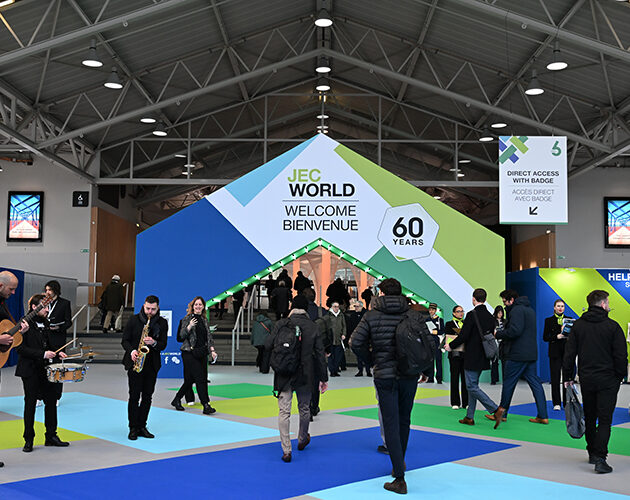
Despite the challenging economic landscape, the atmosphere at the show was exceptionally positive, reflecting the industry’s resilience and forward-looking mindset. While production volumes in the composites sector are expected to further decline and shift towards Asia, the European market continues to show strong demand, underscoring the region’s ongoing commitment to innovation and advanced applications. Exhibitors and attendees alike expressed confidence in the sector’s adaptability, highlighting new opportunities for growth and collaboration. The global market for composites saw a slight growth to 13,5 million tons. In Europe, Germany remains by far the country with the highest market volume, although there has also been a decline here. Market momentum in Europe was significantly lower than in the global market. Europe’s share of the global market is now around 18% (after around 20% in 2023) with America and Asia still gaining shares.
A downturn in material production volumes
Dr. Elmar Witten, managing director, AVK – Industrievereinigung Verstärkte Kunststoffe e.V./Federation of Reinforced Plastics: “We are facing a downturn in material production volumes, impacting all regions and material types. Unfortunately, growth remains elusive at the moment. However, JEC World once again stood out as a highlight in the industry’s annual calendar, providing a much-needed boost of energy and inspiration. Thermoset composites accounted for 41,8 % (2023: 43%) of the total market in Europe. There is now a significant decrease in market share in contrast to thermoplastic systems. The two main areas of application for thermoset composites remain the construction/infrastructure and the transport sector. Aviation is this year a special focus point at JEC World. This sector is quite independent of economic cycles, though volumes for CFK are rather low compared to consumption in wind energy. Modern wind turbines would be inconceivable without blades made of composites. Around 25 % of the total installed capacity in Europe is located in Germany with 70 MW. The composites market will only be able to recover if industrial production in Germany can be revived. Political decisions are now required. We need the active promotion of industrial locations in the DACH region and Europe as a whole.”
Chairman of the board of AVK, Dr. Michael Effing comments the current situation as follows: “Since the migration of thermoset production in 2008, manufacturing has increasingly shifted to Asia. While overall production volumes have declined, demand in Europe remains strong. High labour and energy costs have further driven the trend of re-importing finished components from Asia, shaping the industry’s evolving supply chain dynamics. To remain competitive in the global market, the industry must explore new application areas and niche segments. High-performance composites for aviation and aerospace, particularly in lightweight structures and objects in flight, present promising opportunities. These sectors demand cutting-edge materials with superior strength-to-weight ratios, positioning European manufacturers to leverage their expertise in innovation and advanced engineering. Automation and digitisation are the driving forces to secure competitive advantages.”
Werner Loscheider, head of division IV B4 – construction industry, lightweight construction/new materials, resource efficiency from the German Federal Ministry for Economic Affairs and Climate Action enjoyed the “incredible spirit of optimism at the show.” An innovation fair par excellence JEC World is year after year a “fascinating experience” for him. “JEC World is a great opportunity to promote lightweighting as enabler for competitiveness, innovation and decarbonisation. To achieve these goals, the European Lightweighting Network, ELN, calls on a European Lightweighting Strategy to link economy and ecology. That makes this design philosophy unique.”
JEC World highlights from DACH’s perspective
One of the highlights at the Mitsubishi Chemical Group (MCG) booth was the display of the lunar rover Yaoki, developed by Dymon Co. Ltd., which is led by robot creator Shinichiro Nakajima. As an automobile engineer, Nakajima also worked on the development of Audi’s four-wheel drive system “quattro”, which was said to be the best on the ground. Dymon was founded by him with the aim of developing the ultimate mobility. “Yaoki is the smallest, lightweight and high-strength rover that will be sent to the moon several times in a short period. It is geared to lead the moon development steadily forward and explore the best landing positions for space missions. During JEC World it was sent to the moon for the 2nd time. SpaceX took it on board,” Hiroshi Takahashi, manager mobility parts group from Mitsubishi Chemical Group explains. CFRP and PAI materials were provided by MCG.

Austrian company Action Composites is globally operating with around 2,000 employees, specialised in the development, design and production of carbon composite components with facilities in China and Vietnam. Customers are European premium vehicle manufacturers as well as large volume producers and automotive manufacturers in America and Asia. “For us, JEC World is like a family reunion,” Robert Reitinger comments with enthusiasm. Since already two decades Action Composites benefits from the network opportunities at the show. The company invested significantly in sustainability, but a corresponding demand is currently barely noticeable.

Aditya Birla Chemicals Ltd – Advanced Materials, Thailand was among the innovation award winners in the category “Design, Furniture and Home” this year. A range of innovative carbon fibre-based furniture was produced with its recyclable epoxy resins. The US$65 billion global conglomerate Aditya Birla Group is in the League of Fortune 500 and has a consolidated market cap of over US$ 100 billion. With a legacy of over 165 years, the group has grown into global powerhouses in a wide range of sectors, from metals to cement, fashion to financial services and textiles to trading. Aditya Birla Group’s chemical business has a strong presence in Germany through CTP Advanced Materials, acquired by Aditya Birla Group in 2013. CTP is known as a supplier of specialty products and solutions provider. “Germany is a key market in Europe for Aditya Birla Group,” explains Dr Andreas Palinsky, head of research and development composite & electrical, CTP Advanced Materials GmbH. One of the core application areas for the corporate recyclable resin system is wind energy. Aditya Birla is one of the largest suppliers of recyclable but also conventional epoxy resins for rotor blade production with Siemens Gamesa as a main customer. A large investment has been made in Thailand. From next month on around 40,000 t per year will be produced, outlines Amit Dixit, senior vice president, ADC. “Despite original considerations to build the Recyclamine production plant in Germany, the investment was finally made in Thailand,” Palinsky adds, “due to significantly shorter approval procedures. This aspect will of course remain important for future expansions of the current production capacity in Germany.”
Aditya Birla has been exhibiting at JEC World since 2011. Dr Bharat Singh, joint president research & development, Grasim Industries Ltd. (Advanced Materials), based in Mumbai, India, raves about JEC World: “Year after year, the show attracts new customers and business opportunities from around the world, making it an invaluable platform for growth. Its comprehensive value chain – bringing together all stakeholders from research to production – is a unique strength that sets it apart. That’s what makes JEC World so special to us. The show’s remarkable continuity over the past years has mirrored our own journey as a company, enabling steady growth and investment in new markets. Looking ahead, aerospace could be one of the exciting frontiers for our future expansion.”

After a decade of exhibiting at JEC World, Dipl.-Ing. Matthias Mayr, head of composite systems, Engel Austria GmbH, reflects on the experience and draws the following key conclusions: “As an industrial-scale producer of lightweight plastic components, we have grown alongside JEC – expanding not only our booth size but also the scale and ambition of our projects. For us, it is a must.” JEC World helps in times of crisis, sends a signal for innovation. The trend towards thermoplastics has prevailed in recent years.
Aerospace, the main driver for innovations in lightweighting
Teijin Carbon Europe GmbH supplies the aviation industry already since several decades with Tenax™ carbon fibre. With the launch of Tenax Next™ HTS45 E23 24K carbon fibre filament yarn at JEC World 2025, Teijin Carbon showcased a new product with a potential 35% CO2 reduction compared to existing solutions, while maintaining excellent processability. With a tensile strength of over 4,800 MPa and a modulus of 240 GPa, Tenax Next™ HTS45 E23 24K provides a high-performance alternative for applications from aerospace, automotive, energy, civil engineering to pressure vessels. Apart from production using renewable energy, with the option of sustainable raw materials Teijin Carbon is implementing new process technologies to further mitigate environmental impact. Teijin Carbon is a subsidiary of the Teijin Group, specialised in the production and development of carbon fibres and carbon fibre-based materials. A major partner Marc Fette, CEO of the Composite Technology Center/ CTC GmbH (An Airbus company) comments: “The new Teijin fibre has reshaped our expectations. It’s amazing to see a material that not only delivers outstanding performance but also aligns with our sustainability ambitions.” Teijin Carbon intends to purchase more materials obtained through recycling or directly from bio-based sources. Teijin’s carbon fibres enable the creation of lightweight yet incredibly strong components – about a quarter of the weight of steel while offering 10 times the strength. They also excel in fatigue resistance, corrosion resistance and chemical stability, making them ideal for a wide range of applications.
CTC GmbH has been working on sustainable cabin and interior structures for quite some time. At this year’s JEC World, the company showcased an aircraft sidewall with CFRP waste from the aircraft production, equipped with furan resin top layers made from a bio-based matrix complying with fire, smoke and toxicity standards (FST standards). “Currently, aviation manufacturing still relies heavily on manual production processes. However, the industry is steadily shifting towards fully automated manufacturing, driven by the need for greater efficiency, precision and scalability,” Marc Fette reveals. Aerospace is currently one main driver for innovations in lightweighting. This covers commercial aviation, Unmanned Aircraft Systems (UAS) and air defence systems. JEC World holds a three-dimensional significance, according to Fette: it serves as a common platform uniting the entire composites community, from research to mass production; it spans the full value chain, from raw materials to end-of-life solutions; and it offers a cross-industry perspective, fostering innovation and collaboration across diverse sectors. He strongly believes that aviation is essential for connecting cultures and bringing people together across the globe. “However, to ensure worldwide acceptance, the industry must become even more sustainable than it is today, embracing innovative solutions for a better future.”

The beating heart of the industry
“Teijin is one of the 1st hour exhibitors. JEC World is like a class reunion for us,” Hinrich-Albert Hampe, director marketing & sales EMEA, explains retrospectively. “We used the show as a platform to increase our presence in the growth market of carbon fibre. Here in Paris, the trade fair serves as the beating heart of the industry, bringing together all stakeholders, key players, innovations and future opportunities in one dynamic hub. Teijin is together with its partners one of the major drivers of the wing technologies of tomorrow. In all our efforts we keep in mind the EU target of making all products that go into aircraft CO2 neutral by the year 2050.”

At the Teijin booth, Austrian company FACC showcased a technology demonstrator, a butt strap or bracket connection rib – a thermoplastic component that has been developed from genuine recyclate of material producer Teijin. Apart from fast processability, thermoplastic composites have other properties that make it suitable for aviation. First and foremost is the weldability and thus a possible more efficient assembly process. “8 years ago, JEC World was our springboard as a technology provider,” René Adam, director research &technology, FACC, sums up.

Orbital debris protection at low weight
DuPont showcased this year a new generation of Kevlar® aramid fibre called Kevlar® EXO™, recently named Edison Award finalist in the Critical Safety Materials Advancement category. This new fibre shows an exceptional increase in specific strength along with an increased performance in thermal tolerance and flame resistance. François-Xavier Belottini, EMEA & AP regional market leader aerospace said: “The next generation of Kevlar® fibre for Micrometeoroid and Orbital Debris (MMOD) protection demonstrates the potential to increase orbital debris protection while optimising the overall weight of the MMOD system by up to 40% and reducing damage to the rear wall of the shield. The DuPontTM CoreMatrixTM Technology process combines numerous woven layers by infusing staple fibre to strengthen the fabric and enables lightweight and flexible protective solutions compared to traditional woven structures.” Similar to legacy Kevlar® fibres, Kevlar® EXOTM is inherently flame and temperature-resistant and does not melt, with a decomposition temperature greater than 500°C (932°F). Additional properties such as tenacity and elongation are significantly improved over legacy versions of Kevlar®. Additionally, Kevlar® EXOTM can be used in a traditional plain weave, similar to legacy Kevlar® products, or “it can be incorporated into our CoreMatrixTM process for additional performance and ease of system layup.”

Over the past 13 years, Austrian company Fill has grown significantly through its participation in JEC World, strengthening its brand and unlocking new business opportunities on a global scale. For the 1st time though, this year the company put a clear focus on aviation. Wilhelm Rupertsberger, head of competence centre composites, reports with enthusiasm that JEC World was the door opener for Fill’s Non-Destructive Testing (NDT) in recent years. The awareness of Fill in the testing scene has increased significantly. The participation at JEC World in Paris supports the corporate goal to increase the turnover in aviation to 30% until 2030. The focus on the US market is intended to promote this goal. A branch office for sales and services providing technical support for aerospace is imminent.

German company Evonik, one of the world leaders in specialty chemicals, put the focus on foams at this year’s JEC World. According to Dr David Bolz, head of marketing & sales foams, JEC World is for them by far the most important show in Europe. The company showcased a further development of FSTH-compliant foam Rohaform®. It is a lightweight fully recyclable particle foam designed specifically for industries with stringent fire, smoke and toxicity level requirements (FSTH).
Büfa Composites, a leading manufacturer and supplier of gelcoats and polyester resin specialties, launched fire retardant BÜFA®-Firestop-Gelcoat-S 320, that meets all conceivable requirements. Applications range from exterior and interior claddings in building and construction to driver’s desks in trains. Lothar Kempf, managing director composites, had a special reason to celebrate the 2nd day of the show. It was his 60th birthday in the same year that JEC World marked 6 decades of industry excellence.

The next edition of JEC World will take place from March 10 to 12, 2026.
Cover photo: JEC World 2025
Isa Hofmann
Editorial contributor

