









Pusan University unveils rapid composite material homogenisation method
Researchers at Pusan National University (Korea) have developed a computational technique that accelerates the estimation of composite material properties. Their RBHM enhances conventional FEM simulations by cutting computation time by over 99%, without compromising accuracy.
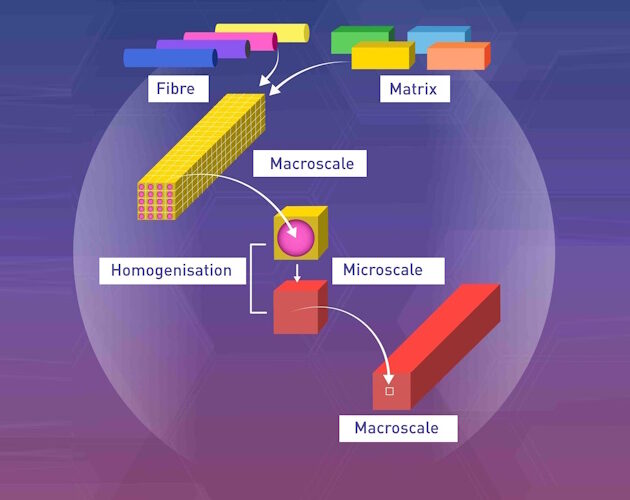
Estimating composite material properties can be computationally expensive and time-consuming. Researchers propose a Reduced Basis Homogenisation Method (RBHM) to enhance homogenisation based on a Finite Element Method (FEM). This RBHM significantly improves computational efficiency while maintaining high accuracy. RBHM is rapid, yet accurate for calculating homogenised composite material properties.
Composite materials are made by combining 2 or more distinct materials, such as a fibre and a matrix, to exploit the best qualities of each. However, predicting the performance of a composite material in real-world conditions can be challenging. Engineers usually rely on experimental testing or numerical analysis to predict homogenised properties like thermal conductivity and elasticity, but these approaches can be time-consuming or computationally expensive.
Enhancing multiscale modelling through RBHM
The numerical homogenisation process approximates composite material properties at a macroscopic scale by solving Partial Differential Equations (PDEs) at a microscopic scale. The team, led by Professor Kyunghoon Lee from Pusan National University, proposed a Reduced Basis Homogenisation Method (RBHM) to speed up numerical homogenisation.
RBHM decreases the computational cost by performing numerical homogenisation on a reduced basis space and allows one to easily change fibre and matrix materials to obtain desired composite material properties. Their work was published online in the International Journal of Mechanical Sciences on November 15, 2024.
“Through the use of the RBHM, we can rapidly yet accurately generate the solutions of microscale PDEs. We then use these solutions to quickly evaluate the homogenised properties of a periodic composite material as we try various combinations of fibre and matrix materials,” explains Professor Lee. RBHM significantly expedites numerical homogenisation, particularly for parametric analyses requiring multiple simulations, while providing prompt evaluations of macroscopic properties with minimal error.
Enhancing computational speed
RBHM achieved computational speeds up to 1,030 times faster than the FEM for evaluating thermal properties and 670 times faster for elastic properties, while maintaining accuracy comparable to that of the FEM. RBHM predictions matched not only the FEM predictions but also the experimental data, providing confidence in the method’s reliability. For instance, RBHM produced homogenised thermal conductivity and Young’s modulus with errors of less than 5% and less than 3%, respectively, compared with experimental results.
“Our method also allows for easy adjustments to fibre and matrix properties, enabling engineers to swiftly explore and test new fibre and matrix combinations,” adds Professor Lee. This feature is crucial for industries where the virtual testing and design of a composite material is needed.
RBHM can reduce overall computation time by up to 70%, which not only improves efficiency but also ensures scalability for large-scale industrial applications. Looking to the future, the researchers aim to expand RBHM to handle even more complex materials and use cases, including nonlinear elastic behaviour and thermoelastic coupling, further broadening its applications in cutting-edge material science.
Cover photo: Pusan University

